In today’s fast-paced digital communication, abbreviations and acrronyms have become essential for quick and efficient messaging.
One such commonly used term is “NTY.” If you’ve come across it in a text message, social media comment, or online chat, you might have wondered what it means and how to respond appropriately.
People often search for this term because its meaning can vary slightly depending on context, tone, and platform.
Understanding short forms like this is important not only for casual conversations but also for avoiding misunderstandings in both personal and professional interactions.
Whether you’re chatting with friends, scrolling through social media, or communicating in a more formal setting, knowing the meaning of “NTY” helps you interpret messages accurately.
This article provides a detailed explanation of its meaning, origins, uses, and variations so you can confidently understand and use it in everyday communication.
Meaning & Definition
“NTY” is a widely used abbreviation that stands for “No, Thank You.” It is a polite and concise way to decline an offer, suggestion, or invitation. Instead of typing the full phrase, people shorten it to save time and effort while still maintaining a courteous tone.
The phrase carries a neutral to polite tone, depending on how it is used. For example:
- If someone offers you something you don’t want, replying “NTY” communicates refusal without sounding rude.
- It helps soften rejection by including “thank you,” which adds a layer of politeness.
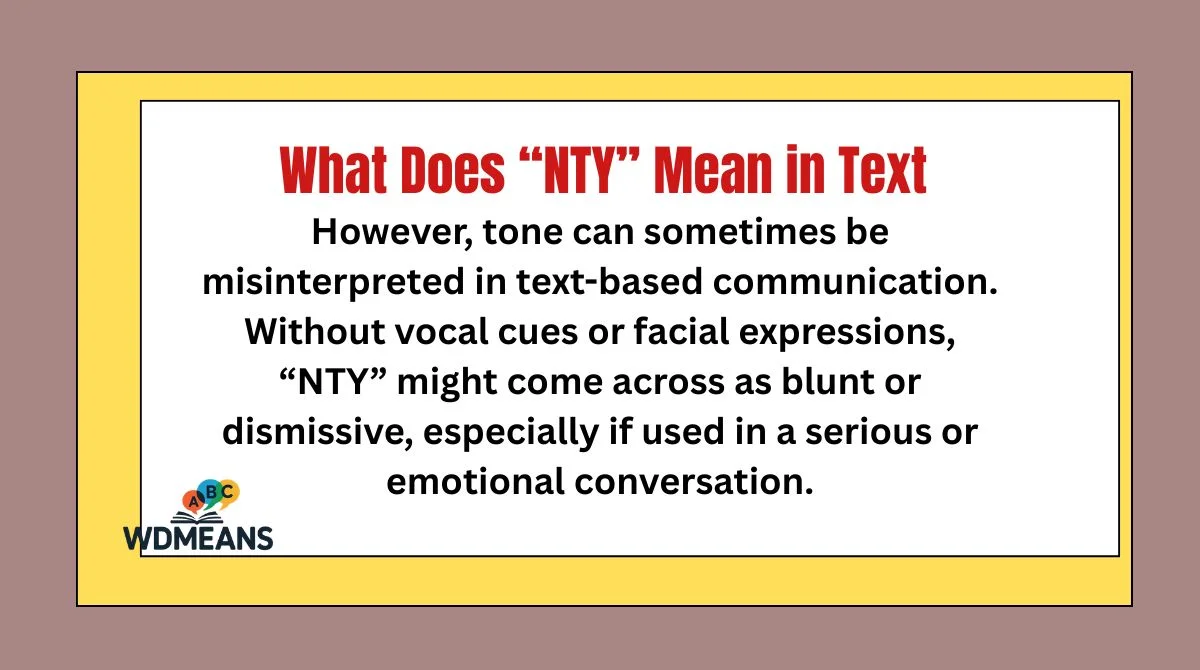
However, tone can sometimes be misinterpreted in text-based communication. Without vocal cues or facial expressions, “NTY” might come across as blunt or dismissive, especially if used in a serious or emotional conversation.
In essence, “NTY” is a digital shorthand that balances efficiency and politeness. It’s particularly useful in quick exchanges where typing a full sentence may feel unnecessary.
Background
The rise of abbreviations like “NTY” can be traced back to the early days of SMS texting and internet chatrooms. Limited character counts and slow typing speeds encouraged users to shorten phrases. Over time, these abbreviations became part of everyday digital language.
As messaging platforms evolved—from SMS to instant messaging apps and social media—these short forms remained popular. They became especially common among younger users who value speed and brevity in communication.
“NTY” follows a pattern seen in many other abbreviations, such as “TY” (Thank You) or “NP” (No Problem). It reflects a broader trend where politeness is preserved even in shortened communication.
Today, the term is widely recognized across different platforms and age groups, although its usage is still more common in informal settings.
Usage in Different Contexts (Chat, Social Media, Professional Fields)
The meaning of “NTY” stays consistent, but its appropriateness depends on the context.
In casual chat, it is perfectly acceptable and widely used. Friends often use it to decline plans or offers quickly. On social media, it appears in comments or replies when someone politely disagrees or declines participation.
In professional settings, however, “NTY” is generally avoided. While it is polite in intention, it may appear too informal or abrupt in emails or workplace communication. Instead, people prefer full phrases like “No, thank you” or more elaborate responses such as “I appreciate the offer, but I’ll pass.”
Understanding the context ensures that you use the term appropriately and avoid unintended impressions.
Meaning in Chat, WhatsApp, Instagram, TikTok
Across popular platforms, “NTY” maintains its core meaning but adapts slightly to the tone of each environment:
- Chat & WhatsApp: Used in everyday conversations to decline offers casually.
- Instagram: Often appears in comments or direct messages to politely reject suggestions or trends.
- TikTok: Sometimes used humorously or sarcastically, depending on the content or tone of the video.
On these platforms, brevity is key, so abbreviations like “NTY” fit naturally into communication styles.
Meaning in Physics, Medical, and Aircraft Terminology
Interestingly, “NTY” is not a standard abbreviation in most technical fields such as physics, medicine, or aviation.
- Physics: It does not represent any widely recognized scientific term.
- Medical field: There is no commonly accepted medical abbreviation for “NTY.”
- Aircraft/Aviation: It is not used as a standard aviation code or acronym.
If “NTY” appears in these contexts, it is usually informal communication rather than technical terminology.
Common Misconceptions
One common misconception is that “NTY” is rude or dismissive. In reality, it is meant to be polite, but tone can vary depending on context and relationship between speakers.
Another misunderstanding is that it has multiple meanings across industries. While many abbreviations do, “NTY” is fairly consistent in meaning and rarely used outside informal communication.
Similar Terms & Alternatives
Several abbreviations and phrases serve a similar purpose:
- “No thanks”
- “Nah, thanks”
- “I’m good”
- “Pass”
- “Maybe next time”
Each option varies slightly in tone, from casual to more polite or indirect.
How to Respond to It
Responding to “NTY” depends on the situation:
- Accept it gracefully: “No problem!”
- Offer an alternative: “Alright, maybe another time.”
- Ask for clarification (if needed): “Got it—anything else you’d prefer?”
The key is to respect the response and avoid pressuring the other person.
Differences from Similar Words
While “NTY” is polite, phrases like “No” or “Nope” can sound more abrupt. On the other hand, longer responses such as “I appreciate it, but I’ll pass” feel more formal and considerate.
The main difference lies in tone and level of formality. “NTY” sits somewhere in the middle—brief yet polite.
Relevance in Online Conversations & Dating Apps
In online conversations, especially on dating apps, “NTY” is commonly used to decline interest politely. It helps users set boundaries without being overly harsh or confrontational.
However, because tone can be easily misinterpreted, some people prefer slightly longer responses to appear more respectful or considerate.
Still, “NTY” remains a convenient and widely understood way to communicate a polite refusal in digital interactions.
Conclusion
“NTY” is a simple yet effective abbreviation that means “No, Thank You.” It reflects the modern need for quick, polite communication in digital spaces.
While it is widely accepted in casual chats and social media, it should be used carefully in professional settings where a more formal tone is expected.
Understanding its meaning, context, and appropriate usage helps avoid confusion and ensures smoother communication.
As online conversations continue to evolve, terms like “NTY” will remain an important part of everyday language, balancing brevity with courtesy.

I am Alexander Hayes, creator of WDMEANS, dedicated to simplifying English learning through clear word meanings. I help learners improve vocabulary with easy, accurate, and practical explanations for everyday use online.