In today’s fast-paced digital world, abbreviations and slang dominate online communication. One such term that frequently appears in text messages and social media conversations is “IDEK.”
Many people search for its meaning because it can be confusing at first glance, especially for those unfamiliar with internet slang.
Understanding such terms is essential for effective communication, particularly when chatting with friends, engaging on social platforms, or navigating online communities.
“IDEK” is widely used in casual conversations, often expressing uncertainty or confusion. However, its usage can vary depending on the context, tone, and platform.
This article provides a complete breakdown of what “IDEK” means, where it comes from, how it’s used, and how you should respond to it.
Whether you’re new to texting slang or simply curious, this guide will help you understand and use “IDEK” confidently in your daily digital interactions.
Meaning & Definition
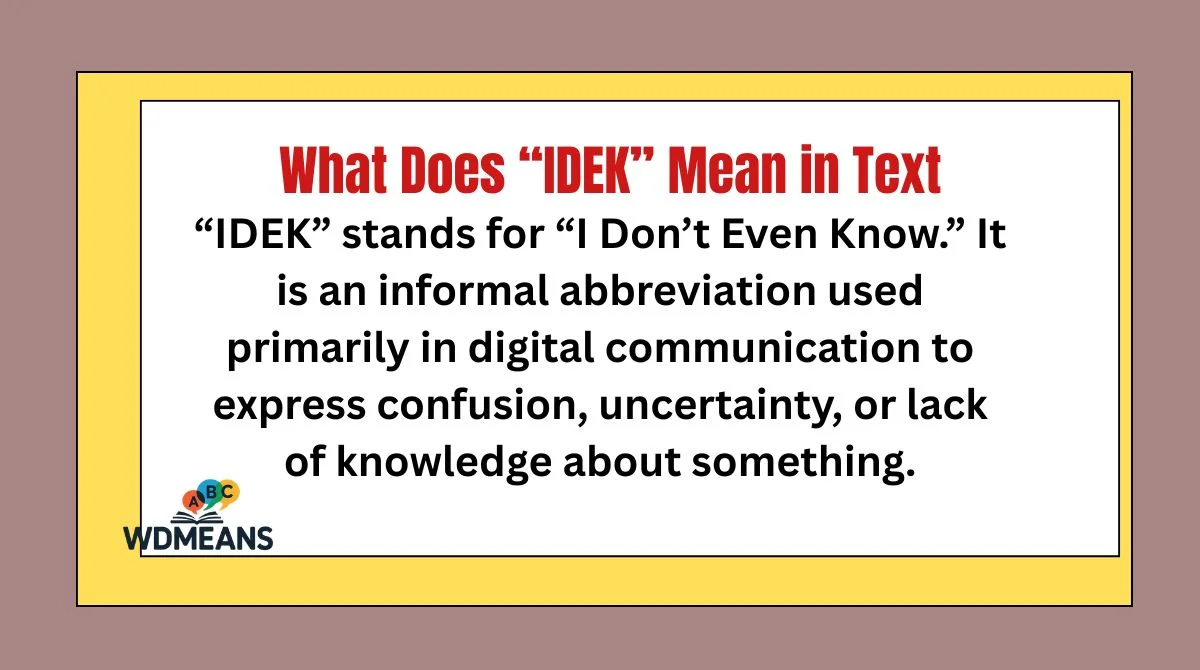
“IDEK” stands for “I Don’t Even Know.” It is an informal abbreviation used primarily in digital communication to express confusion, uncertainty, or lack of knowledge about something.
Unlike the simpler “IDK” (I don’t know), “IDEK” adds an extra layer of emphasis. The word “even” highlights stronger feelings—often frustration, disbelief, or being overwhelmed. For example:
- “Why is the app not working?”
- “IDEK, it was fine yesterday.”
Here, the speaker isn’t just unsure—they’re completely clueless or possibly annoyed.
The tone of “IDEK” depends on context. It can sound casual, humorous, or slightly dramatic. People often use it when they don’t have an explanation or when something doesn’t make sense at all.
In essence, “IDEK” is a shorthand way to communicate deeper uncertainty than a simple “I don’t know,” making it popular in expressive digital conversations.
Background
The rise of “IDEK” is closely tied to the evolution of internet slang and texting culture. As messaging platforms became faster and more widely used, people began shortening phrases to save time and effort.
Initially, abbreviations like “LOL,” “BRB,” and “IDK” dominated early online chats and SMS conversations. Over time, users started modifying these acronyms to add emotional nuance. This is where “IDEK” emerged—essentially an intensified version of “IDK.”
Social media platforms and instant messaging apps accelerated its popularity. As younger generations embraced quick, expressive communication, slang terms like “IDEK” became part of everyday language.
Another factor behind its growth is the informal nature of digital communication. People prefer short, relatable expressions that convey emotion efficiently. “IDEK” fits perfectly into this style because it’s brief yet expressive.
Today, it is widely recognized across different age groups, although it is still most commonly used among teenagers and young adults.
Usage in Different Contexts (Chat, Social Media, Professional Fields)
“IDEK” is primarily used in informal communication, but its meaning can shift slightly depending on the setting.
Casual Chat
In everyday texting, “IDEK” is used to show confusion or lack of knowledge. It’s common in conversations between friends or family.
Social Media
On platforms like Instagram or TikTok, it often appears in captions or comments to express relatable confusion or humor. For example:
- “IDEK why I stayed up all night watching this.”
Professional Fields
In formal or professional communication, “IDEK” is generally inappropriate. Using it in emails, reports, or workplace chats may come across as unprofessional. Instead, phrases like “I’m not sure” or “I don’t have that information” are preferred.
The key takeaway is that “IDEK” belongs in relaxed, informal environments rather than structured or formal communication.
Meaning in Chat, WhatsApp, Instagram, TikTok
Across messaging apps and social platforms, “IDEK” maintains a consistent meaning but adapts to tone and style.
- Chat & WhatsApp: Used in quick replies when someone doesn’t know an answer. It’s direct and casual.
- Instagram: Often used in captions or comments to express humor or confusion about a situation.
- TikTok: Common in video captions or comment sections, usually in a playful or exaggerated tone.
On these platforms, “IDEK” often carries emotional weight—sometimes dramatic, sometimes humorous—depending on how it’s used.
Meaning in Physics, Medical, and Aircraft Terminology
Unlike some abbreviations, “IDEK” does not have a recognized meaning in technical fields such as physics, medicine, or aviation.
- Physics: No scientific term or formula uses “IDEK.”
- Medical Field: It is not a medical abbreviation and should not be used in clinical communication.
- Aircraft/Aviation: There is no official aviation terminology linked to “IDEK.”
If seen in these contexts, it is almost certainly informal communication rather than technical language.
Common Misconceptions
Many people misunderstand “IDEK” due to its similarity to other abbreviations.
- Some assume it means “I didn’t know earlier,” which is incorrect.
- Others think it’s interchangeable with “IDK,” but “IDEK” is more expressive.
- It’s sometimes mistaken for a technical or coded term, which it is not.
Understanding these distinctions helps avoid confusion and ensures correct usage.
Similar Terms & Alternatives
Several similar abbreviations and phrases convey related meanings:
- IDK – I don’t know (less emphasis)
- IDC – I don’t care
- IKR – I know, right?
- TBH – To be honest
Alternatives in full sentences include:
- “I’m not sure.”
- “I have no idea.”
- “I’m completely clueless.”
Each option varies in tone and formality.
How to Respond to It
When someone says “IDEK,” your response depends on the situation.
- Offer help: “Let me check for you.”
- Agree: “Same here, it’s confusing.”
- Ask more questions: “What part don’t you understand?”
- Provide clarification: “I think it works like this…”
Responding appropriately keeps the conversation flowing naturally.
Differences from Similar Words
The main difference between “IDEK” and similar terms lies in intensity.
- IDK: Neutral lack of knowledge
- IDEK: Stronger confusion or disbelief
- IDC: Indicates indifference, not uncertainty
Choosing the right term depends on how strongly you feel about the situation.
Relevance in Online Conversations & Dating Apps
“IDEK” plays a significant role in modern digital interactions, especially on dating apps and social platforms.
In dating conversations, it can:
- Show honesty when unsure about something
- Add humor or relatability
- Keep conversations light and informal
For example:
- “IDEK what to watch tonight, any suggestions?”
However, overusing it may make someone seem indecisive, so balance is important.
Conclusion
“IDEK” is a simple yet expressive abbreviation that reflects the evolving nature of digital communication. It stands for “I Don’t Even Know” and is commonly used to convey strong uncertainty or confusion in informal settings.
While it is widely accepted in chats and social media, it should be avoided in professional or technical contexts.
Understanding how and when to use “IDEK” helps improve communication, especially in online conversations where tone and brevity matter.
As language continues to adapt to digital trends, terms like this will remain an essential part of everyday interaction.

I am Alexander Hayes, creator of WDMEANS, dedicated to simplifying English learning through clear word meanings. I help learners improve vocabulary with easy, accurate, and practical explanations for everyday use online.