In today’s fast-paced digital communication, abbreviations and acronyms have become essential tools for quick and efficient messaging.
One such commonly used term is “CYA.” Many people encounter it in texts, chats, or social media and wonder what it actually means.
Understanding these short forms is important, especially as they can carry different meanings depending on context.
People often search for this phrase because it appears in casual conversations, professional emails, and even technical fields.
Misinterpreting it can lead to confusion or unintended impressions, particularly in formal situations.
This article breaks down its meaning, origins, and various uses in simple terms, helping you confidently understand and use it in everyday communication.
Meaning & Definition
“CYA” is an acronym with two primary meanings:
- “See You” (informal and friendly)
This is the most common usage in text messaging. It’s simply a shortened way of saying goodbye, similar to “see you later.” - “Cover Your Ass” (slang, professional context)
In workplace or serious discussions, it can refer to taking precautions to protect oneself from blame or trouble. This meaning is more informal and sometimes considered slightly inappropriate depending on tone.
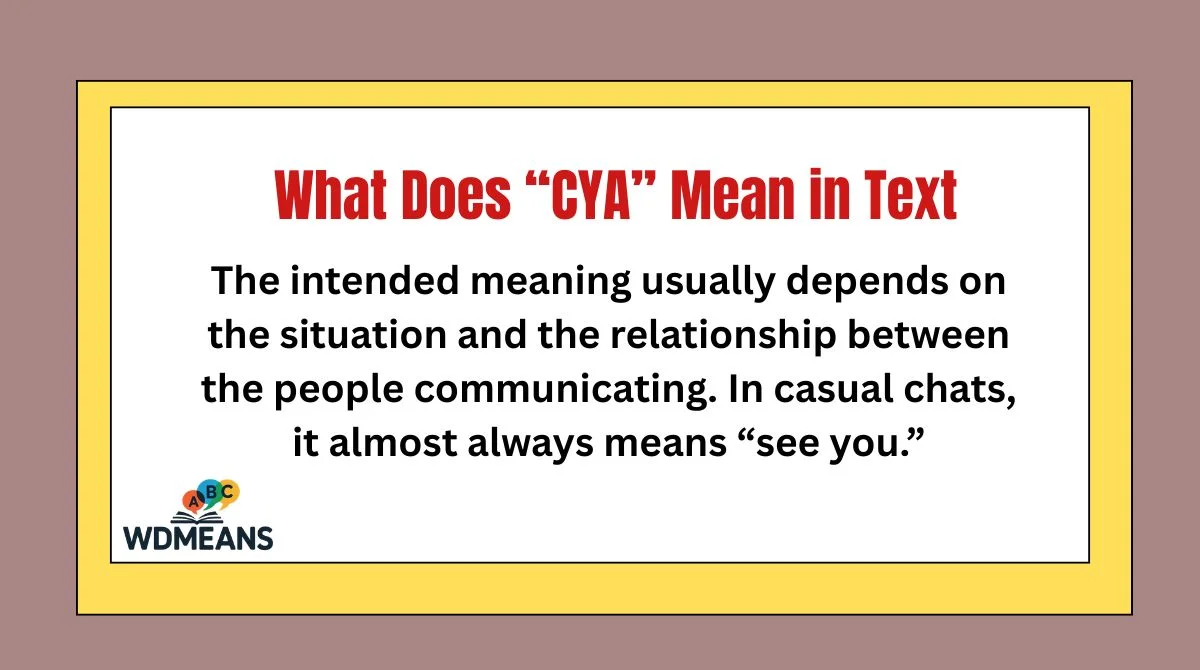
The intended meaning usually depends on the situation and the relationship between the people communicating. In casual chats, it almost always means “see you.”
Background
The rise of acronyms like “CYA” can be traced back to early internet culture, SMS texting, and chatrooms where character limits and speed mattered. Short forms became popular as people looked for quicker ways to communicate.
Over time, these abbreviations spread across platforms like messaging apps and social media. “CYA” gained popularity because it is short, easy to type, and flexible in meaning. The dual meaning evolved naturally—one from casual speech (“see ya”) and the other from workplace slang emphasizing caution and responsibility.
Today, it is widely recognized across different age groups, though younger users tend to use it more frequently in casual contexts.
Usage in Different Contexts (Chat, Social Media, Professional Fields)
The meaning of “CYA” changes depending on where and how it is used:
- Casual Chat:
Used as a quick goodbye. Example: “I’m heading out, CYA!” - Social Media:
Often appears in comments or captions to signal leaving a conversation or ending a post casually. - Professional Settings:
Refers to taking steps to avoid blame. For example, documenting decisions or keeping written records can be described as “CYA.”
Tone plays a big role. In professional environments, the second meaning is often implied rather than directly stated.
Meaning in Chat, WhatsApp, Instagram, TikTok
On modern platforms, “CYA” almost always means “see you.”
- WhatsApp: Used at the end of conversations
- Instagram: Appears in comments or direct messages
- TikTok: Used in captions or replies to signal departure
Examples:
- “Gotta go now, CYA tomorrow!”
- “Nice talking to you, CYA!”
It’s friendly, casual, and widely accepted among users.
Meaning in Physics, Medical, and Aircraft Terminology
Interestingly, “CYA” can also appear in technical fields, though less commonly:
- Physics: Rarely used, but may appear as shorthand in informal notes (not standard terminology).
- Medical Field: Sometimes used informally among staff to indicate precautionary documentation or actions.
- Aircraft/Aviation: Can be used in internal communication to imply safety measures or procedural compliance (again, informal).
In these fields, the meaning aligns more with “Cover Your Ass,” emphasizing safety, responsibility, and accountability.
Common Misconceptions
One common misunderstanding is assuming “CYA” always has a rude or negative meaning. In reality:
- Most of the time, it simply means “see you.”
- The slang interpretation is context-specific and not always intended.
Another misconception is that it is inappropriate to use everywhere. While casual usage is fine, it should be avoided in formal writing unless clearly appropriate.
Similar Terms & Alternatives
Depending on the context, alternatives include:
- For “See You”:
- Bye
- See ya
- Later
- Catch you later
- For “Cover Your Ass”:
- Take precautions
- Protect yourself
- Document everything
These alternatives can be used when clarity or professionalism is needed.
How to Respond to It
Your response depends on the meaning:
- If it means “See You”:
- “Bye!”
- “See you later!”
- “Take care!”
- If it means “Cover Your Ass”:
- Acknowledge the advice: “Good point, I’ll document it.”
- Respond professionally: “I understand, I’ll take precautions.”
Always match the tone of the conversation.
Differences from Similar Words
“CYA” differs from similar abbreviations in subtle ways:
- “BRB” (Be Right Back): Temporary pause, not goodbye
- “TTYL” (Talk To You Later): Similar to “see you,” but slightly more formal
- “BYE”: Direct and clearer
“CYA” stands out because it has dual meanings, unlike most abbreviations.
Relevance in Online Conversations & Dating Apps
In online conversations and dating apps, tone is everything. “CYA” is commonly used to keep things light and friendly:
- Signals a casual ending to a chat
- Avoids sounding too formal or distant
- Keeps communication relaxed
However, overuse or misuse—especially the slang meaning—can come across as unprofessional or confusing. In dating contexts, it’s best used simply as a friendly goodbye.
Conclusion
“CYA” is a versatile acronym that plays a significant role in modern communication.
Whether used as a casual farewell or a reminder to take precautions, its meaning depends heavily on context.
Understanding these differences helps avoid confusion and ensures effective communication in both personal and professional settings.
By recognizing when and how to use it, you can communicate more naturally and confidently across different platforms.
As digital language continues to evolve, staying familiar with such abbreviations keeps you connected and up to date.

I am Alexander Hayes, creator of WDMEANS, dedicated to simplifying English learning through clear word meanings. I help learners improve vocabulary with easy, accurate, and practical explanations for everyday use online.