In today’s fast-paced digital world, abbreviations and slang dominate online communication.
One such term that often confuses people is “ARD.” If you’ve come across it in messages, social media comments, or chats and wondered what it means, you’re not alone.
Many users search for its meaning because it can vary depending on the context and platform.
“ARD” is a short, casual expression that reflects how language continues to evolve in texting culture.
Whether you’re chatting with friends, browsing Instagram, or reading comments on TikTok, understanding this abbreviation helps you stay in the loop and communicate more effectively.
This article breaks down its meaning, origins, and uses across different contexts—so you can confidently understand and respond to it in any situation.
Meaning & Definition
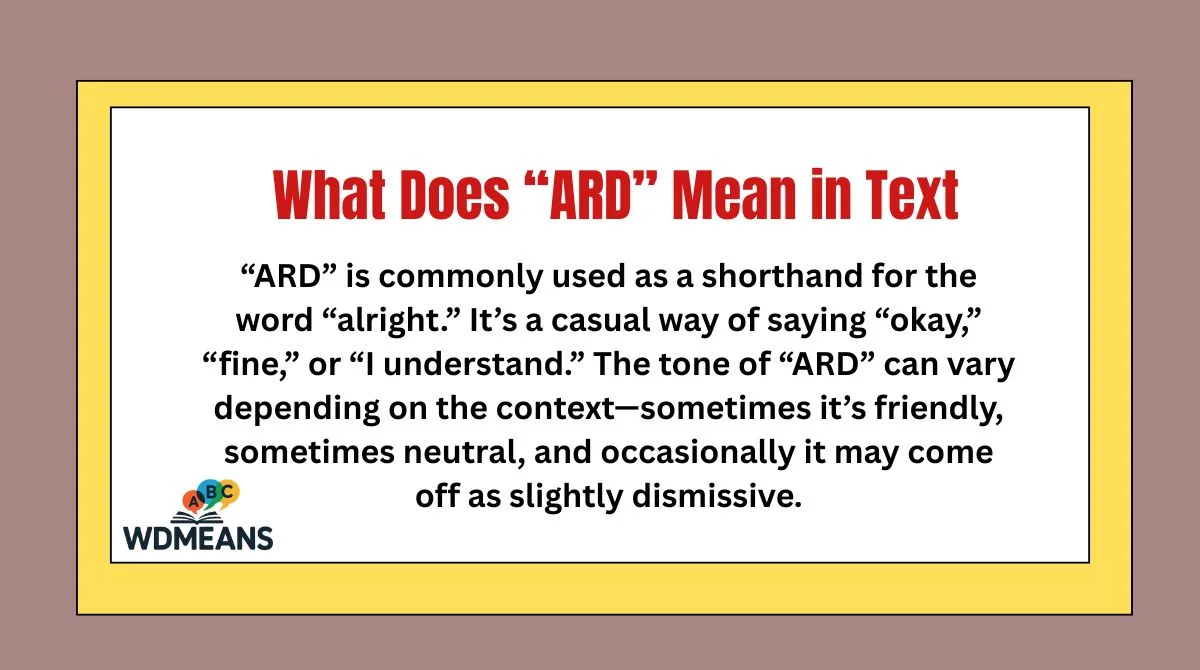
“ARD” is commonly used as a shorthand for the word “alright.” It’s a casual way of saying “okay,” “fine,” or “I understand.” The tone of “ARD” can vary depending on the context—sometimes it’s friendly, sometimes neutral, and occasionally it may come off as slightly dismissive.
For example:
- “I’ll meet you at 7.”
- “ARD.”
In this case, it simply means “okay” or “got it.”
However, tone matters. If used in a short or abrupt way, it might sound uninterested or passive. In other situations, it can signal agreement, acceptance, or acknowledgment without adding extra detail.
Unlike formal language, “ARD” belongs to informal, conversational communication. It’s typically not used in professional emails or official documents. Instead, it thrives in quick messaging environments where brevity is key.
Background
The abbreviation “ARD” likely originated from spoken language, where “alright” is often pronounced quickly as “a’right” or “ard.” Over time, this pronunciation made its way into written form, especially in texting and online chats.
As digital communication evolved, users began shortening words to save time and effort. Just like “ok” became “k” and “you” became “u,” “alright” naturally transformed into “ARD.”
This trend is especially popular among younger users and in urban slang, where phonetic spelling—writing words the way they sound—is common. Social media platforms accelerated its spread, making it a widely recognized term across different regions and communities.
Today, “ARD” is part of a broader linguistic shift where efficiency and speed shape how people communicate online.
Usage in Different Contexts (Chat, Social Media, Professional Fields)
“ARD” is most commonly used in informal settings, particularly in chats and social media. Its meaning remains consistent—generally indicating agreement or acknowledgment—but the tone can shift depending on the situation.
In chat conversations, it serves as a quick reply. Instead of typing a full sentence like “That sounds good,” users simply respond with “ARD.”
On social media platforms, it may appear in comments or replies, often signaling approval or acceptance. For example, if someone posts a plan or idea, replying with “ARD” shows agreement without elaboration.
In professional environments, however, “ARD” is rarely appropriate. Using such informal shorthand in emails, reports, or workplace communication can appear unprofessional or careless. Instead, full words like “okay” or “understood” are preferred.
Understanding where to use “ARD” is important—it works best in relaxed, casual conversations but should be avoided in formal contexts.
Meaning in Chat, WhatsApp, Instagram, TikTok
Across messaging and social platforms, “ARD” carries a similar meaning but may reflect different tones depending on the platform culture.
- Chat & WhatsApp: Often used as a quick acknowledgment. It may feel neutral or slightly blunt if not accompanied by emojis or additional words.
- Instagram: Appears in comments or DMs to show agreement or approval, sometimes casually reacting to posts or plans.
- TikTok: Frequently used in comments to agree with content or express a laid-back reaction.
In these platforms, context and tone are key. Adding emojis or punctuation can soften the message, making it feel more friendly and less abrupt.
Meaning in Physics, Medical, and Aircraft Terminology
Interestingly, “ARD” can have completely different meanings in technical or professional fields:
- Physics/Engineering: It may stand for specific technical terms depending on the context, though it is not a universally standard abbreviation.
- Medical Field: “ARD” can refer to conditions like Acute Respiratory Disease or be used as part of broader acronyms (e.g., ARDS – Acute Respiratory Distress Syndrome).
- Aviation/Aircraft: It might represent internal codes or abbreviations, though usage varies by organization and is not universally standardized.
These meanings are unrelated to texting slang, so understanding the context is crucial when interpreting “ARD.”
Common Misconceptions
A common misconception is that “ARD” always has a negative or dismissive tone. While it can sound blunt, it doesn’t automatically mean the person is annoyed or uninterested.
Another misunderstanding is assuming it has a fixed meaning across all contexts. In reality, its interpretation depends heavily on where and how it’s used.
People also sometimes confuse it with other abbreviations or assume it carries deeper hidden meanings, when in most cases, it simply means “alright.”
Similar Terms & Alternatives
Several abbreviations and words are similar to “ARD,” including:
- “OK” or “K”
- “Alright”
- “Bet” (used to show agreement)
- “Sure”
- “Got it”
Each of these alternatives carries a slightly different tone. For instance, “bet” feels more enthusiastic, while “k” can feel colder or more abrupt than “ARD.”
How to Respond to It
Responding to “ARD” depends on the conversation:
- If it confirms a plan, you can continue normally.
- If it feels short or unclear, you might ask a follow-up question.
- If you want to keep the tone friendly, add emojis or extra words in your reply.
For example:
- “ARD 👍 see you then!”
- “Cool, glad that works.”
This helps maintain clarity and warmth in the conversation.
Differences from Similar Words
“ARD” differs from similar words mainly in tone and formality. While “okay” is universally acceptable, “ARD” is informal and conversational.
Compared to “k,” it often feels slightly more expressive, but less detailed than “alright.” Understanding these subtle differences helps you choose the right response depending on the situation.
Relevance in Online Conversations & Dating Apps
In online conversations and dating apps, “ARD” can signal agreement or acknowledgment, but tone is especially important here.
A simple “ARD” might come across as neutral or even disinterested if not paired with engaging follow-up messages. In dating contexts, where communication style matters, adding personality—like emojis or additional comments—can make interactions feel more genuine and engaging.
Using “ARD” wisely helps maintain a balance between being casual and showing interest.
Conclusion
“ARD” is a simple yet versatile abbreviation that reflects the evolving nature of digital communication.
Most commonly meaning “alright,” it’s used to acknowledge, agree, or respond quickly in informal conversations.
While it’s widely accepted in chats and social media, understanding its tone and context is essential to avoid misunderstandings.
As with many slang terms, its meaning can shift depending on usage, but its core purpose remains the same—efficient communication.
By recognizing when and how to use “ARD,” you can better navigate online interactions and communicate more effectively in today’s fast-moving digital world.

I am Alexander Hayes, creator of WDMEANS, dedicated to simplifying English learning through clear word meanings. I help learners improve vocabulary with easy, accurate, and practical explanations for everyday use online.