In today’s fast-paced digital communication, abbreviations and slang have become essential for quick and efficient conversations. One such commonly used term is “HBU.”
If you’ve ever received this short phrase in a text message or seen it on social media, you might have wondered what it means and how to respond.
People search for this term because it appears frequently in chats, especially among younger users, and understanding it helps improve communication and avoid confusion.
“HBU” is a simple abbreviation, but its meaning can vary slightly depending on context. It is widely used in casual conversations and plays a role in keeping discussions interactive and engaging.
This article explores its meaning, origins, usage across platforms, and how it compares with similar expressions, giving you a complete understanding of this popular texting shorthand.
Meaning & Definition
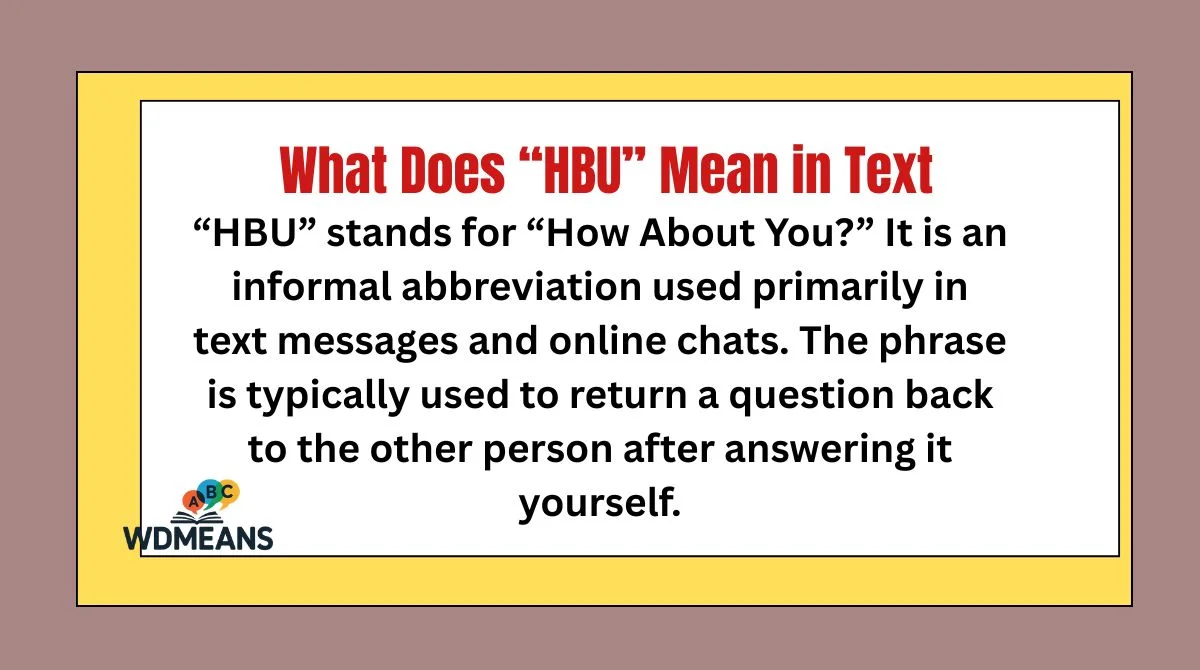
“HBU” stands for “How About You?” It is an informal abbreviation used primarily in text messages and online chats. The phrase is typically used to return a question back to the other person after answering it yourself.
For example:
- “I’m doing great today, HBU?”
- “I like pizza. HBU?”
In both cases, the speaker shares their own response and then invites the other person to share theirs. It helps keep the conversation flowing naturally and shows interest in the other person’s thoughts or feelings.
The tone of “HBU” is casual and friendly. It is not considered appropriate for formal writing, emails, or professional communication. Instead, it belongs to the category of internet slang and texting abbreviations designed for convenience and speed.
Background
The use of abbreviations like “HBU” became popular with the rise of SMS texting and instant messaging platforms in the early 2000s. At that time, character limits and small keyboards encouraged users to shorten phrases. Over time, these abbreviations became part of digital culture.
As social media platforms and messaging apps evolved, “HBU” continued to spread globally. It is now widely recognized among English-speaking users and even by non-native speakers who interact online.
The simplicity of the phrase contributed to its longevity. Unlike more complex slang, “HBU” is easy to understand once learned, making it a staple in casual communication.
Usage in Different Contexts (Chat, Social Media, Professional Fields)
“HBU” is most commonly used in casual digital conversations. In chat and messaging apps, it appears frequently as a quick way to keep dialogue going.
On social media, users include “HBU” in comments, captions, or replies to engage with followers. For instance, someone might post: “I love rainy days. HBU?” to encourage interaction.
In professional settings, however, “HBU” is rarely used. Formal communication typically requires complete phrases like “How about you?” instead of abbreviations. Using “HBU” in a business email may appear unprofessional or overly casual.
Thus, context is key: while it fits perfectly in informal conversations, it should be avoided in formal environments.
Meaning in Chat, WhatsApp, Instagram, TikTok
Across platforms like WhatsApp, Instagram, and TikTok, “HBU” carries the same core meaning but is used slightly differently based on interaction style.
- WhatsApp: Often used in private conversations to maintain friendly dialogue.
- Instagram: Seen in comments or direct messages to encourage replies.
- TikTok: Used in captions or comment sections to engage viewers and prompt responses.
Despite platform differences, the purpose remains consistent: to invite the other person’s opinion or response.
Meaning in Physics, Medical, and Aircraft Terminology
Interestingly, “HBU” can also have different meanings outside casual texting, depending on the field:
- Physics: It is not a standard abbreviation, but in rare cases, it might be used informally within specific groups or notes.
- Medical: “HBU” may refer to “Hepatitis B Virus Unit” or similar variations, depending on context.
- Aircraft/Aviation: It can stand for technical terms like “Hydraulic Backup Unit,” used in engineering discussions.
These meanings are highly context-specific and not commonly encountered in everyday conversations.
Common Misconceptions
One common misunderstanding is that “HBU” has multiple meanings in casual conversation. In reality, in texting, it almost always means “How About You?”
Another misconception is that it can be used in formal communication. This is incorrect, as it is strictly informal.
Some people also confuse it with similar abbreviations like “WBU” (What About You), though their meanings are nearly identical.
Similar Terms & Alternatives
There are several alternatives to “HBU,” including:
- WBU – What About You
- And you?
- Your thoughts?
- How about yourself?
These alternatives may vary slightly in tone, with some being more formal than others.
How to Respond to It
Responding to “HBU” is simple. You just answer the question that was implied.
For example:
- “I’m good, just relaxing.”
- “I prefer coffee over tea.”
- “I had a busy day at work.”
The response should match the topic of the conversation.
Differences from Similar Words
“HBU” and “WBU” are often used interchangeably, but there is a slight nuance. “HBU” feels slightly more conversational, while “WBU” can sound a bit more direct.
Compared to full phrases like “How about you?”, the abbreviation is less formal and more suited for quick digital exchanges.
Relevance in Online Conversations & Dating Apps
“HBU” plays an important role in online interactions, especially on dating apps. It helps keep conversations balanced and prevents them from becoming one-sided.
For example, after answering a question about hobbies, adding “HBU?” invites the other person to share their interests. This creates a natural flow and encourages engagement.
Its simplicity makes it especially useful in early conversations, where maintaining interest is key.
Conclusion
“HBU” is a widely used abbreviation that stands for “How About You?” and serves as a simple yet effective way to keep conversations interactive.
While it originated from early texting culture, it remains relevant across modern platforms like WhatsApp, Instagram, and TikTok.
Understanding its meaning, context, and appropriate usage helps improve communication and avoids misunderstandings.
Whether in casual chats or online dating, it continues to be a valuable tool for engaging conversations.

I am Alexander Hayes, creator of WDMEANS, dedicated to simplifying English learning through clear word meanings. I help learners improve vocabulary with easy, accurate, and practical explanations for everyday use online.