In everyday communication, especially in digital conversations, you’ve likely come across the abbreviation “etc.” and wondered what it truly means or how to use it properly.
Short for a Latin phrase, “etc.” appears in texts, emails, academic writing, and even social media posts.
People often search for its meaning because it’s widely used but not always fully understood.
With the rise of messaging platforms like WhatsApp, Instagram, and TikTok, shorthand expressions have become essential for quick communication.
“Etc.” is one such term that helps people save time while conveying broader ideas without listing every detail. However, misuse or overuse can lead to confusion or make writing seem vague.
This article explores the meaning, origin, usage, and significance of “etc.” in different contexts—from casual chats to professional fields—so you can use it confidently and correctly.
Meaning & Definition
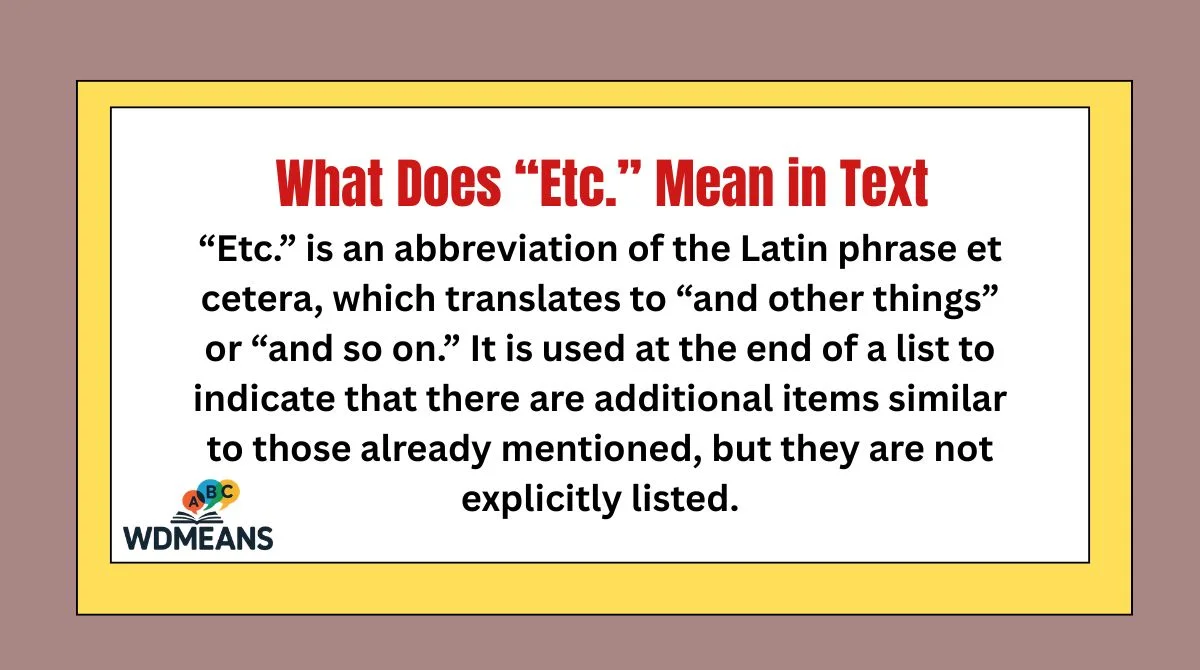
“Etc.” is an abbreviation of the Latin phrase et cetera, which translates to “and other things” or “and so on.” It is used at the end of a list to indicate that there are additional items similar to those already mentioned, but they are not explicitly listed.
For example:
- “I bought apples, oranges, bananas, etc.”
This implies there are more fruits, but they are not named.
The primary purpose of “etc.” is to make communication more concise. Instead of writing long, repetitive lists, it allows the writer or speaker to summarize. However, it should only be used when the omitted items are obvious or follow a clear pattern.
It is important to note that “etc.” is not used for people (in formal writing) and should not replace essential information. Overusing it can make your message unclear or incomplete.
In formal grammar, “etc.” is usually preceded by a comma and followed by a period since it is an abbreviation. It is widely accepted in both informal and formal contexts, though some professional writing styles recommend limiting its use.
Background
The term et cetera originates from Latin, a language historically used in academic, legal, and scholarly texts. Over time, many Latin phrases became part of the English language, especially in formal writing.
“Et cetera” began appearing in English texts centuries ago as a way to avoid repetitive listing. As writing evolved and became more practical, the abbreviated form “etc.” became the standard. Today, it is one of the most commonly used abbreviations globally.
In earlier times, it was primarily used in books, legal documents, and academic writing. However, with the development of digital communication, its usage has expanded significantly. People now use “etc.” in everyday texting, emails, and even social media captions.
Despite its long history, the meaning of “etc.” has remained consistent. What has changed is how frequently and casually it is used. In modern communication, brevity is valued, and “etc.” perfectly fits that need.
Understanding its origin helps users appreciate why it should be used thoughtfully—it represents omitted information, not laziness in communication.
Usage in Different Contexts (Chat, Social Media, Professional Fields)
“Etc.” is versatile and can be used across various types of communication. In casual chats, it helps shorten messages and avoid unnecessary typing. For example, instead of listing multiple tasks or items, people simply use “etc.” to indicate continuation.
On social media platforms, it often appears in captions or comments to keep content brief and engaging. For instance:
- “Traveling, खाना, exploring new places, etc.”
In professional settings, its usage becomes more controlled. In emails, reports, or presentations, “etc.” may be used when the context is clear, but excessive use can appear unprofessional. For example:
- “The project includes research, analysis, testing, etc.”
However, in formal documents like legal contracts or academic papers, writers often avoid “etc.” because it can create ambiguity. Instead, they prefer complete and precise listings.
In education, teachers may use “etc.” when giving examples but expect students to understand the pattern rather than rely on incomplete information.
Overall, the appropriateness of “etc.” depends on the audience and purpose. It works best when clarity is maintained and the omitted items are obvious.
Meaning in Chat, WhatsApp, Instagram, TikTok
In modern messaging apps like WhatsApp, Instagram, and TikTok, “etc.” is used very casually. It often signals that the speaker doesn’t want to type everything or assumes the other person already understands the rest.
For example:
- “We’ll watch movies, eat snacks, chill, etc.”
- “He likes gaming, football, cricket, etc.”
On TikTok or Instagram captions, it can make content feel relaxed and conversational. It also helps keep captions short, which is important for user engagement.
In chat, “etc.” can sometimes imply “you get the idea” or “and more of the same.” However, overusing it may make messages seem lazy or unclear, especially if the context isn’t obvious.
It’s also worth noting that in casual texting, people may skip punctuation and simply write “etc” without the period, although this is grammatically incorrect in formal writing.
In summary, in social media and chats, “etc.” is a quick and informal way to express continuation without going into detail.
Meaning in Physics, Medical, and Aircraft Terminology
In technical fields like physics, medicine, and aviation, “etc.” is used more carefully. Its meaning remains the same—“and other similar things”—but precision is critical in these disciplines.
In physics, it might appear in explanations or textbooks when listing examples:
- “Forces such as gravity, friction, tension, etc.”
In medicine, “etc.” may be used in informal notes or general discussions, but in official medical documentation, clarity is crucial, so it is often avoided.
In aviation or aircraft terminology, where safety is a priority, “etc.” is rarely used in official manuals or instructions. Instead, all items are explicitly listed to avoid misunderstandings.
Thus, while “etc.” exists in these fields, professionals use it sparingly and only when there is no risk of confusion.
Common Misconceptions
Many people misunderstand how to use “etc.” correctly. One common mistake is using it after phrases like “for example” or “such as,” which can be redundant.
Another misconception is using “etc.” when the list is not clear. If readers cannot guess the remaining items, the abbreviation becomes confusing rather than helpful.
Some also believe it can replace any missing information, which is incorrect. It should only be used when the omitted items follow a predictable pattern.
Additionally, people sometimes write “and etc.,” which is incorrect because “et” already means “and.”
Understanding these mistakes helps ensure proper usage and clearer communication.
Similar Terms & Alternatives
Several alternatives can be used instead of “etc.” depending on the context:
- “and so on”
- “and more”
- “and others”
- “among others”
These alternatives may feel more natural in spoken language or less formal writing. In professional contexts, it’s often better to list key items instead of using “etc.”
Choosing the right alternative depends on tone, audience, and clarity.
How to Respond to It
When someone uses “etc.” in conversation, your response depends on context. If the meaning is clear, no clarification is needed.
However, if the list seems incomplete or unclear, you can politely ask:
- “What else do you mean?”
- “Can you give more details?”
In professional settings, it’s better to request clarification to avoid misunderstandings.
In casual chats, people usually assume shared understanding, so responses remain simple and relaxed.
Differences from Similar Words
“Etc.” differs from phrases like “and so on” mainly in tone and usage. While both mean continuation, “etc.” is more commonly used in writing, whereas “and so on” is more conversational.
Unlike “such as,” which introduces examples, “etc.” ends a list. This distinction is important for proper grammar.
Understanding these differences ensures accurate and effective communication.
Relevance in Online Conversations & Dating Apps
In online conversations and dating apps, “etc.” can make messages feel casual and effortless. It helps users avoid over-explaining while still conveying personality and interests.
For example:
- “I like traveling, food, music, etc.”
However, overusing it may come across as vague or uninterested. In dating profiles, being specific often creates better engagement than relying on “etc.”
Thus, while useful, it should be balanced with clarity and detail.
Conclusion
“Etc.” is a simple yet powerful abbreviation that helps make communication concise and efficient.
Whether used in casual chats, social media, or professional writing, its purpose remains the same: to indicate continuation without unnecessary repetition.
Understanding its meaning, origin, and proper usage ensures that your communication stays clear and effective.
While it is highly useful, it should be used thoughtfully to avoid confusion or vagueness.
In today’s fast-paced digital world, abbreviations like “etc.” play an important role in simplifying communication—but clarity should always come first.

I am Alexander Hayes, creator of WDMEANS, dedicated to simplifying English learning through clear word meanings. I help learners improve vocabulary with easy, accurate, and practical explanations for everyday use online.