In today’s fast-paced digital communication, short forms and abbreviations dominate conversations. One such commonly used expression is “k.”
Many people search for what “k” means in text because its interpretation can vary depending on context, tone, and relationship between the people communicating.
At first glance, it seems like a simple shorthand, but it can carry different meanings—from neutral acknowledgment to subtle emotional signals.
Understanding how “k” is used can help avoid misunderstandings, especially in chats, social media, and even professional settings.
This article explores the meaning of “k,” its background, how it’s used across different platforms, and how to interpret it correctly.
Whether you’ve received a one-letter reply or are unsure how to use it yourself, this guide will clarify everything in a simple and engaging way.
Meaning & Definition
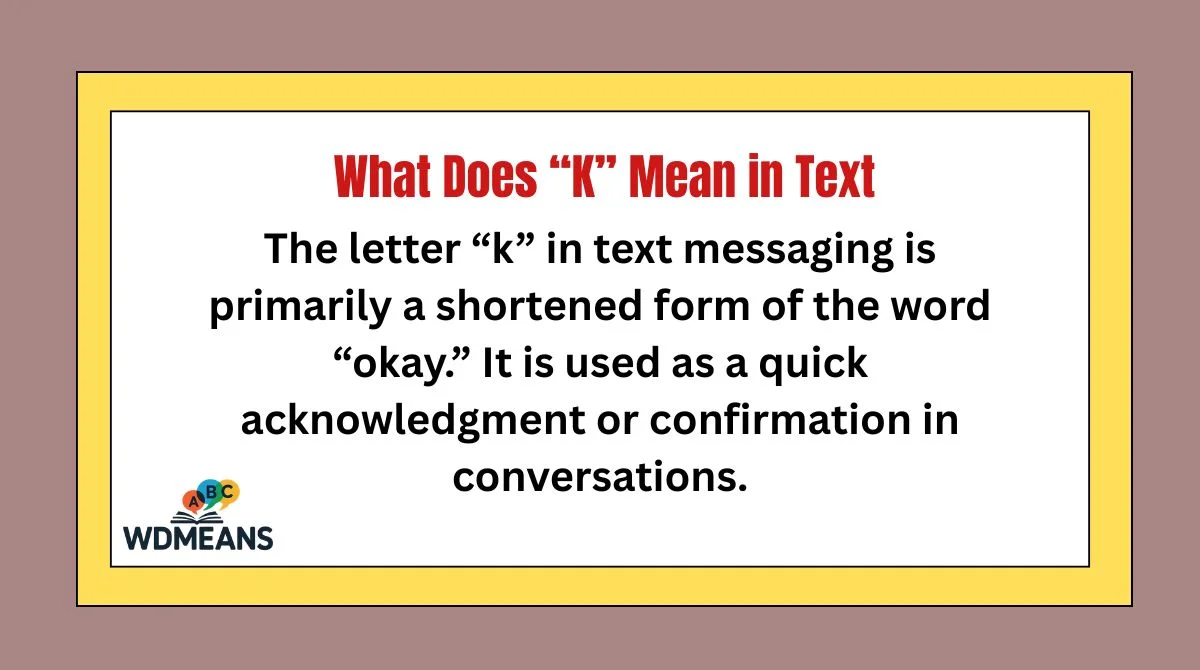
The letter “k” in text messaging is primarily a shortened form of the word “okay.” It is used as a quick acknowledgment or confirmation in conversations. Instead of typing the full word, people often use “k” to save time and effort, especially in informal chats.
However, the meaning of “k” goes beyond its literal definition. It can express different tones depending on how and where it is used. In its most basic form, it simply means:
- “I understand”
- “That’s fine”
- “Got it”
Despite its simplicity, “k” can sometimes come across as blunt or even dismissive. For example, replying with just “k” instead of “okay” or “okay!” may feel less enthusiastic or less engaged. Tone plays a huge role here. Since text lacks vocal cues and facial expressions, even a single letter can be interpreted differently.
In some cases, “k” can also signal the end of a conversation. It may indicate that the sender has nothing more to add or does not wish to continue the discussion.
Overall, “k” is a minimalistic response that relies heavily on context. Its meaning is shaped by factors such as relationship, mood, and the flow of conversation.
Background
The use of “k” as shorthand originates from the broader trend of text abbreviations that began with early mobile phones and SMS messaging. Character limits and small keyboards encouraged users to shorten words wherever possible.
“Okay” itself has an interesting history, dating back to the 19th century as a playful abbreviation. Over time, it became one of the most widely recognized words in the English language. With the rise of digital communication, it was naturally shortened even further to “ok,” and eventually to just “k.”
As messaging apps evolved—like WhatsApp, Instagram, and others—the need for quick replies increased. People began favoring speed over formality, and “k” became a convenient option.
Today, its use is deeply embedded in online culture. However, modern users are more aware of tone and emotional nuance, which is why “k” can sometimes be seen as cold or passive-aggressive, especially compared to more expressive alternatives.
Usage in Different Contexts (Chat, Social Media, Professional Fields)
The meaning of “k” changes depending on where it is used.
In casual chat, “k” is widely accepted as a quick acknowledgment. Friends often use it without overthinking. However, even in casual conversations, it can sometimes feel abrupt if the other person expects a more engaging response.
On social media, “k” may appear in comments or direct messages. Here, it often signals indifference or lack of interest. For example, replying “k” to a long message might suggest the sender is not fully engaged.
In professional settings, the use of “k” is generally discouraged. It can appear too informal or even disrespectful. Instead, people prefer “okay,” “noted,” or “understood” to maintain professionalism.
In group chats, “k” may serve as a quick acknowledgment without interrupting the flow of conversation. It helps keep communication efficient, especially when multiple participants are involved.
Ultimately, the appropriateness of “k” depends on the level of formality and the relationship between the individuals.
Meaning in Chat, WhatsApp, Instagram, TikTok
Across popular platforms, “k” carries slightly different tones:
- Chat & WhatsApp: Often used for quick replies. It can mean agreement or acknowledgment, but sometimes feels dry or uninterested.
- Instagram: In direct messages, it may signal disinterest or a desire to end the conversation.
- TikTok: Usually appears in comments. It can be sarcastic or dismissive depending on context.
Younger users, especially on social media, tend to interpret “k” more emotionally. A simple “k” might be seen as passive-aggressive or even rude if the conversation was expected to be more engaging.
Adding punctuation or emojis (like “k.” or “k 😊”) can completely change the tone, making it softer or more friendly.
Meaning in Physics, Medical, and Aircraft Terminology
Outside of texting, “k” has entirely different meanings in technical fields:
- Physics: “k” often represents constants, such as the Boltzmann constant or spring constant.
- Medical field: It can refer to potassium (from the Latin word “kalium”).
- Aircraft terminology: “k” may denote speed in knots when abbreviated in certain contexts.
These meanings are unrelated to texting but highlight how a single letter can carry multiple interpretations across disciplines.
Common Misconceptions
One common misconception is that “k” always means something negative. While it can sound dismissive, it is not inherently rude. Often, it simply reflects brevity.
Another misunderstanding is assuming emotional intent without context. People may interpret “k” as anger or annoyance when the sender simply intended a quick reply.
Some also believe it is universally acceptable, but in formal or professional communication, it can create a poor impression.
Similar Terms & Alternatives
There are many alternatives to “k,” each with a slightly different tone:
- “Ok” – neutral and widely accepted
- “Okay” – more complete and polite
- “Alright” – slightly warmer
- “Got it” – clear acknowledgment
- “Sure” – agreeable and friendly
Using these alternatives can help convey tone more effectively and avoid misunderstandings.
How to Respond to It
Responding to “k” depends on the situation. If it seems neutral, you can continue the conversation normally. If it feels dismissive, you might ask a follow-up question to clarify intent.
If you receive “k” in a professional setting, it’s best to maintain a polite tone and respond clearly. In casual chats, you can match the tone or add more context to keep the conversation flowing.
Differences from Similar Words
“K” differs from “ok” or “okay” mainly in tone. While all mean agreement, “k” is more abrupt. “Okay” feels complete and polite, whereas “k” may feel minimal or detached.
Similarly, “kk” (double k) is often used to sound more friendly and less harsh than a single “k.”
Relevance in Online Conversations & Dating Apps
In online conversations and dating apps, “k” can carry strong emotional implications. A single-letter reply may signal lack of interest, especially if the conversation was previously engaging.
People often analyze texting patterns in dating scenarios. Using “k” repeatedly might suggest disinterest or low effort, which can impact communication and connection.
On the other hand, occasional use in a natural flow is usually harmless. The key is balance and awareness of how it may be perceived.
Conclusion
The meaning of “k” in text is simple on the surface but nuanced in practice. While it primarily stands for “okay,” its tone can shift depending on context, platform, and relationship.
From casual chats to professional communication, understanding how and when to use “k” helps prevent misunderstandings. It reflects the evolving nature of digital language, where even a single letter can carry emotional weight.
By being mindful of tone and choosing alternatives when needed, you can communicate more effectively and clearly in any setting.

I am Alexander Hayes, creator of WDMEANS, dedicated to simplifying English learning through clear word meanings. I help learners improve vocabulary with easy, accurate, and practical explanations for everyday use online.