In today’s fast-paced digital world, abbreviations and slang dominate online communication. One such commonly used abbreviation is “WB.”
If you’ve ever received a message with just these two letters, you might have wondered what it means and why people use it.
The term appears frequently in texting, social media platforms, and even professional or technical contexts, making it important to understand its different interpretations.
People search for the meaning of “WB” because it can vary depending on where and how it’s used. In casual chats, it may carry a friendly tone, while in technical fields, it can represent something entirely different.
This article breaks down all possible meanings of “WB,” explains its background, and explores how it’s used across various contexts.
By the end, you’ll not only understand what “WB” means but also how to respond to it appropriately in different situations.
Meaning & Definition
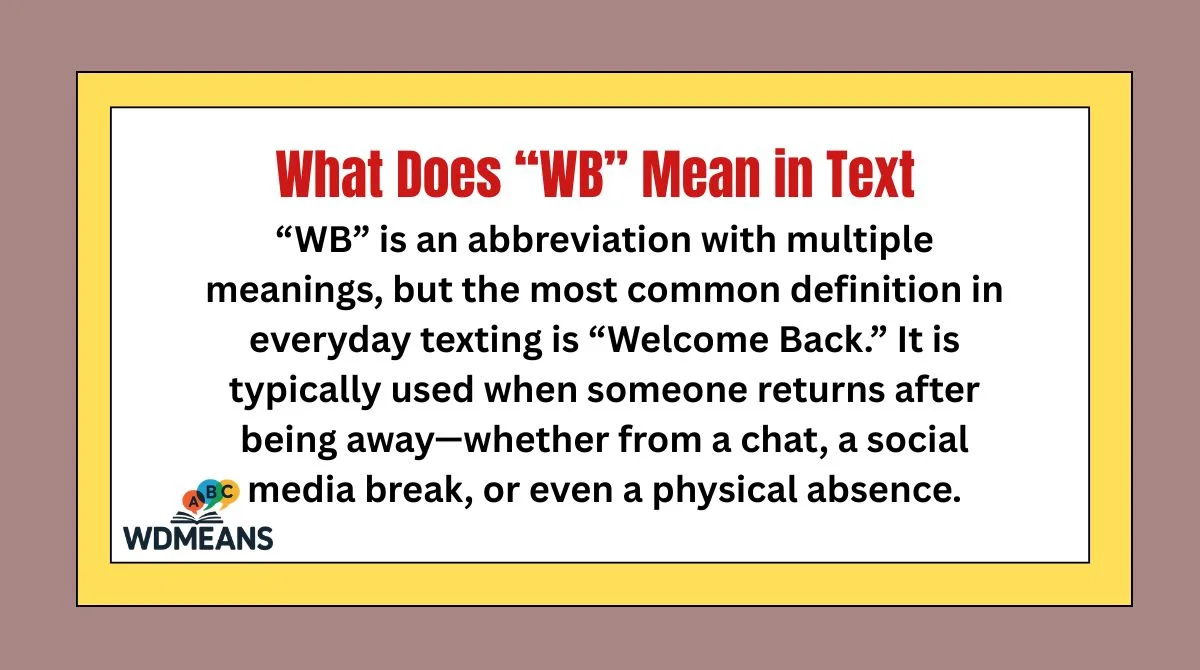
“WB” is an abbreviation with multiple meanings, but the most common definition in everyday texting is “Welcome Back.” It is typically used when someone returns after being away—whether from a chat, a social media break, or even a physical absence.
For example, if someone logs back into a group chat after a while, another person might simply type “WB!” to greet them. It’s short, friendly, and efficient, which makes it perfect for quick conversations.
However, “WB” is not limited to this meaning. Depending on the context, it may also stand for:
- Well Being – often used in health-related discussions
- Write Back – used when asking someone to reply
- White Balance – in photography or videography
- World Bank – in global or financial discussions
Because it has multiple meanings, understanding the context is crucial. In casual messaging, “Welcome Back” is by far the most widely used interpretation. In contrast, professional or technical conversations may use it differently, requiring more attention to the surrounding text.
Overall, “WB” is a versatile abbreviation that saves time while communicating, but its meaning must always be interpreted based on the situation.
Background
The use of abbreviations like “WB” dates back to early internet culture, particularly during the rise of chat rooms, instant messaging platforms, and SMS texting. When character limits were strict and typing was slower on older devices, users developed shorthand expressions to communicate more efficiently.
“WB” became popular in early online communities such as forums and messaging services, where users frequently logged in and out. Greeting someone returning to the chat with “Welcome Back” was common, and shortening it to “WB” made interactions quicker and more convenient.
As communication platforms evolved—from early messaging apps to modern social media—the abbreviation remained relevant. Today, it is widely used across platforms like WhatsApp, Instagram, and TikTok, maintaining its original meaning while also adapting to new contexts.
Interestingly, abbreviations like “WB” reflect how language evolves with technology. What started as a necessity due to technical limitations has now become a cultural norm in digital communication. Even though modern devices allow full typing with ease, people continue using such shorthand out of habit and preference for brevity.
Usage in Different Contexts (Chat, Social Media, Professional Fields)
“WB” is highly context-dependent, and its meaning changes based on where it is used.
In casual chat, it almost always means “Welcome Back.” It’s commonly seen in group chats, gaming communities, and messaging apps when someone returns after being inactive.
On social media, “WB” can appear in comments or direct messages. For example, if a user returns after a long break from posting, followers may comment “WB!” to acknowledge their return. It’s a quick way to show friendliness and recognition.
In professional fields, the meaning of “WB” can differ significantly. For instance:
- In business or economics, it might refer to the World Bank
- In healthcare, it could relate to well-being
- In media production, it may stand for white balance
Because of these variations, professionals typically rely on context or clarify the abbreviation when necessary.
Overall, “WB” is flexible and widely used, but understanding the setting—casual or professional—is key to interpreting it correctly.
Meaning in Chat, WhatsApp, Instagram, TikTok
In everyday digital communication, especially on platforms like WhatsApp, Instagram, and TikTok, “WB” almost always means “Welcome Back.”
- WhatsApp: Used in personal or group chats when someone returns after being offline.
- Instagram: Seen in comments when someone resumes posting after a break.
- TikTok: Used in comment sections or messages to greet returning creators or users.
The tone is usually friendly and informal. It helps maintain social connection without requiring a long message.
For example:
- “Hey, WB! Missed you here.”
- “WB bro, where were you?”
This simple abbreviation adds warmth to conversations while keeping communication quick and effortless.
Meaning in Physics, Medical, and Aircraft Terminology
Beyond casual use, “WB” also appears in technical fields with entirely different meanings.
- Physics: It may refer to “Work Balance” or other context-specific terms depending on the topic.
- Medical Field: “WB” can stand for “Whole Blood,” which is commonly used in medical reports and discussions.
- Aircraft/Aviation: It may represent “Wide Body,” referring to large aircraft with wider fuselages designed for long-haul flights.
These meanings are highly specialized and usually understood within their respective fields. Unlike casual texting, these interpretations require domain knowledge to fully grasp.
Common Misconceptions
One common misconception is assuming that “WB” always means “Welcome Back.” While this is true in most casual conversations, it’s not universal. Misunderstandings can occur when the abbreviation is used in professional or technical contexts.
Another misconception is that “WB” is outdated. In reality, it remains widely used across modern platforms due to its simplicity and convenience.
Some people also confuse “WB” with other abbreviations like “WBU” (What About You), which can lead to miscommunication if not carefully interpreted.
Similar Terms & Alternatives
There are several alternatives to “WB,” depending on the tone and context:
- Welcome back (full phrase)
- Glad you’re back
- Good to see you again
- Hey again
Similar abbreviations include:
- WBU – What About You
- BRB – Be Right Back
- TTYL – Talk To You Later
Each serves a slightly different purpose, but they all contribute to efficient communication.
How to Respond to It
Responding to “WB” is simple and depends on the tone of the conversation.
Common replies include:
- “Thanks!”
- “Glad to be back!”
- “Missed you guys too!”
In more formal contexts, a fuller response may be appropriate, such as:
- “Thank you, it’s good to be back.”
The key is to match the tone of the person who used it.
Differences from Similar Words
“WB” differs from similar abbreviations because it specifically focuses on someone’s return. For example:
- BRB indicates leaving temporarily
- WBU asks a question
- WB acknowledges someone’s return
This makes “WB” unique in its purpose—it’s more of a greeting than a statement or question.
Relevance in Online Conversations & Dating Apps
In online conversations and dating apps, “WB” plays a subtle but important role in maintaining engagement. When someone returns after being inactive, using “WB” shows attentiveness and interest.
On dating platforms, it can help restart conversations smoothly without awkwardness. For example, saying “WB, how have you been?” can reopen communication in a friendly way.
Its simplicity makes it ideal for casual and semi-formal interactions, helping users stay connected without overthinking their responses.
Conclusion
“WB” is a small but powerful abbreviation that carries different meanings depending on context. While it most commonly stands for “Welcome Back” in everyday texting and social media, it also appears in professional and technical fields with entirely different interpretations.
Understanding these variations helps avoid confusion and ensures effective communication.
As digital communication continues to evolve, abbreviations like “WB” remain relevant because they save time and keep conversations engaging.
Whether you’re chatting with friends, interacting on social media, or navigating professional discussions, knowing how and when to use “WB” can enhance your communication skills.

I am Alexander Hayes, creator of WDMEANS, dedicated to simplifying English learning through clear word meanings. I help learners improve vocabulary with easy, accurate, and practical explanations for everyday use online.