In today’s fast-paced digital world, short forms and abbreviations dominate online communication. One such commonly used expression is “KK.”
If you’ve ever received this reply in a text message or chat, you might have wondered what it actually means and whether it carries a specific tone or intention.
People search for this phrase to better understand its meaning, especially since tone can be hard to interpret in written conversations.
Misunderstanding even a simple abbreviation can sometimes lead to confusion or miscommunication. This article explores the meaning of “KK,” its origins, and how it is used across different platforms and contexts.
Whether you’re texting friends, chatting on social media, or communicating professionally, understanding this small yet powerful expression can help you respond appropriately and communicate more effectively.
Meaning & Definition
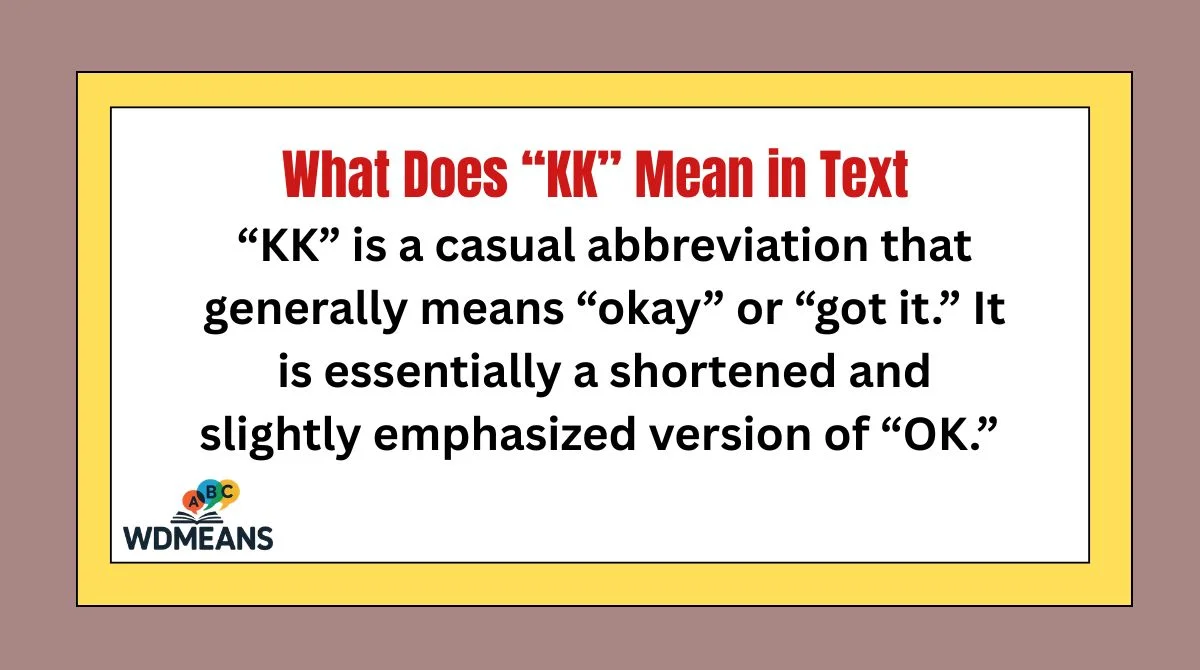
“KK” is a casual abbreviation that generally means “okay” or “got it.” It is essentially a shortened and slightly emphasized version of “OK.” While “OK” is already brief, “KK” adds a tone of acknowledgment, often signaling agreement or confirmation in a friendly and informal way.
The doubling of the letter “K” doesn’t change the literal meaning but slightly modifies the tone. It can make the response feel quicker, lighter, or more conversational. For example, if someone says, “Meet me at 6,” replying with “KK” indicates that you’ve understood and accepted the plan.
In essence, “KK” serves as:
- A confirmation of receipt of information
- An agreement with a statement or plan
- A casual acknowledgment in conversation
It is important to note that tone depends heavily on context. While it is usually friendly, in some situations it may feel abrupt or dismissive, especially if the conversation required a more detailed response.
Background
The use of “KK” originates from early internet and gaming culture, where speed and efficiency in communication were essential. Typing quickly during online games or chatrooms led users to shorten common words even further than their original abbreviations.
“OK” itself has a long history, dating back to the 19th century as a humorous abbreviation of “oll korrect” (a playful misspelling of “all correct”). Over time, “OK” became universally accepted. As digital communication evolved, especially in instant messaging platforms, users began experimenting with variations like “kk” to make responses faster and more informal.
Gaming communities in particular popularized “KK” as a quick acknowledgment during gameplay. From there, it spread to texting, messaging apps, and eventually social media platforms.
Today, “KK” is widely recognized across different age groups, though it remains more common among younger users and those familiar with internet slang.
Usage in Different Contexts (Chat, Social Media, Professional Fields)
The meaning of “KK” stays consistent across most platforms, but its appropriateness varies depending on the context.
Casual Chat
In everyday conversations, “KK” is widely used to confirm plans or acknowledge messages. It feels natural and friendly among friends or peers.
Social Media
On platforms like Instagram or TikTok, “KK” is often used in direct messages or comments. It maintains a casual tone and helps keep conversations quick and informal.
Professional Fields
In professional communication, the use of “KK” is generally discouraged. While it still means “okay,” it may come across as too informal or even careless. In workplace emails or formal chats, it’s better to use “OK,” “Understood,” or “Noted.”
Using “KK” in the wrong setting can unintentionally signal a lack of professionalism, so context awareness is important.
Meaning in Chat, WhatsApp, Instagram, TikTok
Across messaging and social platforms, “KK” consistently conveys acknowledgment or agreement, but subtle tone differences can appear:
- Chat & WhatsApp: Commonly used to confirm plans or show understanding quickly.
- Instagram: Often appears in direct messages as a casual reply to coordinate or acknowledge something.
- TikTok: Seen in comments or replies, usually indicating agreement or quick acknowledgment without adding much detail.
In all these platforms, “KK” is valued for its speed and simplicity. However, because it’s so short, it can sometimes feel impersonal if overused or used in emotional conversations.
Meaning in Physics, Medical, and Aircraft Terminology
Interestingly, “KK” can have entirely different meanings outside casual communication:
- Physics: “K” often represents Kelvin (a unit of temperature), so “KK” might occasionally be interpreted as “kilokelvin” in scientific contexts, though this is rare.
- Medical Field: It is not a standard medical abbreviation but could appear informally in notes, though professionals avoid ambiguous shorthand.
- Aircraft Terminology: “KK” is not a widely recognized aviation code but could appear in internal shorthand or identifiers depending on the system used.
In technical fields, clarity is critical, so abbreviations like “KK” are usually avoided unless clearly defined.
Common Misconceptions
Many people misunderstand the tone or intent behind “KK.” Some common misconceptions include:
- It’s rude or dismissive: While it can feel abrupt, it is not inherently rude. Tone depends on context.
- It means something different from “OK”: It does not change the meaning, only the tone.
- It’s universally appropriate: It is not suitable for formal communication.
Understanding these nuances helps prevent misinterpretation.
Similar Terms & Alternatives
There are several alternatives to “KK” that convey similar meanings:
- OK
- Okay
- Got it
- Sure
- Sounds good
- Noted
Each option varies slightly in tone. For example, “Got it” feels more attentive, while “Sure” sounds more enthusiastic.
How to Respond to It
When someone sends “KK,” your response depends on the situation:
- If it’s confirming a plan: No further reply may be needed.
- If the conversation continues: You can proceed with the next point.
- If clarity is needed: Ask follow-up questions instead of assuming full agreement.
“KK” usually signals closure or acknowledgment, so it often marks the end of a conversational step.
Differences from Similar Words
Although “KK” and “OK” share the same meaning, they differ in tone and usage:
- KK: More casual, quick, and informal
- OK: Neutral and widely acceptable in all contexts
- Okay: Slightly more conversational and expressive
The choice depends on how formal or detailed you want your response to be.
Relevance in Online Conversations & Dating Apps
In online conversations and dating apps, tone matters significantly. “KK” can sometimes feel too brief or uninterested, especially in early interactions where engagement is important.
- In friendly chats: It works fine as acknowledgment
- In dating apps: It may seem low-effort or disengaged
- In deeper conversations: It can feel dismissive
Using more expressive replies like “Sounds good 😊” or “Got it!” often creates a better impression.
Conclusion
“KK” is a simple yet widely used abbreviation that means “okay” or “understood.” While it is convenient and efficient, its tone can vary depending on context and platform. It works best in casual conversations where speed and simplicity are valued.
However, in professional settings or emotionally nuanced discussions, more descriptive responses are often a better choice.
Understanding when and how to use “KK” ensures clearer communication and helps avoid unintended misunderstandings.
As digital language continues to evolve, mastering these small expressions can make a big difference in how your messages are perceived.

I am Alexander Hayes, creator of WDMEANS, dedicated to simplifying English learning through clear word meanings. I help learners improve vocabulary with easy, accurate, and practical explanations for everyday use online.