In today’s fast-paced digital communication, abbreviations and acronyms have become a core part of how people interact online.
One such abbreviation that often leaves people puzzled is “JW.” Many users encounter it in text messages, social media platforms, or even casual online conversations and wonder what it actually means.
The confusion arises because “JW” can have multiple meanings depending on the context in which it is used.
People frequently search for this term to avoid misunderstandings, especially when chatting with friends, colleagues, or someone new.
Knowing the correct interpretation can help you respond appropriately and maintain smooth communication.
This article breaks down the meaning of “JW,” explores its background, and explains how it is used in different contexts—from casual texting to professional fields—so you can confidently understand and use it in everyday conversations.
Meaning & Definition
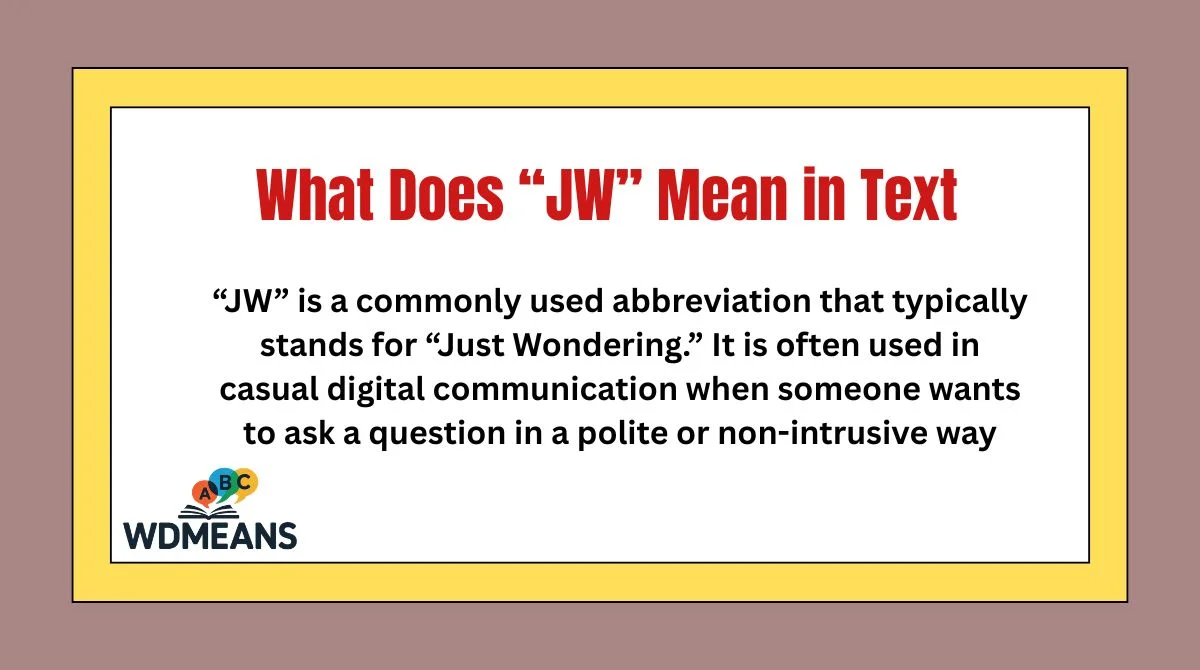
“JW” is a commonly used abbreviation that typically stands for “Just Wondering.” It is often used in casual digital communication when someone wants to ask a question in a polite or non-intrusive way. By adding “JW” to a message, the sender signals that they are asking out of curiosity rather than urgency or demand.
For example:
- “Are you free later? JW.”
- “Did you finish the project? JW.”
In these cases, “JW” softens the tone of the question, making it feel less direct or pressuring. It adds a layer of casual friendliness, which is especially useful in informal conversations.
However, it’s important to note that “JW” is not limited to one meaning. In different contexts, it can represent entirely different phrases or concepts. That’s why understanding the surrounding conversation is essential before interpreting it.
Background
The abbreviation “JW” emerged as part of the broader trend of internet shorthand that developed with the rise of texting, instant messaging, and social media. As people began communicating more frequently through digital platforms, the need for faster and more efficient typing led to the creation of shortened expressions like “LOL,” “BRB,” and “JW.”
Initially, such abbreviations were popular among younger users and early adopters of chat platforms. Over time, they spread across all age groups as smartphones and messaging apps became universal. “JW” gained popularity because it serves a practical purpose—it helps people ask questions without sounding overly direct or intrusive.
Additionally, the abbreviation has evolved beyond casual chat. In certain communities and professional fields, “JW” may have entirely different meanings, which adds to its complexity and widespread use.
Usage in Different Contexts (Chat, Social Media, Professional Fields)
The meaning of “JW” depends heavily on where and how it is used. In casual communication, it almost always means “Just Wondering.” However, in more formal or specialized environments, it can represent something entirely different.
In chat and texting, it is used to soften questions.
In social media, it often appears in comments or direct messages to express curiosity.
In professional fields, it may be an abbreviation for specific terms, organizations, or technical phrases.
For example, in some contexts, “JW” can refer to a group or organization, while in others, it might be shorthand used internally within a company or industry. Because of this variability, interpreting “JW” correctly requires attention to the context and the relationship between the people communicating.
Meaning in Chat, WhatsApp, Instagram, TikTok
On platforms like WhatsApp, Instagram, and TikTok, “JW” is most commonly used as “Just Wondering.” It helps keep conversations light and non-confrontational.
Examples include:
- “Why didn’t you reply earlier? JW.”
- “Is that your new car? JW.”
On social media, people often use it in comments or captions to ask questions without sounding critical. It can also be used humorously or sarcastically, depending on tone.
Because these platforms emphasize quick and casual interaction, abbreviations like “JW” fit naturally into the communication style. They save time and help convey tone more effectively than longer sentences.
Meaning in Physics, Medical, and Aircraft Terminology
Outside casual communication, “JW” can take on entirely different meanings:
- Physics: It may refer to specific variables, names, or shorthand used in research contexts, though it is not a standard universal symbol.
- Medical field: “JW” is sometimes used as shorthand for “Jehovah’s Witness,” particularly in patient notes where religious considerations may affect treatment decisions.
- Aircraft terminology: In aviation, “JW” can be part of flight codes, airline identifiers, or internal abbreviations depending on the system being used.
These meanings are highly specialized and usually only understood within their respective fields. This is why context is critical—what “JW” means in a hospital or cockpit is very different from what it means in a text message.
Common Misconceptions
One of the biggest misconceptions about “JW” is that it always means the same thing. Many people assume it has a fixed definition, which can lead to misunderstandings.
Another common mistake is interpreting it as something negative or passive-aggressive. While tone can vary, “JW” is generally neutral and simply indicates curiosity.
Some also confuse it with other abbreviations or assume it represents a name or initials, which may not always be the case.
Similar Terms & Alternatives
There are several alternatives to “JW” that convey a similar tone:
- “Just curious”
- “Out of curiosity”
- “I was wondering”
- “If you don’t mind me asking”
These phrases serve the same purpose but are more formal or explicit. Choosing between them depends on the level of formality and the relationship between the people communicating.
How to Respond to It
Responding to “JW” is usually straightforward. Since it signals curiosity, you can simply answer the question without overthinking it.
For example:
- Question: “Are you coming tonight? JW.”
- Response: “Yes, I’ll be there!”
If you’re unsure about the tone, you can respond politely and keep the conversation open. There’s no need to treat it as urgent or serious unless the context suggests otherwise.
Differences from Similar Words
“JW” differs from other abbreviations like “FYI” (for your information) or “IMO” (in my opinion) because it is specifically used to soften questions rather than provide information or opinions.
It also differs from “IDK” (I don’t know), which expresses uncertainty rather than curiosity. Understanding these distinctions helps you interpret messages more accurately.
Relevance in Online Conversations & Dating Apps
In online conversations and dating apps, tone is everything. “JW” plays a useful role by making questions feel less intense or intrusive. When getting to know someone, asking questions gently can make interactions more comfortable.
For example:
- “What do you do for fun? JW.”
This approach feels more relaxed and less like an interrogation, which can improve communication and build rapport. However, overusing abbreviations may come across as too casual, so balance is key.
Conclusion
“JW” is a versatile abbreviation that primarily means “Just Wondering” in everyday digital communication. Its purpose is to soften questions and create a more relaxed, friendly tone.
However, its meaning can shift significantly depending on the context, especially in professional or technical fields.
Understanding how and where it is used helps prevent confusion and ensures smoother conversations.
Whether you’re texting friends, commenting on social media, or navigating online dating, recognizing the intent behind “JW” allows you to respond appropriately and confidently.
As digital language continues to evolve, staying familiar with such abbreviations will keep your communication clear, modern, and effective.

I am Alexander Hayes, creator of WDMEANS, dedicated to simplifying English learning through clear word meanings. I help learners improve vocabulary with easy, accurate, and practical explanations for everyday use online.