In today’s fast-paced digital world, short forms and abbreviations have become a natural part of communication.
One of the most commonly used among them is “BTW.” If you’ve ever received a message with this term and paused to wonder what it means, you’re not alone.
Many people search for its meaning to better understand conversations happening across texts, social media, and even professional chats.
“BTW” is widely used because it saves time and keeps conversations concise. However, its meaning can slightly shift depending on the context in which it appears.
Whether you’re chatting with friends, scrolling through social media, or communicating in a work environment, understanding how “BTW” is used can help you respond appropriately and confidently.
This article will walk you through its meaning, origins, usage in various contexts, and how to interpret it correctly without confusion.
Meaning & Definition
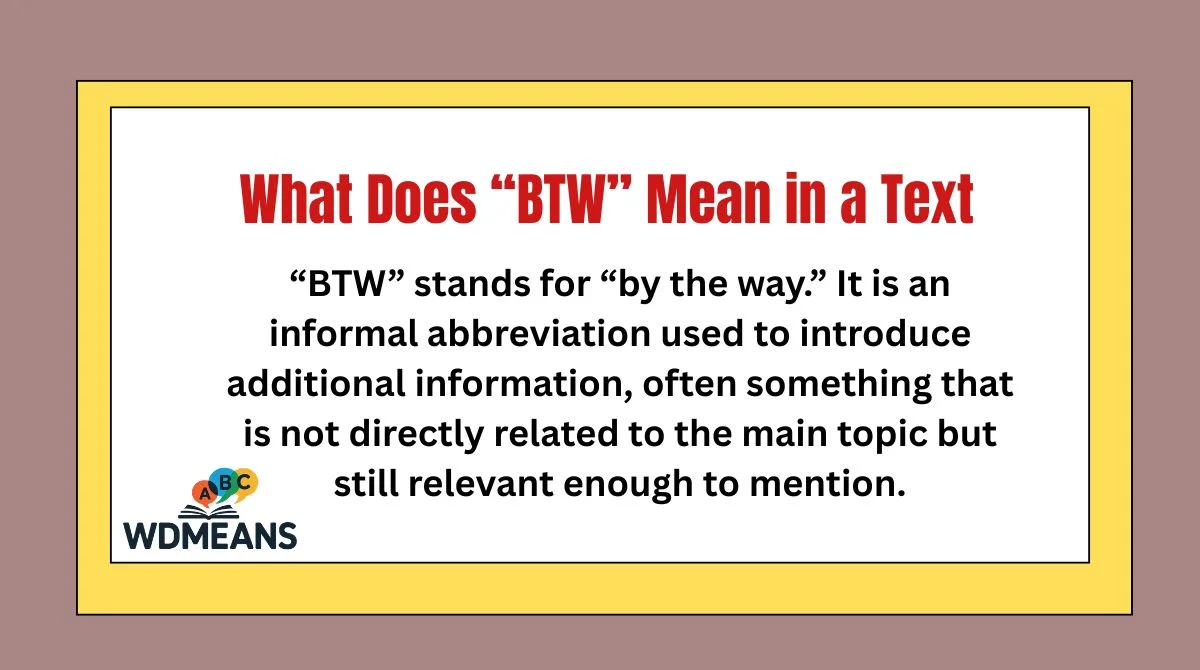
“BTW” stands for “by the way.” It is an informal abbreviation used to introduce additional information, often something that is not directly related to the main topic but still relevant enough to mention.
In conversation, it acts as a transition phrase. For example, if someone is discussing one topic and suddenly adds something else, they might use “BTW” to smoothly shift the focus.
For instance:
- “I finished the project. BTW, did you send the email?”
Here, the second part of the sentence introduces a new thought without starting a completely separate conversation.
The simplicity of “BTW” makes it extremely popular in casual communication. It reduces typing effort while still conveying the intended meaning clearly. Although it is mostly informal, its usage has expanded across various platforms due to the rise of digital communication.
Overall, “BTW” is a conversational bridge—short, efficient, and easy to understand once you know what it stands for.
Background
The abbreviation “BTW” originated from early internet culture, particularly during the rise of online chat rooms, forums, and SMS messaging in the late 1990s and early 2000s. At that time, character limits and slow typing speeds encouraged users to shorten common phrases.
“By the way” was a frequently used phrase in everyday conversation, so naturally, it was shortened to “BTW” for convenience. As mobile phones and instant messaging platforms became more popular, this abbreviation spread rapidly.
Over time, it became a standard part of digital language, alongside other abbreviations like “LOL” and “BRB.” Today, it is universally recognized by most internet users, regardless of age or location.
Interestingly, the adoption of “BTW” reflects how language evolves with technology. What started as a necessity due to limitations has now become a stylistic choice. Even though modern devices no longer require such shortcuts, people continue to use them because they are quick and familiar.
Thus, “BTW” is not just an abbreviation—it’s a small example of how communication adapts to changing tools and environments.
Usage in Different Contexts (Chat, Social Media, Professional Fields)
“BTW” is versatile and can be used across various communication settings, though the tone and appropriateness may differ.
In casual chats, it is used freely to add extra thoughts or change topics slightly. Friends often use it without any concern for formality.
On social media platforms, “BTW” appears in captions, comments, and direct messages. It helps users quickly insert additional information without writing long sentences.
In professional environments, however, its usage depends on the level of formality. While it may be acceptable in internal chats or informal team communication, it is generally avoided in formal emails or official documents. In such cases, writing out “by the way” is considered more professional.
For example:
- Informal: “BTW, the meeting is postponed.”
- Formal: “By the way, the meeting has been postponed.”
Understanding when and where to use “BTW” ensures that your communication remains appropriate and effective.
Meaning in Chat, WhatsApp, Instagram, TikTok
On platforms like WhatsApp, Instagram, and TikTok, “BTW” carries the same core meaning—“by the way”—but is often used more casually and spontaneously.
In WhatsApp chats, it is commonly used in ongoing conversations to introduce a new idea or reminder.
On Instagram, it might appear in captions or comments, often to add a side note or extra detail.
On TikTok, users may include it in captions or replies to add context or clarify something quickly.
Because these platforms emphasize quick and engaging communication, “BTW” fits perfectly. It keeps messages short while maintaining clarity.
For example:
- “BTW, check my latest post!”
- “BTW, that video was hilarious.”
Its informal tone makes it ideal for social interactions where brevity and friendliness are key.
Meaning in Physics, Medical, and Aircraft Terminology
While “BTW” is most commonly used as “by the way,” it can occasionally have different meanings in specialized fields.
In physics, “BTW” is not a standard abbreviation, but in some niche contexts, it may refer to specific models or theories depending on the subject matter.
In the medical field, abbreviations are common, but “BTW” is rarely used officially. If it appears, it is usually in informal communication rather than clinical documentation.
In aviation, abbreviations are strictly standardized for safety reasons. “BTW” is not a recognized official term in aircraft communication, though it might appear informally among personnel.
These variations are rare and context-dependent, so in most everyday situations, “BTW” should still be interpreted as “by the way.”
Common Misconceptions
One common misconception is that “BTW” has multiple widely accepted meanings. In reality, its primary meaning remains “by the way.”
Another misunderstanding is that it is appropriate in all types of communication. While it is widely accepted in casual settings, it may appear unprofessional in formal writing.
Some people also confuse it with other abbreviations or assume it carries emotional tone. However, “BTW” is neutral—it simply introduces additional information.
Clarifying these misconceptions helps avoid miscommunication and ensures proper usage.
Similar Terms & Alternatives
There are several alternatives to “BTW” that convey a similar idea:
- “By the way” (full form)
- “Also”
- “Additionally”
- “On another note”
- “Just so you know”
Each alternative varies slightly in tone. For instance, “additionally” sounds more formal, while “just so you know” feels conversational.
Choosing the right alternative depends on the context and audience.
How to Respond to It
Responding to “BTW” is usually straightforward. Since it introduces new information, your response should address the added point.
For example:
- Message: “BTW, are you free tomorrow?”
- Response: “Yes, I am available.”
If the added information is not a question, you can acknowledge it or continue the conversation naturally.
The key is to treat it as a normal part of the message rather than something separate or confusing.
Differences from Similar Words
“BTW” differs from similar connectors like “also” or “however.”
- “Also” adds information directly related to the main topic.
- “However” introduces contrast.
- “BTW” shifts slightly away from the main topic to add something extra.
Understanding these differences helps you use each term more accurately and effectively.
Relevance in Online Conversations & Dating Apps
In online conversations and dating apps, “BTW” plays a subtle but useful role. It helps keep chats flowing naturally without making conversations feel forced.
For example, someone might use it to introduce a new question or topic casually:
- “BTW, what do you like to do on weekends?”
This makes the conversation feel relaxed and spontaneous. It can also help transition between topics smoothly, which is especially important in early interactions.
Because dating apps rely heavily on text-based communication, small phrases like “BTW” can make conversations feel more human and engaging.
Conclusion
“BTW” is a simple yet powerful abbreviation that has become a staple of modern communication.
Meaning “by the way,” it allows people to introduce additional thoughts quickly and efficiently across texts, social media, and casual conversations.
While its usage is mostly informal, understanding its context ensures that you use it appropriately in different settings. From everyday chats to online interactions, “BTW” helps maintain a natural flow of conversation.
As digital communication continues to evolve, abbreviations like “BTW” remain relevant because they combine clarity with convenience.
Knowing how to use and respond to them not only improves your communication skills but also helps you stay connected in a fast-moving digital world.

I am Alexander Hayes, creator of WDMEANS, dedicated to simplifying English learning through clear word meanings. I help learners improve vocabulary with easy, accurate, and practical explanations for everyday use online.