In today’s fast-paced digital world, abbreviations and slang dominate how we communicate. One such commonly used term is “MK.”
If you’ve seen it in messages or social media and wondered what it means, you’re not alone. Many people search for this term because its meaning can vary depending on the context, platform, and even the tone of the conversation.
Understanding short forms like this helps avoid confusion and improves communication, especially in informal chats.
“MK” is a simple yet versatile abbreviation that appears in texting, online conversations, and even in technical fields.
While it often carries a casual tone, its interpretation can shift based on usage.
This article breaks down its meaning, origins, and various applications so you can confidently understand and respond whenever you encounter it.
Meaning & Definition
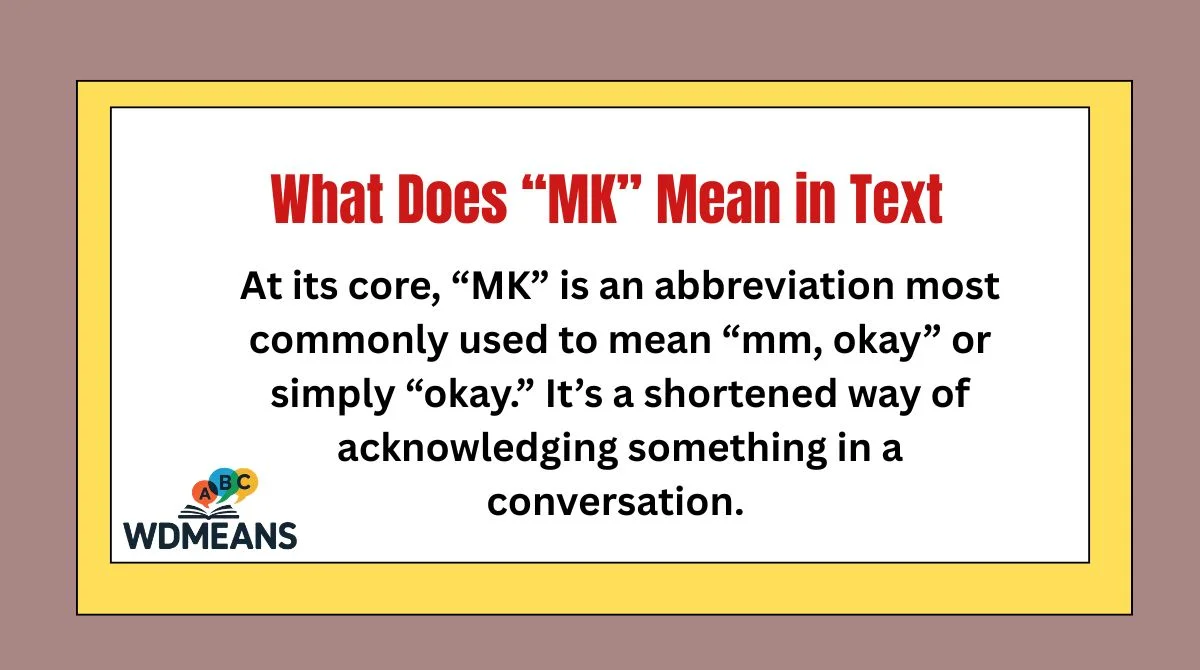
At its core, “MK” is an abbreviation most commonly used to mean “mm, okay” or simply “okay.” It’s a shortened way of acknowledging something in a conversation. The term often conveys agreement, acceptance, or understanding, but sometimes it can also imply indifference or mild reluctance depending on tone.
Unlike a full “okay,” “MK” feels more casual and slightly less enthusiastic. For example:
- “I’ll call you later.”
“MK.” - “We’re meeting at 6 PM.”
“MK, got it.”
In these cases, it acts as a quick acknowledgment rather than a detailed response. The simplicity of “MK” makes it popular in fast messaging environments where brevity matters.
Background
The origin of “MK” is tied to the evolution of digital communication. As texting became widespread, users began shortening words to save time and effort. “Okay” itself was already abbreviated as “OK,” but “MK” emerged as a variation influenced by how people pronounce “mm, okay” in casual speech.
This shift reflects a broader trend in internet language where phonetic expressions—words written the way they sound—become common. “MK” mirrors the spoken hesitation or acknowledgment people use in real-life conversations, making it feel more natural and conversational in text.
Over time, its use spread across messaging platforms, social media, and even informal emails, becoming a recognizable shorthand in everyday communication.
Usage in Different Contexts
“MK” is flexible and appears in various types of communication:
Casual Conversations:
Most commonly, it’s used among friends or peers to signal agreement or acknowledgment.
Social Media:
Users often reply with “MK” in comments or direct messages when they want to keep responses brief.
Professional Settings:
Although less common, it may appear in informal workplace chats. However, it’s generally avoided in formal communication, as it can seem too casual or vague.
Tone Variations:
- Neutral: Simple acknowledgment
- Slightly annoyed: Minimal effort reply
- Indifferent: Lack of strong opinion
Understanding the tone depends heavily on context and relationship between speakers.
Meaning in Chat, WhatsApp, Instagram, TikTok
On platforms like WhatsApp, Instagram, and TikTok, “MK” is widely used in quick replies.
- WhatsApp: Often used to confirm plans or acknowledge messages.
- Instagram DMs: Can signal agreement or mild disinterest.
- TikTok comments: Used casually, sometimes with a humorous or sarcastic tone.
Because these platforms emphasize speed and brevity, “MK” fits perfectly as a low-effort response that still keeps the conversation going.
Meaning in Physics, Medical, and Aircraft Terminology
Beyond casual texting, “MK” can have entirely different meanings in specialized fields:
Physics:
“mk” may represent millikelvin, a unit of temperature equal to one-thousandth of a kelvin.
Medical Field:
It can stand for abbreviations like “medical kit” or be part of specific shorthand used in notes.
Aircraft & Engineering:
“Mk” often means “Mark,” used to denote a version or model, such as “Mk II” (Mark 2), indicating an upgraded design.
These meanings are context-specific and usually appear in technical or professional documents rather than casual conversation.
Common Misconceptions
A common misunderstanding is assuming “MK” always means enthusiasm or agreement. In reality, it can sometimes signal:
- Disinterest
- Passive acknowledgment
- Mild annoyance
Another misconception is confusing it with “OK.” While similar, “OK” is more neutral and widely accepted in all settings, including formal ones, whereas “MK” is distinctly informal.
Similar Terms & Alternatives
Several other abbreviations serve similar purposes:
- OK / Okay – Standard acknowledgment
- K – Very brief, sometimes perceived as blunt
- Got it – Clear understanding
- Sure – Agreement with a positive tone
Each alternative carries a slightly different emotional tone, making word choice important in communication.
How to Respond to It
Responding to “MK” depends on context:
- If it confirms something → continue the conversation normally
- If it feels dismissive → clarify or ask a follow-up question
- If unsure → respond with more detail to keep engagement
For example:
- “MK” → “Great, see you then!”
- “MK” (cold tone) → “Everything okay?”
Differences from Similar Words
“MK” differs from similar abbreviations in tone and clarity:
- MK vs OK: “OK” is clearer and more neutral
- MK vs K: “K” can feel abrupt; “MK” feels slightly softer
- MK vs Sure: “Sure” sounds more positive and engaged
These subtle differences influence how messages are perceived.
Relevance in Online Conversations & Dating Apps
In online conversations and dating apps, tone matters greatly. “MK” can sometimes be interpreted as:
- Lack of interest
- Minimal effort
- Neutral acknowledgment
Because communication is text-based, small cues like this can shape impressions. Using or receiving “MK” in dating chats may prompt users to question engagement levels, making it important to balance brevity with clarity.
Conclusion
“MK” is a simple yet versatile abbreviation that plays a meaningful role in modern communication. While it generally means “okay” or acknowledgment, its tone can vary widely depending on context.
From casual chats to technical fields, understanding its different meanings helps avoid confusion and improves clarity in conversations.
As digital language continues to evolve, small expressions like “MK” highlight how efficiency and tone combine in online communication.
Knowing when and how to use it ensures smoother interactions across platforms and situations.

I am Alexander Hayes, creator of WDMEANS, dedicated to simplifying English learning through clear word meanings. I help learners improve vocabulary with easy, accurate, and practical explanations for everyday use online.