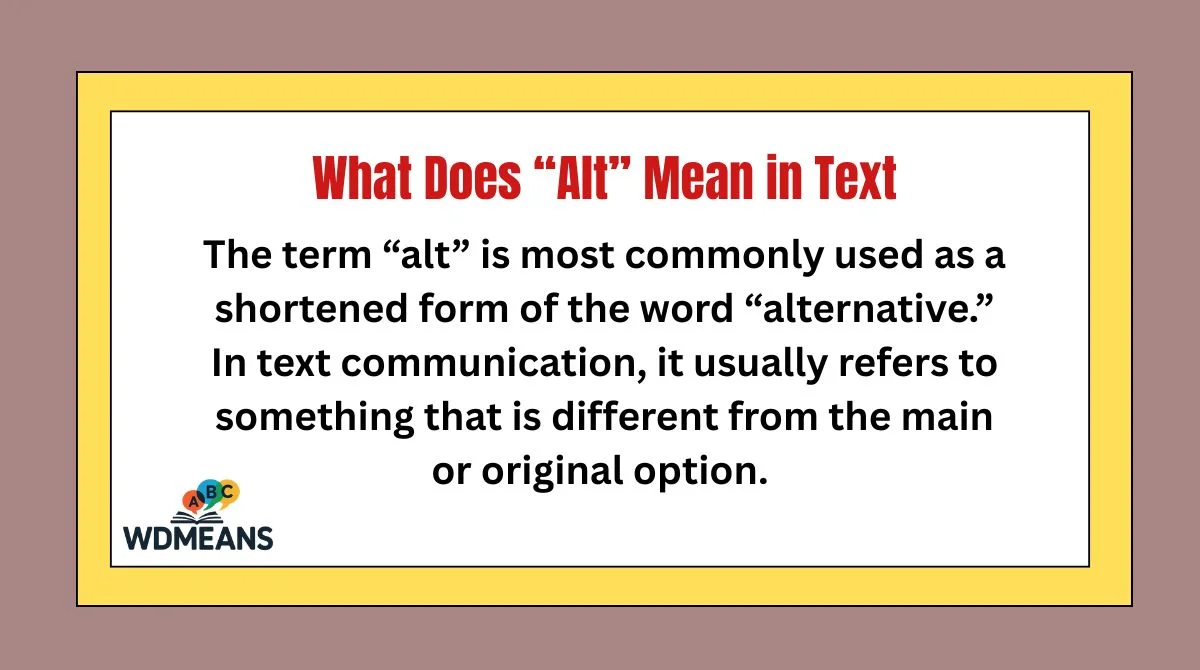
If you’ve ever come across the word “alt” in a message, caption, or comment, you might have paused and wondered what it actually means.
The term is short, simple, and widely used—but its meaning can change depending on the context. That’s exactly why so many people search for it.
In today’s fast-paced digital communication, abbreviations like “alt” help people express ideas quickly, but they can also create confusion for those unfamiliar with them.
“Alt” can appear in casual chats, social media bios, gaming communities, and even technical or professional discussions.
Sometimes it refers to personality, sometimes to an alternative account, and in other cases, it’s linked to science or aviation.
Understanding these meanings not only helps you communicate better but also ensures you don’t misinterpret someone’s message.
This article breaks down everything you need to know about “alt” in text, covering its definitions, origins, and real-world usage in a clear and engaging way.
Meaning & Definition
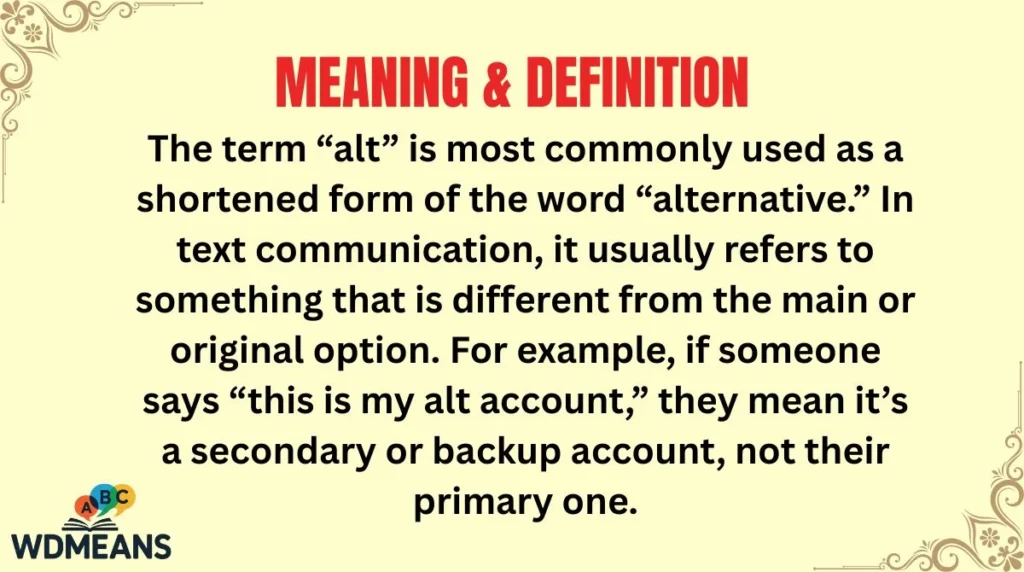
The term “alt” is most commonly used as a shortened form of the word “alternative.” In text communication, it usually refers to something that is different from the main or original option. For example, if someone says “this is my alt account,” they mean it’s a secondary or backup account, not their primary one.
In everyday digital language, “alt” can carry several meanings depending on context. It may describe a different version of something, such as an alternate identity, style, or perspective. In social media spaces, it often represents a persona that differs from someone’s main online identity. For instance, a person might have a professional account and an “alt” account where they post more casually.
The word can also function as a label. People might use “alt” to describe music genres (like alternative rock), fashion styles, or subcultures that deviate from mainstream trends. In this sense, it signals uniqueness or individuality.
Despite its simplicity, “alt” is highly flexible. Its meaning depends on how and where it’s used. Whether referring to a backup account, a different personality, or a non-mainstream choice, the core idea remains the same: something that exists as an alternative to the norm.
Background
The origin of “alt” comes from the longer word “alternative,” which has been part of the English language for centuries. Over time, as digital communication evolved—especially with texting, forums, and online gaming—people began shortening words to save time and effort. This led to the widespread adoption of abbreviations like “alt.”
In early internet culture, particularly in gaming and online forums, “alt” became popular as shorthand for “alternate character” or “alternate account.” Gamers would create multiple profiles to explore different strategies or identities, and these were commonly referred to as “alts.” This usage quickly spread beyond gaming into social media and messaging platforms.
As platforms like WhatsApp, Instagram, and TikTok gained popularity, the meaning of “alt” expanded further. It started to reflect not just alternative accounts, but also alternative lifestyles, aesthetics, and identities. For example, “alt culture” emerged as a way to describe non-mainstream fashion, music, and attitudes.
Today, “alt” is deeply embedded in digital communication. Its evolution reflects how language adapts to technology and culture, making communication faster while still carrying rich meaning.
Usage in Different Contexts (Chat, Social Media, Professional Fields)
“Alt” is used across various contexts, and its meaning shifts slightly depending on where you encounter it. In casual chat, it usually refers to something secondary or different. For example, someone might say, “Message me on my alt,” indicating they want to continue the conversation on another account.
On social media platforms, “alt” often describes a secondary profile. People use these accounts for privacy, experimentation, or expressing a different side of their personality. For instance, a user might maintain a polished public profile and a more relaxed “alt” account for close friends.
In professional or technical environments, “alt” can have more structured meanings. In computing, it may refer to the “Alt key” on a keyboard, which is used in combination with other keys to perform shortcuts. In design and web development, “alt text” describes alternative text used to explain images for accessibility purposes.
The flexibility of “alt” makes it useful across different fields. While its core meaning remains tied to the idea of “alternative,” its specific interpretation depends on the situation. Understanding the context is key to interpreting it correctly.
Meaning in Chat, WhatsApp, Instagram, TikTok
In everyday messaging and social platforms, “alt” is commonly used in a few recognizable ways. On WhatsApp and general chat apps, it often refers to a secondary account. For example, “This is my alt” means the person is not using their main account.
On Instagram and TikTok, “alt” has become even more nuanced. Many users create “alt accounts” where they share more personal, unfiltered, or niche content. These accounts are usually followed by a smaller, trusted audience. In this context, “alt” represents freedom of expression and authenticity.
Sometimes, “alt” is also used to describe a style or identity. For example, someone might say “alt vibe” or “alt aesthetic,” referring to a look or attitude that is different from mainstream trends. This could include unique fashion, music preferences, or creative expression.
Overall, in social media spaces, “alt” is less about strict definition and more about identity and individuality. It allows users to present different sides of themselves in a flexible and creative way.
Meaning in Physics, Medical, and Aircraft Terminology
Outside of casual communication, “alt” can also appear in technical and professional fields with entirely different meanings. In physics and aviation, “alt” is often used as an abbreviation for “altitude.” It refers to the height of an object above a reference point, typically sea level. Pilots and engineers frequently use this term in calculations and communication.
In the medical field, “ALT” (often written in uppercase) stands for Alanine Aminotransferase, which is an enzyme found in the liver. Doctors measure ALT levels through blood tests to assess liver health. Elevated ALT levels can indicate liver damage or disease.
In aviation, “alt” is crucial for navigation and safety. Pilots rely on altitude readings to maintain proper flight paths and avoid collisions. It’s a fundamental part of flight communication and instrumentation.
These technical meanings highlight how the same abbreviation can have entirely different interpretations depending on the field. This is why context is essential when understanding the term.
Common Misconceptions
One common misconception is that “alt” always refers to an alternative account. While this is a popular usage, it’s not the only meaning. Depending on the context, it could refer to style, identity, or even technical terms like altitude or medical enzymes.
Another misunderstanding is assuming “alt” has a negative or secretive meaning. Some people think “alt accounts” are used only to hide something, but in reality, many users create them simply for convenience or creativity.
Some also confuse “alt” with similar abbreviations or assume it has a fixed definition across all platforms. In truth, its meaning is flexible and context-dependent.
Recognizing these misconceptions helps avoid confusion and ensures more accurate communication.
Similar Terms & Alternatives
Several terms are related to “alt” and can be used in similar ways. Words like “backup,” “secondary,” or “alternate” often carry the same meaning in different contexts. For example, instead of saying “alt account,” someone might say “backup account.”
In social media culture, terms like “finsta” (fake Instagram) are sometimes used similarly, though they have slightly different connotations. “Alt” tends to be broader and more neutral.
In technical fields, alternatives depend on the context. For example, “altitude” is used instead of “alt” in formal communication, while “ALT levels” is the standard term in medicine.
Understanding these alternatives helps you choose the most appropriate term for each situation.
How to Respond to It
Responding to “alt” depends on how it’s used in the conversation. If someone says, “This is my alt,” a simple acknowledgment like “Got it” or “Okay” is usually enough.
If the term is unclear, it’s perfectly fine to ask for clarification. For example, you might say, “Do you mean your alternate account?” This ensures you understand the message correctly.
In social contexts, responding casually and naturally works best. There’s no need for a formal reply unless the conversation requires it. The key is to match the tone of the discussion.
Differences from Similar Words
“Alt” differs from similar words mainly in its brevity and flexibility. While “alternative” is the full term, “alt” is informal and widely used in digital communication.
Compared to “backup,” “alt” can carry broader meanings beyond just being a replacement. It might represent a different identity or style rather than simply a spare option.
Unlike “secondary,” which sounds more formal, “alt” is casual and adaptable. This makes it more suitable for everyday conversations, especially online.
Relevance in Online Conversations & Dating Apps
In online conversations and dating apps, “alt” can play an important role in how people present themselves. Users may mention having an “alt account” to share more personal content or to separate different aspects of their lives.
On dating platforms, it might indicate that someone prefers to move conversations to another account for privacy or comfort. It can also signal authenticity, as some users feel more relaxed using their “alt” profiles.
Understanding this usage helps you navigate online interactions more effectively and avoid misunderstandings. It also reflects the growing importance of digital identity in modern communication.
Conclusion
“Alt” is a small word with a wide range of meanings. From representing alternative accounts in social media to indicating altitude in aviation or enzymes in medicine, its interpretation depends entirely on context.
Its popularity comes from its simplicity and flexibility, making it a valuable part of modern communication.
By understanding how “alt” is used across different platforms and fields, you can communicate more clearly and confidently.
Whether you encounter it in a casual chat or a technical discussion, recognizing its meaning will help you respond appropriately and avoid confusion.

I am Alexander Hayes, creator of WDMEANS, dedicated to simplifying English learning through clear word meanings. I help learners improve vocabulary with easy, accurate, and practical explanations for everyday use online.