In today’s fast-paced digital world, abbreviations and shorthand expressions dominate online communication.
One such commonly used acronym is “NTY.” Many people come across it in chats, social media platforms, or even casual online interactions and wonder what it actually means.
Understanding such terms is important because they can completely change the tone of a conversation.
“NTY” is typically used to convey a polite refusal, but like many internet slang terms, its meaning can vary slightly depending on context.
People search for this term to avoid misunderstandings, especially when texting, dating online, or interacting in professional or semi-formal digital spaces.
This article breaks down everything you need to know about “NTY,” including its definition, origins, usage in different contexts, and how to respond appropriately.
Meaning & Definition
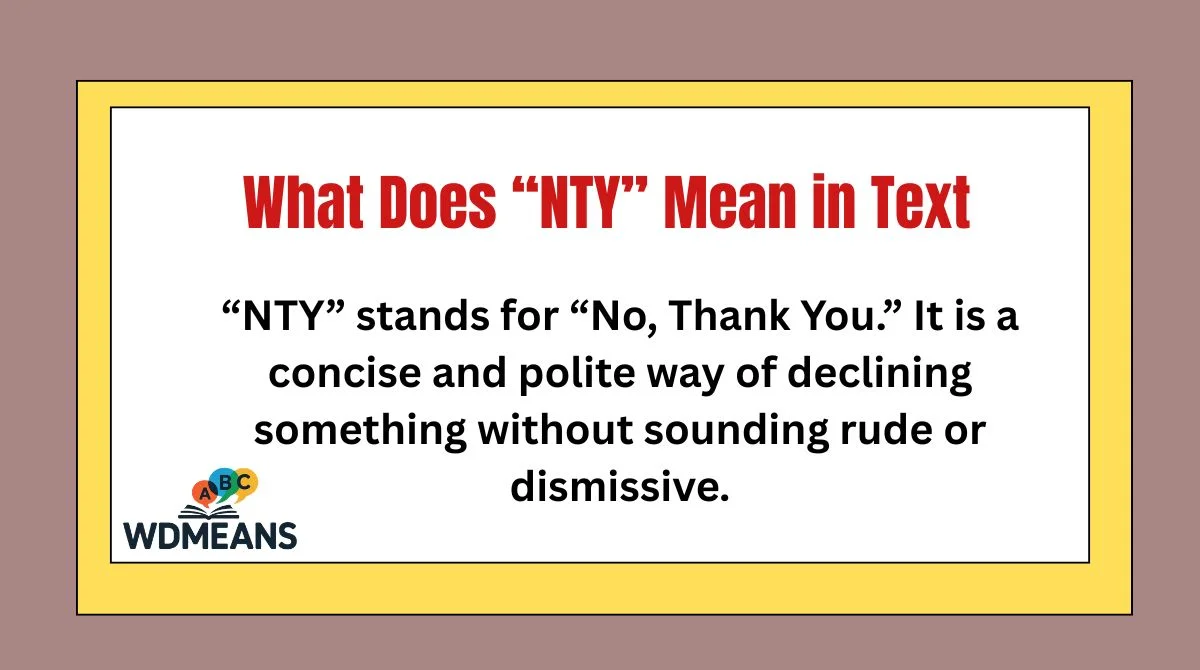
“NTY” stands for “No, Thank You.” It is a concise and polite way of declining something without sounding rude or dismissive. The phrase combines refusal (“No”) with courtesy (“Thank you”), making it widely accepted in both casual and semi-formal communication.
At its core, “NTY” is used when someone wants to reject an offer, suggestion, invitation, or request respectfully. Instead of typing the full phrase, people shorten it to save time, especially in fast-paced conversations like texting or chatting.
For example:
- “Want to join the call?” → “NTY”
- “Do you want extra toppings?” → “NTY”
The tone of “NTY” depends heavily on context. While it is meant to be polite, it can sometimes come across as abrupt if used without additional explanation. For instance, replying with just “NTY” in a serious conversation may feel dismissive.
Overall, “NTY” balances brevity and politeness, making it a practical tool in digital communication.
Background
The rise of abbreviations like “NTY” can be traced back to early texting culture, where character limits and typing speed mattered. As messaging platforms evolved, users continued to favor shorter forms for convenience and efficiency.
Initially, such abbreviations were common in SMS and instant messaging services. Over time, they became deeply embedded in online culture, especially among younger users and frequent social media participants.
“NTY” gained popularity because it serves a universal need: declining something politely without writing a full sentence. Unlike harsher responses like “nope” or “nah,” “NTY” maintains a level of respect.
Its usage has expanded alongside the growth of platforms like messaging apps, forums, and social media networks. Today, it is widely recognized across different age groups, though it remains more prevalent in informal communication.
Usage in Different Contexts (Chat, Social Media, Professional Fields)
In casual chats, “NTY” is commonly used among friends to quickly decline invitations or suggestions. It keeps conversations short and efficient without hurting feelings.
On social media, users may use “NTY” in comments or direct messages when rejecting offers, collaborations, or even opinions. It’s often used to maintain politeness in public interactions.
In professional or semi-formal contexts, “NTY” is less common. While it may appear in internal chats or quick team communications, it is generally better to use the full phrase “No, thank you” in emails or formal messages. This ensures clarity and professionalism.
For example:
- Informal: “Want to grab lunch?” → “NTY”
- Professional: “Would you like to attend the meeting?” → “No, thank you, I have a prior commitment.”
Thus, while “NTY” is versatile, its appropriateness depends on the level of formality required.
Meaning in Chat, WhatsApp, Instagram, TikTok
On platforms like WhatsApp, Instagram, and TikTok, “NTY” is widely used in direct messages and comments.
- WhatsApp: Used in quick replies to friends or groups.
- Instagram: Seen in DMs or comment replies when declining offers or suggestions.
- TikTok: Often used in comment sections, sometimes humorously or sarcastically.
In these environments, tone can vary. Sometimes “NTY” is genuine and polite; other times, it may carry a slightly dismissive or playful tone depending on the context and relationship between users.
For example:
- Friendly: “Try this trend!” → “NTY 😄”
- Slightly dismissive: “You should do this challenge” → “NTY”
Emojis often accompany “NTY” to soften its tone and make it feel more friendly.
Meaning in Physics, Medical, and Aircraft Terminology
Unlike many abbreviations, “NTY” does not have a widely recognized meaning in formal fields such as physics, medicine, or aviation.
- Physics: “NTY” is not a standard scientific abbreviation.
- Medical: It is not used in clinical terminology or documentation.
- Aircraft/Aviation: There is no established technical meaning for “NTY” in aviation codes or communication.
However, abbreviations can sometimes appear in internal systems or shorthand notes, but these are usually organization-specific and not universally recognized.
Therefore, in formal or technical contexts, “NTY” should generally be interpreted as informal slang unless clearly defined otherwise.
Common Misconceptions
One common misconception is that “NTY” is rude. In reality, it is meant to be polite, though it can feel abrupt if used without context.
Another misunderstanding is that it has multiple meanings across industries. While many acronyms do, “NTY” is primarily limited to informal communication.
Some people also assume it carries sarcasm by default. While it can be used sarcastically, that depends entirely on tone and context rather than the acronym itself.
Similar Terms & Alternatives
There are several alternatives to “NTY,” depending on tone and context:
- “No thanks”
- “Nope, thanks”
- “I’ll pass”
- “Not interested”
- “Maybe next time”
Each alternative varies in politeness and directness. “NTY” sits comfortably in the middle—polite but brief.
How to Respond to It
Responding to “NTY” is usually straightforward. Since it’s a polite refusal, the best approach is to respect the decision.
Examples:
- “No problem!”
- “Alright, maybe next time.”
- “Got it, thanks for letting me know.”
Avoid pressuring the person further, as this can make the interaction uncomfortable.
Differences from Similar Words
“NTY” differs from responses like “nope” or “nah” because it includes a polite element. It is softer and more respectful.
Compared to “I’m not interested,” it is less formal and less direct. Meanwhile, “maybe later” suggests uncertainty, whereas “NTY” is a clear refusal.
Relevance in Online Conversations & Dating Apps
In online conversations and dating apps, “NTY” plays an important role in setting boundaries politely. It allows users to decline invitations, conversations, or proposals without escalating tension.
For example, if someone receives an unwanted message, replying with “NTY” can signal disinterest while maintaining civility. However, in sensitive situations, a slightly more detailed response may be better to avoid confusion.
Its brevity makes it especially useful in fast-moving digital interactions, where users prefer quick and clear communication.
Conclusion
“NTY” is a simple yet effective abbreviation that means “No, thank you.” It reflects the modern need for quick, polite communication in digital spaces.
While it is widely accepted in casual conversations and social media, its use in professional or formal settings should be limited.
Understanding its tone, context, and alternatives helps avoid misunderstandings and ensures respectful interactions.
Whether you’re texting a friend or navigating online conversations, knowing how and when to use “NTY” can make communication smoother and more considerate.

I am Alexander Hayes, creator of WDMEANS, dedicated to simplifying English learning through clear word meanings. I help learners improve vocabulary with easy, accurate, and practical explanations for everyday use online.