In everyday communication—especially in texting and online conversations—you may have come across the word “ditto.”
While it may seem simple, many people search for its meaning to understand how and when to use it correctly.
“Ditto” is widely used in casual chats, social media replies, and even professional contexts, yet its meaning can vary slightly depending on where it appears.
Understanding this term helps avoid confusion and improves communication clarity, particularly in fast-paced digital environments where short responses are preferred.
Whether you’re replying to a message, filling out a form, or reading technical content, knowing what “ditto” signifies can make interactions smoother.
This article explains the meaning, background, usage across different fields, and how to respond to it—giving you a complete understanding in a simple and engaging way.
Meaning & Definition
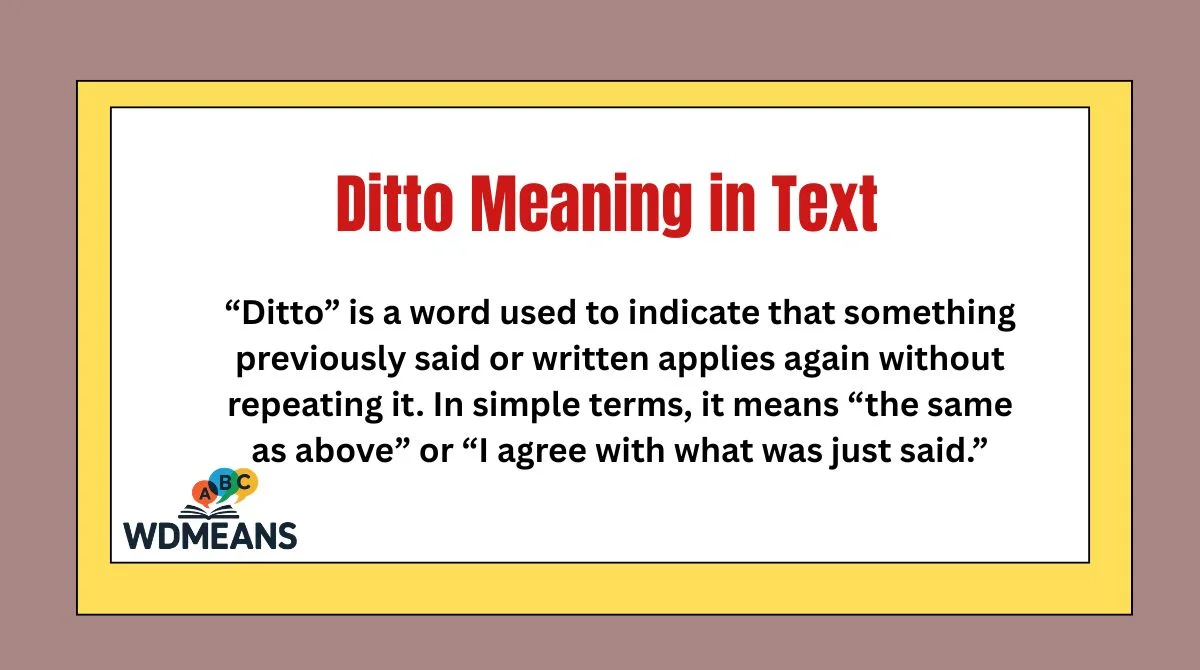
“Ditto” is a word used to indicate that something previously said or written applies again without repeating it. In simple terms, it means “the same as above” or “I agree with what was just said.”
For example:
- Person A: “I love this movie.”
- Person B: “Ditto.”
Here, Person B is expressing the same feeling without restating the sentence.
In written form, especially in lists or tables, “ditto” can replace repeated information to save space and avoid redundancy. It may also be represented by quotation marks (“ ”) to indicate repetition.
The word is commonly used in both formal and informal communication, although its tone often leans toward casual usage in modern digital conversations.
Background
The term “ditto” originates from Italian, where it means “said” or “the same.” It was adopted into English in the 17th century, primarily used in business and clerical writing. Historically, clerks used “ditto” marks to avoid rewriting the same words multiple times in documents such as ledgers and inventories.
Over time, its usage expanded beyond paperwork into everyday language. With the rise of digital communication—text messaging, emails, and social media—the word evolved into a quick way to express agreement or repetition.
Today, “ditto” has become part of informal speech worldwide, maintaining its original meaning while adapting to modern communication styles.
Usage in Different Contexts (Chat, Social Media, Professional Fields)
“Ditto” can be used across various contexts, each with slight differences in tone and purpose:
Casual Conversations:
In everyday chats, it expresses agreement or shared feelings. It’s a quick and friendly response that avoids repeating full sentences.
Social Media:
Users often comment “ditto” to agree with posts or opinions. It helps keep interactions concise while showing support or alignment.
Professional Settings:
In formal documents, “ditto” may appear in tables, forms, or reports to indicate repeated information. However, in highly formal writing, it is sometimes replaced with clearer alternatives like “same as above.”
Emails and Work Communication:
While it can be used in informal workplace chats, it’s generally better to use clearer phrasing in professional emails to avoid ambiguity.
Meaning in Chat, WhatsApp, Instagram, TikTok
In modern digital platforms, “ditto” is primarily used to express agreement or shared emotion:
- Chat & WhatsApp: Quick reply meaning “same here” or “I feel the same.”
- Instagram comments: Used to support someone’s opinion or caption.
- TikTok replies: Often used humorously or to echo a relatable statement.
For example:
- “This song is amazing!”
- “Ditto!”
Here, the response shows enthusiasm and agreement without repeating the sentence.
Meaning in Physics, Medical, and Aircraft Terminology
Although “ditto” is mostly informal, it can appear in technical contexts:
Physics:
Rarely used formally, but in notes or informal discussions, it may indicate repeated values or conditions.
Medical Field:
In handwritten records or shorthand notes, “ditto” may indicate repeated patient information. However, modern digital systems discourage its use to avoid errors.
Aircraft/Aviation:
Pilots and engineers typically avoid ambiguous terms like “ditto” in official communication. However, in informal settings, it might be used conversationally to indicate agreement.
Common Misconceptions
- It always means agreement: Not necessarily—it can also mean repetition of information.
- It is formal language: While it has formal origins, it is mostly informal today.
- It can replace anything: Overusing “ditto” can cause confusion if the reference is unclear.
Similar Terms & Alternatives
Some alternatives to “ditto” include:
- “Same here”
- “Likewise”
- “Me too”
- “Agreed”
- “As above”
Each alternative varies slightly in tone and context, with some being more formal than others.
How to Respond to It
When someone uses “ditto,” your response depends on context:
- Acknowledge agreement: “Glad you feel the same!”
- Continue conversation: Add more details or ask a follow-up question.
- Respond casually: “Nice!” or “Exactly!”
The key is to keep the conversation flowing naturally.
Differences from Similar Words
“Ditto” differs from similar expressions in subtle ways:
- “Me too” is more personal and emotional.
- “Likewise” is slightly more formal.
- “Same” is casual but less expressive.
“Ditto” sits in the middle—casual but slightly more expressive than just saying “same.”
Relevance in Online Conversations & Dating Apps
In online conversations and dating apps, “ditto” is useful for quick engagement. It shows alignment without sounding overly repetitive.
For example:
- If someone says, “I love traveling,” replying with “Ditto” shows shared interest.
However, overusing it may come across as lazy or uninterested. Adding a bit more detail can make conversations more engaging and meaningful.
Conclusion
“Ditto” is a simple yet versatile word that has evolved from formal record-keeping to modern digital communication.
It helps express agreement, repetition, and shared feelings efficiently across different contexts—from casual chats to structured documents.
Understanding its meaning and appropriate usage ensures clearer communication and avoids misunderstandings.
While it is widely accepted in informal settings, it’s important to use it thoughtfully, especially in professional or technical environments.
In today’s fast-paced online world, “ditto” remains relevant as a quick, expressive response—but balancing it with meaningful conversation makes communication more effective and engaging.

I am Alexander Hayes, creator of WDMEANS, dedicated to simplifying English learning through clear word meanings. I help learners improve vocabulary with easy, accurate, and practical explanations for everyday use online.