If you’ve spent any time texting or scrolling through social media, you’ve probably come across the term “ion” and wondered what it actually means.
It can look confusing at first, especially if you associate it with science rather than casual conversation. However, in modern digital communication, “ion” has taken on a completely different meaning.
People search for this term because it appears frequently in chats, memes, and comments, yet isn’t always explained clearly.
Understanding it helps you keep up with online trends and communicate more naturally in informal settings.
This article breaks down what “ion” means in text, where it came from, and how it’s used across different contexts—from casual messaging to professional terminology—so you can confidently understand and use it.
Meaning & Definition
In texting and online slang, “ion” is simply a shortened or stylized way of saying “I don’t.” It is commonly used in informal communication where speed and brevity matter. For example, instead of typing “I don’t know,” someone might write “ion know.”
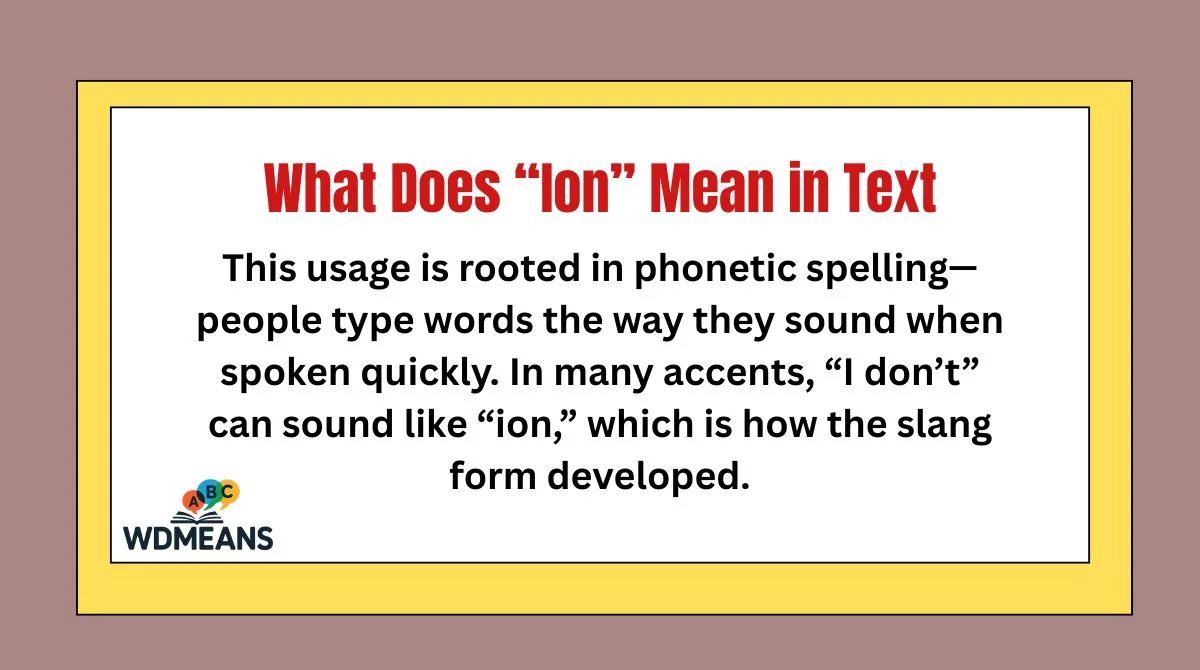
This usage is rooted in phonetic spelling—people type words the way they sound when spoken quickly. In many accents, “I don’t” can sound like “ion,” which is how the slang form developed.
However, it’s important to note that “ion” has a completely different meaning in formal contexts. Scientifically, an ion is an atom or molecule that carries an electric charge due to the loss or gain of electrons. This dual meaning is what often causes confusion.
So, in short:
- Texting/slang: “ion” = “I don’t”
- Scientific usage: charged particle
Understanding the context is key to interpreting the correct meaning.
Background
The slang version of “ion” emerged from internet culture and texting habits, particularly among younger users and communities that favor fast, casual communication. As texting evolved, people began shortening phrases to save time and effort. This led to creative spellings based on pronunciation rather than standard grammar.
The popularity of platforms like messaging apps and social media accelerated the spread of such slang. “Ion” became widely recognized through memes, viral posts, and everyday conversations online. Over time, it moved from niche usage into more mainstream digital language.
Meanwhile, the original meaning of “ion” dates back to scientific studies in chemistry and physics. The term has been used for centuries in academic contexts and remains essential in education and professional fields.
The coexistence of these two meanings—one casual and one scientific—reflects how language evolves. Words can shift and adapt depending on how people use them in different environments.
Usage in Different Contexts (Chat, Social Media, Professional Fields)
“Ion” behaves very differently depending on where you encounter it. In casual chat and social media, it’s widely accepted as slang. People use it in messages, comments, and captions without worrying about grammar rules. It adds a relaxed, conversational tone and often reflects how people speak in real life.
In contrast, in professional settings—such as emails, reports, or academic writing—using “ion” as slang would be inappropriate. In these contexts, clarity and correctness are important, so “I don’t” should always be written in full.
In scientific or technical fields, “ion” retains its original meaning. It refers to particles involved in chemical reactions, electricity, and biological processes. Here, the term is precise and essential, with no connection to slang usage.
This difference highlights the importance of audience awareness. What works in a text message might not be suitable in a workplace or academic setting.
Meaning in Chat, WhatsApp, Instagram, TikTok
On platforms like WhatsApp, Instagram, and TikTok, “ion” is extremely common. It’s used in quick replies, captions, and comments to keep communication fast and casual.
Examples include:
- “ion care” → “I don’t care”
- “ion know what you mean” → “I don’t know what you mean”
- “ion think that’s true” → “I don’t think that’s true”
This style of writing often reflects spoken language and can make messages feel more personal or expressive. On TikTok and Instagram, it’s also used in memes and humorous content, where exaggerated or informal language adds to the entertainment value.
Because these platforms encourage quick interaction, slang like “ion” fits naturally into their communication style.
Meaning in Physics, Medical, and Aircraft Terminology
Outside of casual communication, “ion” has a precise and important meaning.
In physics and chemistry, an ion is a particle with a positive or negative charge. This concept is fundamental to understanding electricity, chemical reactions, and many natural processes.
In medical science, ions such as sodium and potassium play critical roles in the human body. They help regulate nerve signals, muscle function, and fluid balance.
In aircraft and aerospace contexts, ions can be involved in advanced technologies, such as ion propulsion systems used in spacecraft. These systems use charged particles to generate thrust.
In all these fields, “ion” is a technical term and should not be confused with its slang counterpart.
Common Misconceptions
One of the biggest misconceptions is assuming that “ion” always refers to science. This can lead to confusion when reading casual messages.
Another misunderstanding is thinking that “ion” is incorrect or meaningless slang. While it is informal, it serves a clear purpose in digital communication and is widely understood among certain audiences.
Some people also mistakenly use “ion” in formal writing, not realizing it may appear unprofessional. Recognizing when and where to use it is essential.
Similar Terms & Alternatives
There are several alternatives to “ion” depending on the tone you want:
- “I don’t” (standard, formal)
- “idk” (I don’t know)
- “don’t” (slightly less formal but still correct)
Each option serves a different purpose. “Ion” is the most casual and conversational, while the others range from neutral to formal.
How to Respond to It
When someone uses “ion” in a message, you can respond naturally based on the context. There’s no need to correct them unless the situation is formal.
For example:
- If someone says “ion know,” you can reply normally: “That’s okay” or “Let me explain.”
- If you want to match their tone, you can use similar casual language.
Understanding the intent behind the message is more important than focusing on the wording.
Differences from Similar Words
“Ion” differs from “I don’t” mainly in formality and usage. While both mean the same thing in casual contexts, “ion” is informal and phonetic, whereas “I don’t” is grammatically correct.
Compared to abbreviations like “idk,” “ion” is more conversational and mimics speech rather than acting as a shortcut acronym.
These differences make “ion” unique in how it reflects spoken language in written form.
Relevance in Online Conversations & Dating Apps
In online conversations and dating apps, tone matters a lot. Using “ion” can make messages feel relaxed, friendly, and less formal. It may help create a more natural flow, especially in early conversations.
However, overusing slang can sometimes come across as unclear or overly casual. Striking a balance is important. Knowing when to switch between informal and standard language can improve communication and leave a better impression.
Understanding terms like “ion” helps you interpret messages accurately and respond in a way that fits the situation.
Conclusion
“Ion” is a great example of how language evolves in the digital age. While it originally belongs to science, it has gained a completely different meaning in texting and social media.
Recognizing the context in which it’s used is essential to understanding its meaning.
Whether you’re chatting with friends, posting online, or reading comments, knowing what “ion” means can help you communicate more effectively.
At the same time, it’s important to use it appropriately and avoid it in formal situations.
By understanding both its casual and technical meanings, you can navigate conversations with confidence and clarity.

I am Alexander Hayes, creator of WDMEANS, dedicated to simplifying English learning through clear word meanings. I help learners improve vocabulary with easy, accurate, and practical explanations for everyday use online.