In today’s fast-paced digital world, communication has become shorter, quicker, and more informal.
Abbreviations and slang dominate text messages, social media, and online chats, often leaving people confused about their meanings.
One such commonly used abbreviation is “IK.” Many people search for its meaning because they encounter it frequently in conversations but aren’t always sure how to interpret it correctly.
Understanding texting slang like “IK” is important not only for staying updated with modern communication trends but also for avoiding misunderstandings.
Whether you’re chatting with friends, browsing social media, or engaging in online discussions, knowing what “IK” means can help you respond appropriately and confidently.
This article breaks down the meaning, origin, and usage of “IK” across different contexts—from casual chats to technical fields—so you can fully understand how and when to use it.
Meaning & Definition
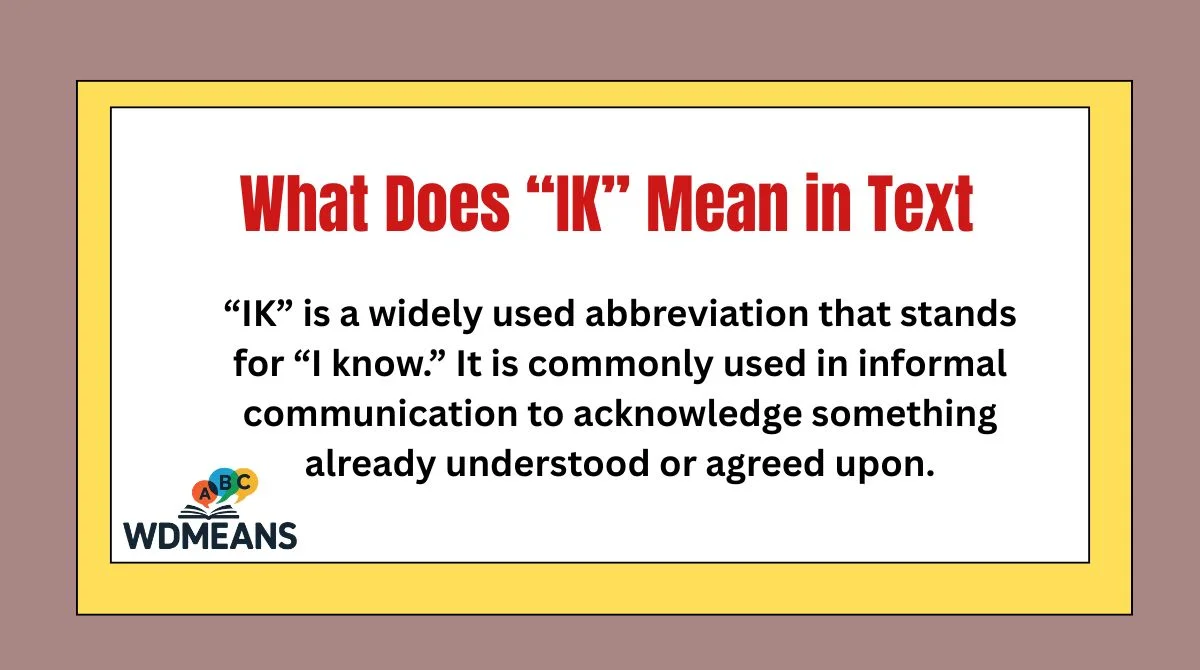
“IK” is a widely used abbreviation that stands for “I know.” It is commonly used in informal communication to acknowledge something already understood or agreed upon.
People use “IK” to express recognition, agreement, or sometimes even mild annoyance when the information being shared is obvious or already known. For example:
- “This movie is amazing!”
- “IK, I’ve watched it twice already.”
In this case, “IK” shows agreement and familiarity with the statement. However, tone plays a significant role. Depending on context, it can also sound dismissive:
- “You need to finish your assignment.”
- “IK…”
Here, it might suggest impatience or that the speaker feels the reminder is unnecessary.
Unlike formal phrases, “IK” is brief and efficient, making it ideal for quick conversations. It is rarely used in professional writing but thrives in casual digital communication.
Background
The rise of abbreviations like “IK” can be traced back to the early days of internet chatrooms, SMS texting, and instant messaging platforms. When character limits were strict and typing on mobile keypads was slow, users developed shortcuts to communicate more efficiently.
As platforms like messaging apps and social media evolved, these abbreviations became part of everyday language, especially among younger generations. Over time, “IK” gained popularity because it conveys a complete thought in just two letters.
Its continued usage today reflects how digital communication prioritizes speed and simplicity. While technology has advanced and typing is easier, the habit of using shorthand remains deeply embedded in online culture.
Usage in Different Contexts (Chat, Social Media, Professional Fields)
“IK” is primarily used in informal settings, but its tone and interpretation can vary depending on where and how it appears.
Chat Conversations
In personal chats, “IK” is often used to show agreement or familiarity. It helps keep conversations flowing quickly without lengthy responses.
Social Media
On platforms like comments or captions, “IK” may be used humorously or sarcastically. For instance:
- “This song is stuck in my head.”
- “IK right??”
Professional Fields
In professional communication, “IK” is generally avoided. It can appear too casual or even disrespectful in formal emails or workplace messages. Instead, phrases like “I understand” or “I’m aware” are preferred.
Meaning in Chat, WhatsApp, Instagram, TikTok
Across popular platforms, “IK” retains the same core meaning but adapts slightly in tone:
- Chat/WhatsApp: Direct acknowledgment or agreement
- Instagram: Often paired with emojis for emphasis (e.g., “IK 😭”)
- TikTok: Used in comments to relate to content or trends
On these platforms, tone is influenced by emojis, punctuation, and context. For example:
- “IK!!!” shows excitement
- “ik…” may suggest boredom or frustration
Meaning in Physics, Medical, and Aircraft Terminology
Outside casual texting, “IK” can have entirely different meanings depending on the field:
- Physics: “IK” may refer to inverse kinematics, a concept used in robotics and motion analysis.
- Medical: It can stand for interleukin, a group of proteins important in the immune system.
- Aircraft/Engineering: It may denote specific codes or abbreviations depending on technical documentation.
These meanings are context-specific and unrelated to texting slang.
Common Misconceptions
One common misconception is that “IK” always expresses agreement. While it often does, it can also convey:
- Sarcasm
- Irritation
- Indifference
Another misunderstanding is confusing “IK” with similar abbreviations like “IDK” (I don’t know), which has the opposite meaning.
Similar Terms & Alternatives
Several abbreviations and phrases convey similar meanings:
- “Yeah”
- “Got it”
- “I understand”
- “True”
- “Exactly”
Each varies slightly in tone and formality, but all can replace “IK” depending on the situation.
How to Respond to It
Responding to “IK” depends on context:
- If it shows agreement → continue the conversation
- If it sounds dismissive → clarify your point politely
- If it feels sarcastic → respond with humor or ask for clarification
For example:
- “IK” → “Right? It’s so good!”
- “IK…” → “Just making sure we’re on the same page.”
Differences from Similar Words
“IK” differs from other abbreviations mainly in tone and certainty:
- IK vs IDK: Opposites (knowing vs not knowing)
- IK vs OK: Agreement vs acknowledgment
- IK vs Yeah: More direct and concise
Understanding these differences helps avoid confusion in conversations.
Relevance in Online Conversations & Dating Apps
In online conversations, especially on dating apps, “IK” can signal familiarity, confidence, or shared understanding. However, tone matters greatly.
- Used positively → shows connection and relatability
- Used dismissively → may come across as uninterested
Because first impressions matter in such platforms, using “IK” thoughtfully can influence how others perceive your communication style.
Conclusion
“IK” is a simple yet powerful abbreviation that plays a significant role in modern digital communication.
While it primarily means “I know,” its tone can vary widely depending on context, punctuation, and platform.
From casual chats to social media interactions, it helps people communicate quickly and efficiently.
However, understanding when and how to use “IK” is essential to avoid sounding dismissive or overly informal, especially in professional or sensitive conversations.
By recognizing its nuances and differences from similar terms, you can use it effectively and interpret it accurately in any situation.

I am Alexander Hayes, creator of WDMEANS, dedicated to simplifying English learning through clear word meanings. I help learners improve vocabulary with easy, accurate, and practical explanations for everyday use online.