In today’s fast-paced digital communication, abbreviations and short forms are everywhere.
One such term that often appears in messages, emails, and online platforms is “GMT.” Many people search for its meaning because it can have different interpretations depending on the context.
Sometimes it refers to time, while in other cases it may carry a casual or slang meaning in conversations.
Understanding what “GMT” means in text is important, especially when communicating across time zones or interacting on social media and messaging apps.
Misinterpreting it can lead to confusion, missed meetings, or awkward replies.
This article explores the meaning of GMT in depth, including its origins, various uses, and how it applies in both professional and casual settings.
Whether you’ve seen it in a chat, on Instagram, or in a technical field, this guide will help you clearly understand and use it correctly.
Meaning & Definition
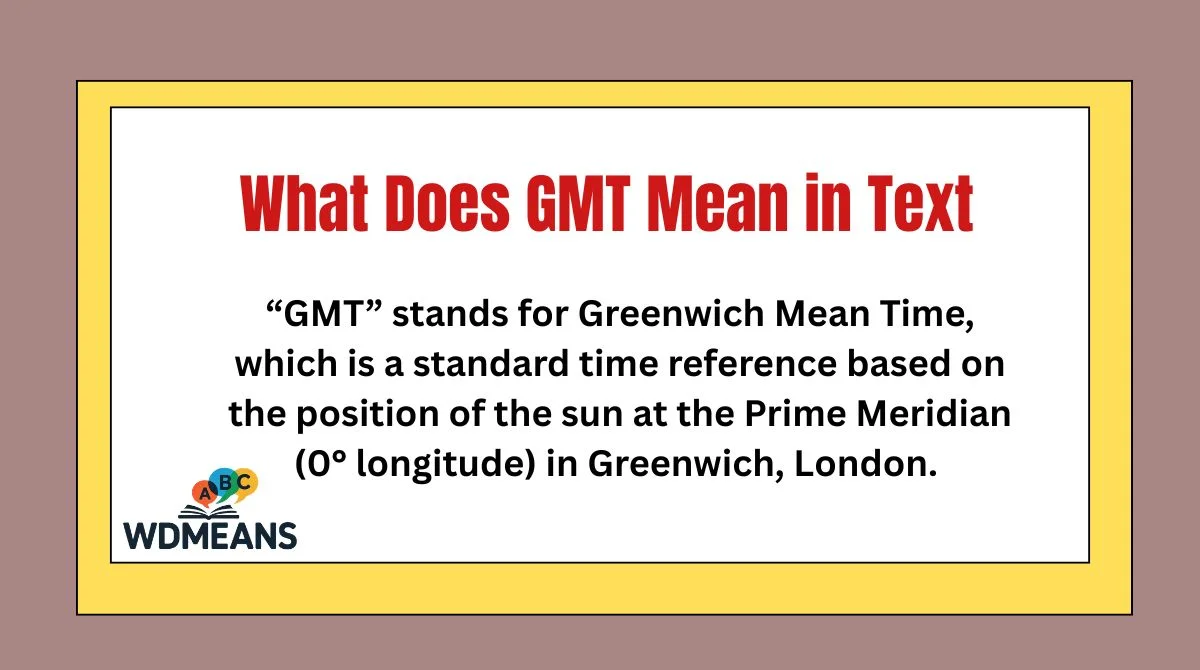
“GMT” stands for Greenwich Mean Time, which is a standard time reference based on the position of the sun at the Prime Meridian (0° longitude) in Greenwich, London. It has historically been used as a global time standard to coordinate clocks and schedules worldwide.
In simple terms, GMT is a baseline time from which other time zones are calculated. For example, if a country is GMT+5, it means its local time is five hours ahead of Greenwich Mean Time.
However, in text messages or online conversations, “GMT” is not always strictly used in its technical sense. Sometimes people use it casually to indicate a time zone when scheduling something, such as:
- “Let’s meet at 6 PM GMT.”
In rare informal contexts, some users may use “GMT” as shorthand for phrases depending on the conversation, but this is uncommon. The primary meaning remains tied to timekeeping.
Background
The concept of GMT dates back to the 19th century when global travel and communication required a standardized time system. Before that, each city followed its own local solar time, which caused confusion as railways and international communication expanded.
Greenwich, a district in London, was chosen as the reference point because it housed the Royal Observatory, which played a key role in navigation and astronomy. Over time, GMT became the world’s time standard.
Today, GMT has largely been replaced in scientific and technical contexts by Coordinated Universal Time (UTC). Despite this, GMT is still widely used in everyday language, especially in the UK and in online communication.
Because of its long history, the term remains familiar and continues to appear in digital conversations, scheduling tools, and global coordination.
Usage in Different Contexts (Chat, Social Media, Professional Fields)
The meaning of GMT can vary slightly depending on where it is used.
In professional settings, GMT is often used to schedule international meetings. For example, global teams may agree to meet at a specific GMT time to avoid confusion between time zones.
On social media, GMT is commonly used when announcing events, live streams, or releases. For instance:
- “New video drops at 8 PM GMT!”
In casual chat, GMT usually appears when people from different countries are coordinating plans. It helps ensure everyone understands the exact time being discussed.
In technical or academic fields, GMT is used as a reference point for time calculations, although UTC is more precise and preferred.
Overall, GMT acts as a universal anchor that simplifies communication across regions.
Meaning in Chat, WhatsApp, Instagram, TikTok
On platforms like WhatsApp, Instagram, and TikTok, GMT is mostly used in its time-related sense. Users often include it when:
- Planning online meetups
- Announcing live sessions
- Sharing event timings
For example:
- “Join the live at 7 PM GMT!”
- “I’ll message you at 10 AM GMT.”
Unlike many internet abbreviations, GMT does not usually have a slang meaning in chats. It remains fairly straightforward and tied to scheduling.
However, confusion can occur if users are unfamiliar with time zones. In such cases, people may convert GMT into their local time using apps or online tools.
Meaning in Physics, Medical, and Aircraft Terminology
In specialized fields, GMT can have slightly different interpretations or uses.
In physics and astronomy, GMT has historically been used to track time based on Earth’s rotation. However, modern systems rely more on UTC for accuracy.
In medical contexts, GMT may occasionally appear in research papers or global studies where timing consistency is important, though it is less common.
In aviation, time is critical for safety and coordination. While UTC is the standard used today, GMT is sometimes used interchangeably in informal discussions. Pilots and air traffic controllers rely on standardized time references to ensure precise communication.
Across these fields, the core idea remains the same: a universal time reference.
Common Misconceptions
One common misconception is that GMT is the same as UTC. While they are closely related, they are not identical. UTC is more precise and based on atomic clocks, whereas GMT is based on Earth’s rotation.
Another misunderstanding is that GMT changes with daylight saving time. In reality, GMT itself does not change; local regions may shift their clocks, but GMT remains constant.
Some people also assume GMT has multiple slang meanings online, but this is rarely true. Its primary usage is still time-related.
Similar Terms & Alternatives
There are several terms similar to GMT, including:
- UTC (Coordinated Universal Time) – the modern global time standard
- BST (British Summer Time) – used in the UK during daylight saving
- EST, PST, IST – regional time zones
These alternatives serve similar purposes but are specific to certain regions or systems. GMT remains a widely recognized reference point.
How to Respond to It
When someone uses GMT in a message, the best response depends on the context.
If it’s about scheduling:
- Convert the time into your local time zone
- Confirm clearly, e.g., “That’s 11 PM my time, works for me!”
If you’re unsure:
- Ask for clarification
- Example: “Do you mean GMT exactly or your local time?”
Clear communication helps avoid misunderstandings, especially in international conversations.
Differences from Similar Words
GMT differs from other time-related abbreviations mainly in its origin and usage.
- GMT vs UTC: UTC is more accurate and widely used in science
- GMT vs local time zones: GMT is universal, while local times vary
- GMT vs slang abbreviations: Unlike many internet terms, GMT is formal and specific
These differences make GMT unique as both a historical and practical reference.
Relevance in Online Conversations & Dating Apps
In online conversations and dating apps, GMT is especially useful when connecting with people from different countries. It helps users coordinate calls, chats, or virtual dates without confusion.
For example, someone might say:
- “Let’s talk at 9 PM GMT.”
This ensures both parties understand the exact timing, regardless of location. In global interactions, using GMT shows clarity and consideration, making communication smoother and more professional.
Conclusion
GMT, or Greenwich Mean Time, remains an important concept in both digital communication and global coordination.
While its roots are historical, its relevance continues in modern conversations, especially when people from different time zones interact.
Whether used in professional meetings, social media announcements, or casual chats, GMT helps establish a clear and consistent reference point.
Although newer systems like UTC are more precise, GMT is still widely understood and commonly used.
By understanding its meaning, context, and differences from similar terms, you can communicate more effectively and avoid confusion.
In a connected world, knowing how to interpret and use GMT correctly is a simple but valuable skill.

I am Alexander Hayes, creator of WDMEANS, dedicated to simplifying English learning through clear word meanings. I help learners improve vocabulary with easy, accurate, and practical explanations for everyday use online.