If you’ve spent any time texting, scrolling social media, or chatting online, you’ve probably come across the abbreviation “FR.”
At first glance, it might seem confusing—does it stand for something technical, casual, or even slang?
The truth is, “FR” can mean different things depending on the context, which is why so many people search for its exact meaning.
Understanding modern abbreviations like this is important because digital communication relies heavily on short forms to save time and express tone quickly.
Whether you’re texting friends, browsing Instagram comments, or engaging on dating apps, knowing what “FR” means helps you avoid misunderstandings and respond appropriately.
In this article, we’ll break down the meaning of “FR,” its origins, how it’s used in different contexts, and how you should respond when you see it.
By the end, you’ll have a clear and practical understanding of this widely used abbreviation.
Meaning & Definition
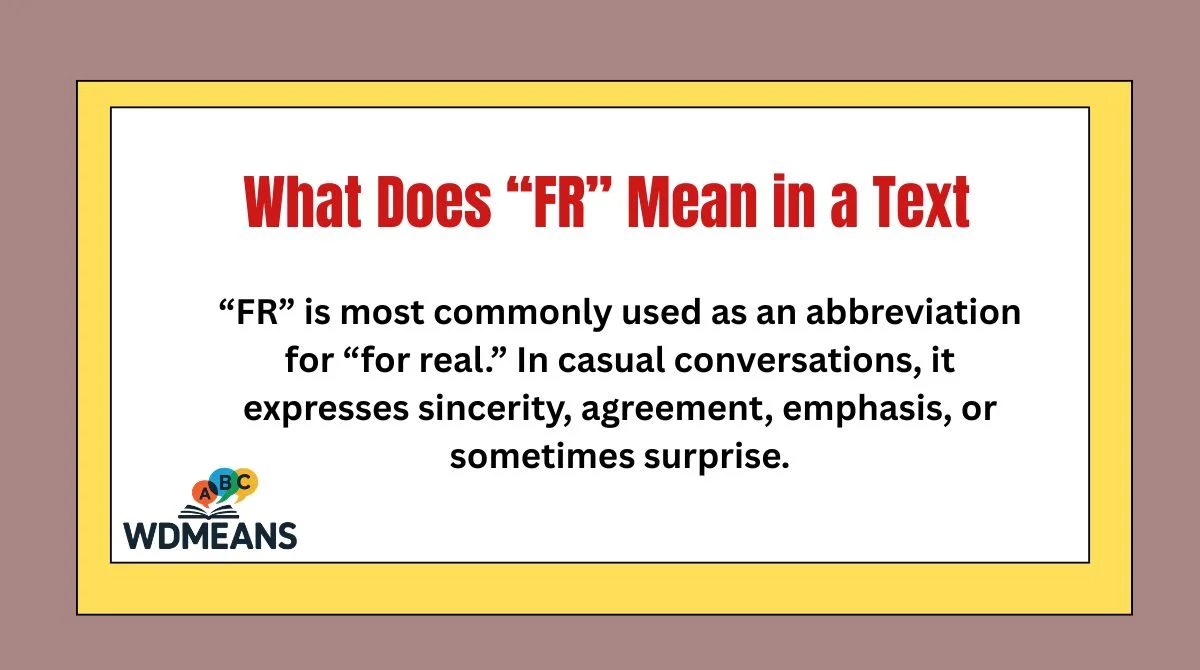
“FR” is most commonly used as an abbreviation for “for real.” In casual conversations, it expresses sincerity, agreement, emphasis, or sometimes surprise. When someone uses “FR,” they’re usually reinforcing that what they’re saying is genuine or serious.
For example:
- “That movie was amazing, FR.” → The person truly means it.
- “You did that FR?” → Expresses surprise or disbelief.
In some contexts, “FR” can also mean “France” (as a country code or abbreviation), especially in formal writing, travel discussions, or technical contexts. However, in everyday texting, “for real” is by far the most common meaning.
Another less common interpretation is “friend request,” particularly on social media platforms. For instance:
- “Send me an FR” → Asking someone to send a friend request.
The key to understanding “FR” is context. In casual chat, it almost always means “for real,” but in more formal or technical settings, it may carry a different meaning.
Background
The abbreviation “FR” emerged from the broader trend of internet slang and texting shortcuts that developed in the early days of mobile messaging and online chatrooms. As character limits and typing convenience became important, users began shortening phrases like “for real” into quicker forms such as “fr.”
Over time, this abbreviation became widely adopted across platforms like SMS, instant messaging apps, and eventually social media. The rise of platforms like Instagram, TikTok, and Twitter accelerated its usage, especially among younger audiences who prefer fast, expressive communication.
Interestingly, “for real” as a phrase has existed long before texting culture. It has roots in spoken English, where it was used to emphasize truthfulness or seriousness. The abbreviation “FR” simply modernized the phrase for digital communication.
Today, “FR” is part of a larger ecosystem of slang that includes abbreviations like “LOL” (laugh out loud), “TBH” (to be honest), and “IMO” (in my opinion). Its simplicity and versatility have helped it remain relevant across different platforms and communication styles.
Despite its informal origins, “FR” has become so common that even people outside younger demographics now recognize and use it regularly.
Usage in Different Contexts (Chat, Social Media, Professional Fields)
“FR” is highly versatile and adapts to different communication environments. In casual chat, it’s primarily used to emphasize honesty or agreement. For example, replying “FR” to someone’s statement can mean “I completely agree.”
On social media platforms, “FR” is often used in comments, captions, and replies to show authenticity or emotional emphasis. It helps users express reactions quickly without writing full sentences.
In professional fields, however, “FR” is rarely used in the slang sense. Instead, it may appear as an abbreviation for technical terms, country codes, or internal shorthand. For example, in documentation or data systems, “FR” could represent “functional requirements.”
Because of these differences, it’s important to adjust your usage based on the setting. Using “FR” in a professional email might appear too informal unless it clearly refers to a technical abbreviation.
Overall, while “FR” thrives in casual communication, it should be used carefully in formal environments to avoid confusion or appearing unprofessional.
Meaning in Chat, WhatsApp, Instagram, TikTok
On platforms like WhatsApp, Instagram, and TikTok, “FR” almost always means “for real.” It’s used to:
- Show agreement: “That’s the best show, FR.”
- Express seriousness: “I’m tired, FR.”
- React emotionally: “FR?? That happened?”
On TikTok especially, “FR” is often used in captions or comments to connect with viewers and make statements feel more genuine or relatable.
On WhatsApp, it’s commonly used in quick replies, sometimes even as a standalone message. For example:
- Person A: “This food is amazing.”
- Person B: “FR!”
This shows strong agreement without needing a full sentence.
In Instagram comments, “FR” can also signal shared feelings or validation, making it a powerful tool for engagement. Its short form makes it perfect for fast-paced conversations where users want to react instantly.
In all these platforms, tone matters. Depending on punctuation and context, “FR” can express excitement, disbelief, or sincerity.
Meaning in Physics, Medical, and Aircraft Terminology
Outside casual conversation, “FR” can have technical meanings in specialized fields.
In physics, “FR” may stand for terms like frame of reference, which is a fundamental concept used to measure motion and position.
In the medical field, “FR” could refer to abbreviations depending on context, such as “functional response” or other shorthand used in clinical notes. However, these meanings are highly context-specific and not commonly used in general conversation.
In aviation or aircraft terminology, “FR” might appear in codes or documentation, sometimes referring to flight-related abbreviations or regional identifiers.
These meanings are usually limited to professional or academic environments. If you see “FR” in a technical document, it’s best to interpret it based on the subject matter rather than assuming it means “for real.”
This highlights how one abbreviation can carry entirely different meanings depending on where it’s used.
Common Misconceptions
One common misconception is that “FR” always means the same thing. While “for real” is the most popular meaning, it’s not universal.
Another misunderstanding is assuming it’s formal language. In reality, “FR” is informal slang and should be avoided in professional writing unless clearly defined.
Some people also confuse “FR” with similar abbreviations like “FYR” (for your reference), which has a completely different meaning.
Lastly, beginners may think “FR” is used only by younger audiences. While it started that way, it has now spread across age groups and is widely understood.
Similar Terms & Alternatives
There are several alternatives to “FR” that convey similar meanings:
- “Honestly” – emphasizes truthfulness
- “Seriously” – adds intensity
- “No cap” – slang meaning no lie
- “For sure” – shows agreement
- “Really” – expresses emphasis
Each of these can replace “FR” depending on tone and context. For example, “no cap” is more trendy, while “honestly” is more neutral and widely accepted.
How to Respond to It
Responding to “FR” depends on how it’s used:
- If it shows agreement: reply with “Exactly” or “Same.”
- If it expresses surprise: clarify or confirm your statement.
- If it’s a question: answer honestly or provide more details.
For example:
- “You liked that movie, FR?” → “Yes, it was great!”
- “That was chaotic, FR.” → “I know, right?”
Matching the tone is key to keeping the conversation natural.
Differences from Similar Words
“FR” differs from similar terms mainly in tone and usage. Unlike “seriously,” which can sound formal or intense, “FR” feels casual and conversational.
Compared to “no cap,” “FR” is more widely understood and less tied to specific slang trends. Meanwhile, “for sure” leans more toward agreement, whereas “FR” can also express disbelief or emphasis.
These subtle differences make “FR” unique and flexible in digital communication.
Relevance in Online Conversations & Dating Apps
In online conversations and dating apps, “FR” plays an important role in expressing authenticity. People often use it to show they are being genuine, which is especially important when building trust with someone new.
For example:
- “I really enjoyed talking to you, FR.”
This adds sincerity and makes the message feel more personal. It can also help lighten conversations and make interactions feel more natural and less formal.
Because dating apps rely heavily on quick, engaging communication, abbreviations like “FR” help users express emotions efficiently without overthinking their messages.
Conclusion
“FR” is a simple yet powerful abbreviation that has become a staple in modern digital communication.
Most commonly meaning “for real,” it helps people express sincerity, agreement, and emotion quickly.
While its primary use is in casual texting and social media, it can also have technical meanings in specific fields like physics or aviation.
Understanding its context is essential to using it correctly and avoiding confusion.
Whether you’re chatting with friends, commenting online, or navigating dating apps, knowing how “FR” works can make your communication clearer and more relatable.
As language continues to evolve in the digital age, abbreviations like “FR” show how communication adapts to be faster, more expressive, and more human.

I am Alexander Hayes, creator of WDMEANS, dedicated to simplifying English learning through clear word meanings. I help learners improve vocabulary with easy, accurate, and practical explanations for everyday use online.