In today’s fast-paced digital world, abbreviations and slang dominate online communication.
One such term that often confuses people is “LWK.” If you’ve come across it in chats, social media, or texts and wondered what it means, you’re not alone.
Many users search for this term to better understand conversations, avoid misunderstandings, and communicate more effectively.
“LWK” is a flexible abbreviation that can carry different meanings depending on context.
Its usage varies widely—from casual texting to niche professional fields—making it both interesting and sometimes confusing.
Understanding what it means and how it’s used can help you stay updated with modern communication trends and respond appropriately in different situations.
This article breaks down the meaning of “LWK,” explores its background, and explains how it’s used across platforms and disciplines.
By the end, you’ll have a clear and practical understanding of this commonly used abbreviation.
Meaning & Definition
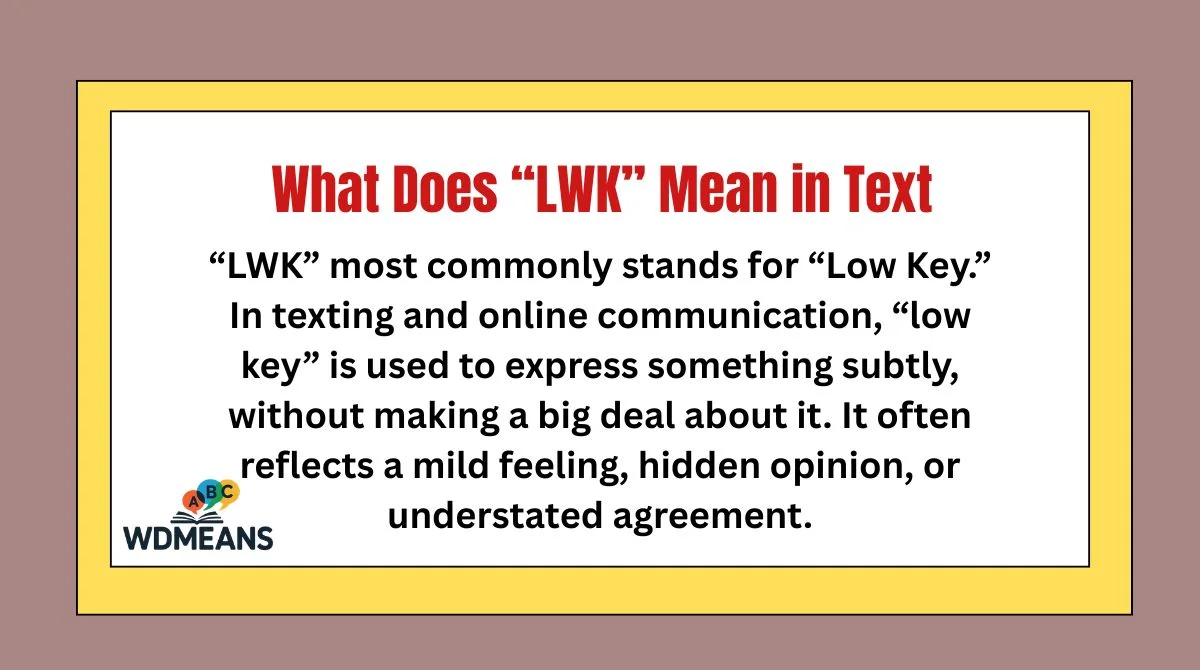
“LWK” most commonly stands for “Low Key.” In texting and online communication, “low key” is used to express something subtly, without making a big deal about it. It often reflects a mild feeling, hidden opinion, or understated agreement.
For example:
- “I LWK like that song” → means “I kind of like that song.”
- “That movie was LWK scary” → suggests it was somewhat scary, but not extremely.
The tone of “LWK” is usually casual and relaxed. It helps soften statements, making them less intense or direct. This is especially useful in conversations where people want to avoid sounding too emotional or overly committed to an opinion.
However, “LWK” doesn’t always carry the same meaning. In certain cases, it may also represent different phrases depending on context, such as abbreviations in technical or professional fields. Still, in everyday digital communication, “low key” remains the dominant and most widely understood meaning.
Background
The phrase “low key” originally comes from traditional English, where it described something subtle, restrained, or not highly emphasized. Over time, it evolved into slang, particularly in youth culture and online spaces.
With the rise of texting and social media platforms, users began shortening phrases for speed and convenience. This led to the abbreviation “LWK.” Like many internet slang terms, it gained popularity because it’s quick to type and widely understood among younger audiences.
The spread of “LWK” can be attributed to platforms like messaging apps and social media, where brevity is key. Influencers, memes, and online communities have also played a role in normalizing its use.
Today, “LWK” is part of a broader trend of digital shorthand, where users compress language into shorter forms without losing meaning. Its continued use reflects how language adapts to technology and changing communication styles.
Usage in Different Contexts (Chat, Social Media, Professional Fields)
In casual communication, “LWK” is used to express subtle opinions or feelings. It’s commonly seen in text messages, group chats, and online comments. For instance, someone might say, “I LWK want to go out tonight,” implying a mild interest rather than strong enthusiasm.
On social media, “LWK” often appears in captions, tweets, or comments. It helps users sound relatable and informal. For example, “LWK missing summer vibes” conveys a nostalgic feeling without being overly dramatic.
In professional settings, however, “LWK” is rarely appropriate. Formal communication typically avoids slang abbreviations to maintain clarity and professionalism. That said, in informal workplace chats or internal messaging platforms, some employees may still use it casually among peers.
In specialized fields, “LWK” can occasionally represent technical abbreviations unrelated to “low key.” In these cases, the meaning depends entirely on the industry and context, making it important to interpret carefully.
Meaning in Chat, WhatsApp, Instagram, TikTok
Across messaging apps and social platforms, “LWK” is widely understood as “low key,” but its tone may vary slightly depending on the platform.
- Chat & WhatsApp:
Used in everyday conversations to soften opinions. Example: “I LWK think you’re right.” - Instagram:
Often used in captions or comments to express subtle emotions. Example: “LWK obsessed with this outfit.” - TikTok:
Frequently appears in comments or video captions, often paired with humor or trends. Example: “This video is LWK hilarious.”
The key idea across all platforms is understatement. It allows users to express themselves without sounding too intense or overly expressive.
Meaning in Physics, Medical, and Aircraft Terminology
Outside casual communication, “LWK” can have entirely different meanings.
- Physics:
It is not a standard abbreviation, but in rare cases, it might appear as a shorthand in notes or specific contexts, depending on the author. - Medical Field:
“LWK” could be used as an internal or shorthand notation, though it is not widely recognized as a universal medical abbreviation. - Aircraft/Aviation:
In aviation, abbreviations are highly standardized, and “LWK” is not commonly used in official terminology. However, it could appear as a location code or internal reference in specific systems.
Because these meanings are not universal, context is crucial when interpreting “LWK” outside casual conversation.
Common Misconceptions
One common misconception is that “LWK” always means the same thing. While “low key” is the most popular meaning, it’s not the only possible interpretation.
Another misunderstanding is that it implies secrecy. While “low key” can suggest subtlety, it doesn’t necessarily mean something is hidden or confidential—it simply indicates a toned-down expression.
Some people also confuse “LWK” with similar-looking abbreviations, leading to incorrect interpretations. This highlights the importance of context in understanding slang.
Similar Terms & Alternatives
Several other terms convey a similar meaning to “LWK”:
- “Kinda” or “Kind of”
- “Slightly”
- “A bit”
- “Sort of”
- “Lowkey” (full word version)
These alternatives can often replace “LWK” in both casual and semi-formal communication.
How to Respond to It
Responding to “LWK” depends on the context of the conversation. If someone says, “I LWK like this,” you can reply casually:
- Agreeing: “Same, it’s pretty good.”
- Asking: “What do you like about it?”
- Expanding: “Yeah, I think it’s better than I expected.”
The tone should remain relaxed and conversational, matching the subtle nature of the phrase.
Differences from Similar Words
“LWK” differs from stronger expressions like “really” or “definitely.” While those words show certainty or intensity, “LWK” suggests mildness or hesitation.
For example:
- “I really like it” → strong feeling
- “I LWK like it” → moderate or subtle feeling
This distinction is important in understanding the speaker’s intent.
Relevance in Online Conversations & Dating Apps
In online conversations and dating apps, tone matters a lot. “LWK” helps users express interest without appearing too eager. For example:
- “I LWK want to meet you” sounds casual and non-pressuring.
- “I really want to meet you” may feel more intense.
This makes “LWK” especially useful in early-stage conversations, where people prefer to keep things light and comfortable.
It also helps avoid awkwardness by leaving room for interpretation, which is valuable in digital communication where tone can easily be misunderstood.
Conclusion
“LWK” is a simple yet versatile abbreviation that plays a significant role in modern communication.
Most commonly meaning “low key,” it allows people to express subtle thoughts, mild emotions, and understated opinions.
Its flexibility makes it popular across chats, social media, and informal conversations.
While it occasionally appears in specialized contexts with different meanings, its primary use remains rooted in casual digital language.
Understanding how and when to use “LWK” can improve communication, prevent misunderstandings, and help you stay aligned with current online trends.
As language continues to evolve, abbreviations like “LWK” highlight the creativity and adaptability of digital communication.

I am Alexander Hayes, creator of WDMEANS, dedicated to simplifying English learning through clear word meanings. I help learners improve vocabulary with easy, accurate, and practical explanations for everyday use online.