In today’s fast-paced digital world, abbreviations and slang dominate online communication.
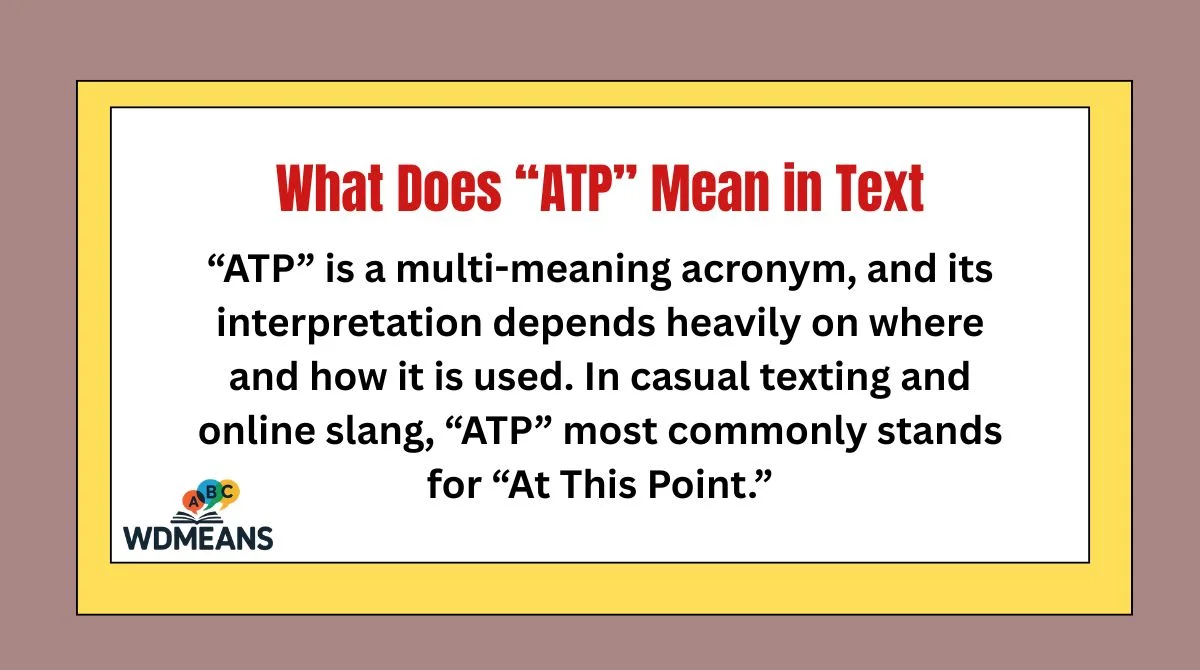
One such term that often leaves people confused is “ATP.” If you’ve seen it in messages, comments, or social media posts, you might wonder what it actually means.
People frequently search for this term because its meaning can change depending on context, making it tricky to interpret correctly.
“ATP” is a versatile abbreviation used across texting, social media platforms, and even professional fields like science and aviation.
Understanding its different meanings can help you avoid misunderstandings and communicate more effectively online.
Whether you’re chatting with friends, scrolling through TikTok, or encountering it in an academic context, knowing how to decode “ATP” is increasingly useful.
This article breaks down the meaning, origin, and various uses of “ATP,” helping you confidently understand and respond to it in any situation.
Meaning & Definition
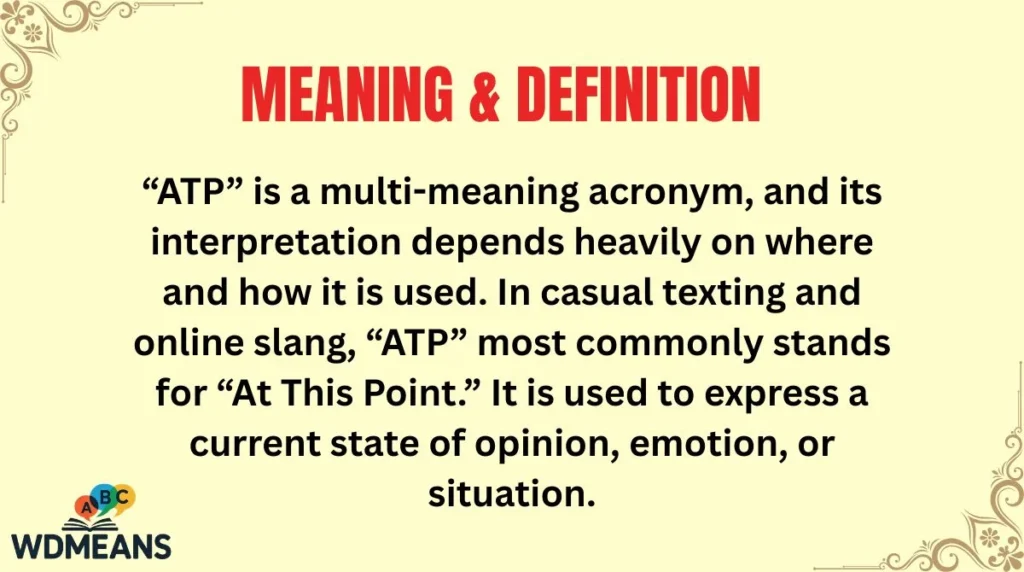
“ATP” is a multi-meaning acronym, and its interpretation depends heavily on where and how it is used. In casual texting and online slang, “ATP” most commonly stands for “At This Point.” It is used to express a current state of opinion, emotion, or situation. For example, someone might say, “ATP, I’m just tired of everything,” indicating how they feel right now.
However, outside of informal communication, “ATP” has completely different meanings. In science, it stands for Adenosine Triphosphate, a molecule that provides energy to cells. In aviation, it can mean Airline Transport Pilot, referring to a high-level pilot certification.
The key takeaway is that “ATP” is not limited to a single definition. Instead, it functions as a context-dependent abbreviation. When you see it, the surrounding conversation usually gives clues about which meaning is intended.
Background
The rise of “ATP” as a slang term is closely tied to the evolution of internet language. As texting and social media became dominant forms of communication, users began shortening phrases to save time and effort. “At This Point” naturally evolved into “ATP” as part of this trend.
Platforms like Twitter, TikTok, and Instagram played a major role in popularizing such abbreviations. Younger audiences, especially Gen Z users, adopted and spread these shorthand expressions quickly. Over time, “ATP” became a common phrase in online conversations, particularly when expressing frustration, resignation, or emphasis.
Meanwhile, the acronym already existed in scientific and professional fields long before it became slang. This overlap is why the term can sometimes be confusing—its modern casual usage is completely different from its traditional meanings.
Usage in Different Contexts
“ATP” is used differently depending on the setting. In casual conversations, it usually conveys emotion or opinion. For example, in a text message, someone might say, “ATP, I don’t even care anymore,” signaling frustration or acceptance.
On social media, it often appears in captions, comments, or memes. People use it to highlight a moment or emphasize a situation. For instance, a post might read, “ATP, life is just about surviving Monday,” adding humor or relatability.
In professional or academic contexts, however, “ATP” rarely means “At This Point.” Instead, it refers to specific technical terms. In biology, it’s essential for understanding cellular energy, while in aviation, it represents a certification level for pilots.
Because of this variation, it’s important to consider the environment in which the term is used. The same three letters can carry entirely different meanings depending on context.
Meaning in Chat, WhatsApp, Instagram, TikTok
In messaging apps like WhatsApp or platforms such as Instagram and TikTok, “ATP” almost always means “At This Point.” It is commonly used to express feelings, summarize a situation, or emphasize a conclusion.
For example:
- “ATP, I’m just going to stay home.”
- “ATP, nothing surprises me anymore.”
On TikTok, it often appears in captions or voiceovers, adding a dramatic or humorous tone. On Instagram, it might be used in stories or comments to react to events or trends.
The tone can vary—sometimes it’s serious, other times sarcastic or comedic. The flexibility of “ATP” is what makes it popular in digital communication.
Meaning in Physics, Medical, and Aircraft Terminology
Outside of casual use, “ATP” has precise meanings in technical fields.
In biology and medicine, ATP stands for Adenosine Triphosphate, a molecule that stores and transfers energy in cells. It is essential for processes like muscle contraction and metabolism.
In aviation, ATP refers to Airline Transport Pilot, the highest level of pilot certification. It indicates advanced training and qualification to operate commercial aircraft.
In physics and chemistry, ATP is studied in relation to energy transfer within living organisms.
These meanings are formal and unrelated to slang usage, highlighting the importance of context when interpreting the term.
Common Misconceptions
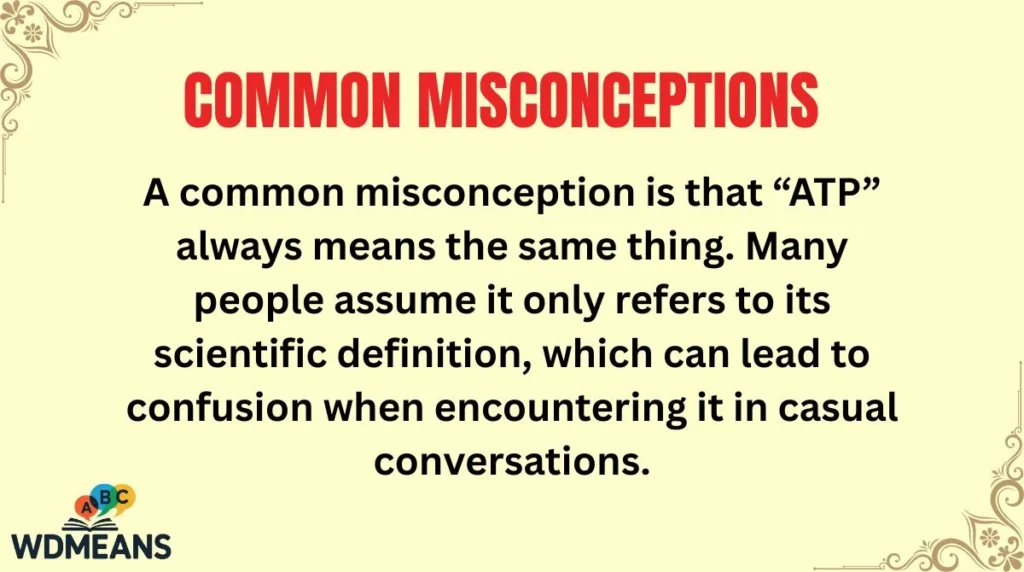
A common misconception is that “ATP” always means the same thing. Many people assume it only refers to its scientific definition, which can lead to confusion when encountering it in casual conversations.
Another misunderstanding is thinking it’s a typo or random letters. In reality, it’s a widely recognized abbreviation in digital communication.
Some also confuse it with other acronyms or assume it has a deeper hidden meaning, when often it’s simply a quick way to say “At This Point.”
Similar Terms & Alternatives
Several abbreviations convey similar meanings to “ATP” in texting:
- TBH (To Be Honest)
- IMO (In My Opinion)
- FR (For Real)
- SMH (Shaking My Head)
These terms, like “ATP,” help express thoughts quickly and efficiently. While they are not exact substitutes, they serve similar conversational purposes.
How to Respond to It
Responding to “ATP” depends on the tone of the message. If someone uses it to express frustration, a supportive reply works best, such as:
- “I get what you mean.”
- “Same here, honestly.”
If it’s used humorously, you can respond in a lighthearted way. The key is to match the tone and intent behind the message.
Differences from Similar Words
Unlike abbreviations like “TBH” or “IMO,” which introduce opinions, “ATP” emphasizes the current state of mind or situation. It focuses more on timing and perspective rather than just opinion.
For example:
- “TBH, I don’t like it” = honest opinion
- “ATP, I don’t like it” = current feeling after some experience
This subtle difference makes “ATP” unique in online communication.
Relevance in Online Conversations & Dating Apps
“ATP” is especially relevant in modern online interactions, including dating apps. People use it to express their current mindset or expectations. For example:
- “ATP, I’m just looking for something real.”
It helps convey emotions quickly, making conversations more efficient and relatable. Its casual tone also makes it suitable for informal interactions, where brevity is valued.
Conclusion
“ATP” is a versatile abbreviation with meanings that range from casual slang to technical terminology.
In most online conversations, it stands for “At This Point,” helping people express their current thoughts or feelings quickly.
However, its meaning can shift dramatically in scientific or professional contexts, where it represents important concepts like cellular energy or pilot certification.
Understanding “ATP” requires paying attention to context. Once you recognize how it’s used in different settings, it becomes much easier to interpret and respond appropriately.
As digital communication continues to evolve, abbreviations like “ATP” will remain an essential part of how people connect and express themselves online.

I am Alexander Hayes, creator of WDMEANS, dedicated to simplifying English learning through clear word meanings. I help learners improve vocabulary with easy, accurate, and practical explanations for everyday use online.