In today’s fast-paced digital world, abbreviations and acronyms have become a core part of communication. One such commonly used term is “LMS,” which often leaves people wondering about its exact meaning—especially when seen in text messages or social media.
The phrase can carry different meanings depending on context, making it both versatile and occasionally confusing.
People frequently search for what “LMS” means in text because it appears in chats, captions, comments, and even professional discussions.
Without understanding the context, it’s easy to misinterpret its intent. Whether you’ve seen it on Instagram, received it in a WhatsApp message, or encountered it in a workplace setting, knowing what it stands for can help you respond appropriately.
This article breaks down the meaning of “LMS,” explores its origins, explains how it’s used in various contexts, and helps you confidently understand and use it in everyday communication.
Meaning & Definition
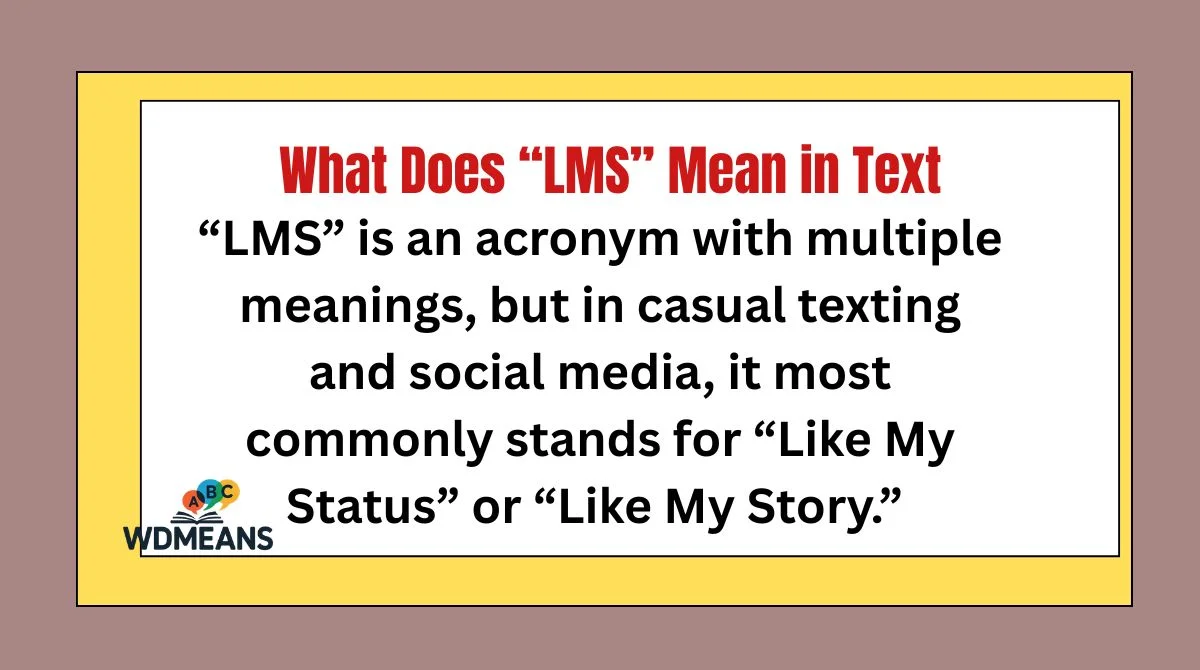
“LMS” is an acronym with multiple meanings, but in casual texting and social media, it most commonly stands for “Like My Status” or “Like My Story.” It is often used as a call-to-action, encouraging others to engage with a post or update.
For example:
- “LMS if you agree!”
- “LMS for a shoutout”
In these cases, the person is asking others to like their content, usually in exchange for something like attention, replies, or interaction.
Outside of informal communication, “LMS” can also stand for:
- Learning Management System (in education and corporate training)
- Last Man Standing (in gaming or competitions)
The key to understanding “LMS” lies in recognizing the context in which it is used. In texting or social media, it’s almost always about engagement, while in professional or technical settings, it carries a more formal meaning.
Background
The use of “LMS” grew alongside the rise of social media platforms where engagement metrics like likes, comments, and shares became highly valued. As users began competing for attention online, short acronyms like “LMS” emerged as quick ways to prompt interaction.
Initially popular on platforms like Facebook, “LMS” was often used in posts such as “LMS for a rate” or “LMS and I’ll message you.” Over time, it spread to other platforms including Instagram, Snapchat, and TikTok. Its simplicity made it easy to adopt, especially among younger users.
Meanwhile, the acronym had already existed in professional environments long before social media. In education and business, “LMS” referred to software systems used to manage courses, training programs, and learning materials.
This dual usage highlights how language evolves differently across communities. While one group uses it casually for engagement, another relies on it for structured, professional communication. Understanding this background helps explain why the same acronym can feel informal in one context and highly technical in another.
Usage in Different Contexts (Chat, Social Media, Professional Fields)
“LMS” is a flexible acronym that adapts to its environment. In casual chats, it is often used informally to encourage interaction. For instance, someone might text “LMS if you’re free tonight,” inviting responses indirectly through engagement.
On social media, the usage becomes more strategic. Users post “LMS” to increase visibility and engagement. It often appears in captions, stories, or comments to attract likes and responses. Influencers and regular users alike use it to boost interaction and maintain online presence.
In professional fields, however, “LMS” has a completely different meaning. It typically refers to a Learning Management System, which is software designed to deliver, track, and manage educational content. Companies use LMS platforms for employee training, while schools use them for online learning.
This variation shows how important context is. A teenager posting “LMS” on Instagram likely wants likes, while a manager mentioning “LMS” in a meeting is referring to a digital learning platform.
Meaning in Chat, WhatsApp, Instagram, TikTok
In messaging apps like WhatsApp, “LMS” is less common but still used occasionally in group chats or casual conversations. It typically retains its informal meaning, such as “Like My Status.”
On Instagram, “LMS” is widely used in stories and captions. For example:
- “LMS and I’ll DM you”
- “LMS for a follow back”
On TikTok, while not as dominant, it can still appear in captions or comments to encourage engagement. The goal remains the same: increasing likes and interaction.
Across all these platforms, the meaning is consistent—encouraging others to interact with content. However, the tone can vary from playful to promotional depending on how it is used.
Meaning in Physics, Medical, and Aircraft Terminology
Beyond social media, “LMS” carries specialized meanings in technical fields.
In physics, it may refer to concepts like Least Mean Squares, a mathematical method used in signal processing and data analysis.
In medical terminology, “LMS” can represent statistical parameters used in growth charts, referring to Lambda (skewness), Mu (median), and Sigma (variation). These are used to analyze data distributions in health studies.
In aviation, “LMS” might refer to systems or procedures depending on the organization, though it is less universally standardized compared to other fields.
These meanings are rarely encountered in everyday conversation, but they are important in academic and professional environments.
Common Misconceptions
One of the biggest misconceptions is that “LMS” always means “Like My Status.” While this is true in casual settings, it is not universally applicable.
Another misunderstanding is assuming it has a negative or spam-like intent. While it can sometimes feel promotional, many users simply use it to engage with friends or followers.
People also confuse “LMS” with other acronyms like “LOL” or “DM,” expecting it to have a single, fixed meaning. In reality, its meaning shifts depending on context.
Similar Terms & Alternatives
Several similar acronyms serve the same purpose as “LMS” in social media:
- “LB” – Like Back
- “F4F” – Follow for Follow
- “C4C” – Comment for Comment
- “SFS” – Shoutout for Shoutout
These terms all aim to increase engagement and interaction. While “LMS” focuses on likes, others may emphasize follows or comments.
How to Respond to It
Responding to “LMS” depends on your interest and relationship with the person.
If you want to engage, simply like the post or reply as requested. If it includes an offer like “LMS for a message,” you can participate and see what follows.
If you’re not interested, you can ignore it without any social obligation. In professional settings, if “LMS” refers to a system, respond accordingly by addressing the topic being discussed.
Differences from Similar Words
Unlike acronyms such as “LOL” (which expresses emotion), “LMS” is action-oriented. It asks for engagement rather than conveying a feeling.
Compared to “DM” (Direct Message), which suggests private communication, “LMS” is public and interaction-driven.
These differences highlight how each acronym serves a unique purpose in digital communication.
Relevance in Online Conversations & Dating Apps
In online conversations and dating apps, “LMS” is less common but still appears occasionally. It may be used to initiate interaction or test interest. For example, someone might post “LMS if you want to chat,” subtly inviting responses.
However, in dating contexts, more direct communication is usually preferred. While “LMS” can start engagement, meaningful conversations typically go beyond such prompts.
Conclusion
“LMS” is a versatile acronym with meanings that vary widely depending on context. In texting and social media, it commonly stands for “Like My Status,” serving as a simple way to boost engagement.
In professional and technical fields, it takes on entirely different meanings, such as Learning Management Systems or statistical models.
Understanding the context in which “LMS” is used is essential to interpreting it correctly. Whether you encounter it in a casual chat, a social media post, or a workplace discussion, recognizing its intended meaning allows you to respond appropriately.
As digital communication continues to evolve, acronyms like “LMS” will remain an important part of how people connect and interact online.

I am Alexander Hayes, creator of WDMEANS, dedicated to simplifying English learning through clear word meanings. I help learners improve vocabulary with easy, accurate, and practical explanations for everyday use online.