In today’s fast-paced digital world, abbreviations and slang dominate online communication. One such term that often leaves people confused is “IHY.”
If you’ve seen it in a message or on social media and wondered what it means, you’re not alone. Many users search for this term because its meaning can vary depending on context, tone, and relationship between people.
“IHY” is a short, informal expression commonly used in texting and online platforms. While it may look simple, it can carry different emotional tones—from affection to sarcasm.
Understanding it correctly helps avoid misunderstandings, especially in casual conversations or online interactions.
This article breaks down everything you need to know about “IHY,” including its definition, origins, different uses, and how to respond to it.
Whether you’re chatting with friends or exploring online slang, this guide will make the meaning of “IHY” clear and easy to understand.
Meaning & Definition
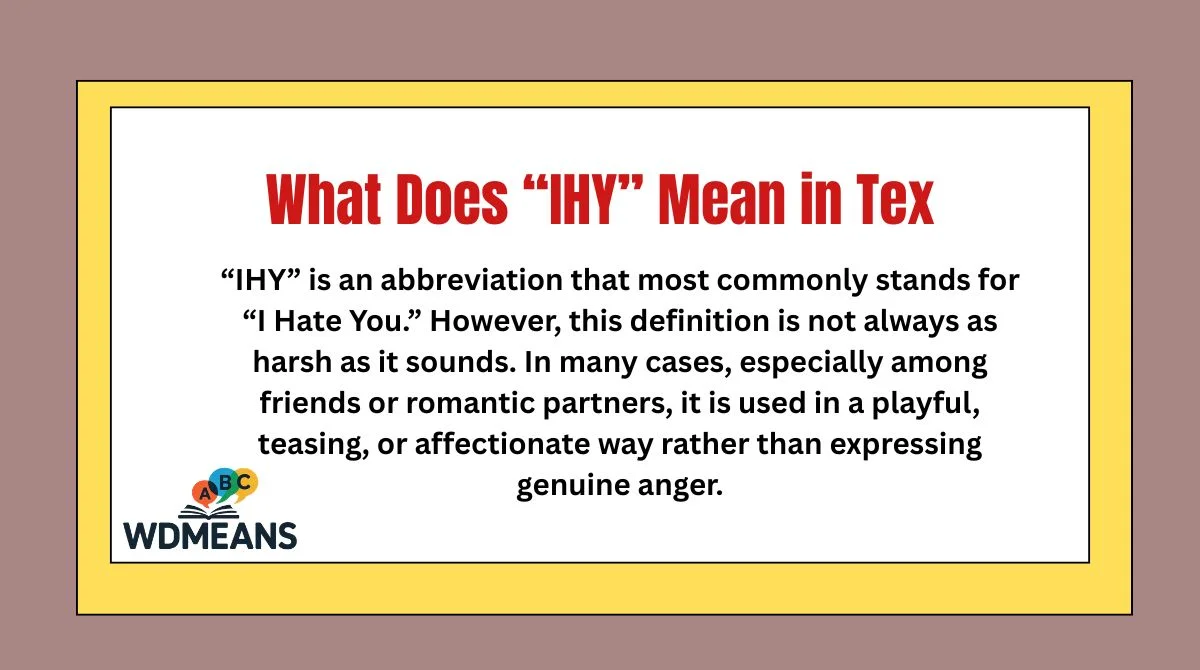
“IHY” is an abbreviation that most commonly stands for “I Hate You.” However, this definition is not always as harsh as it sounds. In many cases, especially among friends or romantic partners, it is used in a playful, teasing, or affectionate way rather than expressing genuine anger.
For example, if someone sends a funny or slightly annoying message, a reply like “IHY 😂” usually means “You’re so annoying (but in a fun way).” The tone is crucial here—without context, the phrase can easily be misunderstood.
In some situations, though, “IHY” can carry its literal meaning. If used during an argument or with no humor attached, it might actually express frustration or dislike. This is why understanding the relationship between the people involved and the overall conversation tone is essential.
In short, “IHY” is a flexible slang term:
- Literal meaning: I Hate You (serious or emotional context)
- Casual meaning: Playful annoyance or teasing
- Emotional tone: Depends heavily on emojis, punctuation, and context
Because of this dual meaning, it’s important not to jump to conclusions when you see it. Always consider the situation before interpreting it negatively.
Background
The rise of abbreviations like “IHY” is closely tied to the evolution of digital communication. As texting, instant messaging, and social media platforms became more popular, users began shortening phrases to communicate quickly and efficiently.
“IHY” likely emerged from the broader trend of using acronyms such as “LOL” (Laugh Out Loud), “BRB” (Be Right Back), and “ILY” (I Love You). Among these, “IHY” stands out because it contrasts with positive expressions like “ILY,” creating a playful or ironic tone.
The phrase gained popularity among younger audiences, especially teenagers and young adults, who often use humor and sarcasm in their conversations. Over time, it spread across platforms like messaging apps and social media, becoming part of everyday digital slang.
Interestingly, the use of “IHY” reflects how language evolves online. Words that once had strong negative meanings are often softened or reinterpreted in casual settings. This shift shows how tone and intent can completely change the meaning of a phrase.
Today, “IHY” is widely understood in informal communication, though its interpretation still depends on context and familiarity between speakers.
Usage in Different Contexts (Chat, Social Media, Professional Fields)
“IHY” is primarily used in informal communication, but its meaning can vary depending on where it appears.
Chat Conversations
In texting or private chats, “IHY” is often used between friends or partners. It typically conveys playful annoyance rather than actual anger. For example:
- “You ate my snacks again? IHY 😭”
This suggests humor rather than hostility.
Social Media
On platforms like Twitter, Instagram, or TikTok, “IHY” is often used in captions or comments. It can react to something relatable, funny, or mildly frustrating. For instance:
- “This video is too accurate… IHY 😂”
Here, it expresses amusement mixed with mock frustration.
Professional Fields
In professional settings, “IHY” is rarely appropriate. It can be misunderstood or seen as unprofessional, even if intended jokingly. Formal communication typically avoids slang to maintain clarity and respect.
Overall, the key takeaway is that “IHY” belongs in casual, friendly environments. Using it in formal contexts may lead to confusion or misinterpretation.
Meaning in Chat, WhatsApp, Instagram, TikTok
“IHY” is widely used across popular platforms, but its tone can shift slightly depending on the app.
Chat & WhatsApp
In messaging apps, it is often used among close contacts. Emojis usually accompany it to clarify tone:
- “IHY 😂” → playful
- “IHY.” → possibly serious
On Instagram, “IHY” appears in comments or captions. It’s commonly used to react to attractive photos, jokes, or relatable posts.
TikTok
On TikTok, it’s frequently used in comments when viewers find content funny, embarrassing, or too relatable. It often means “I can’t believe this, but it’s hilarious.”
Across all platforms, emojis and context are essential in determining whether the phrase is lighthearted or serious.
Meaning in Physics, Medical, and Aircraft Terminology
Unlike some abbreviations, “IHY” does not have widely recognized meanings in technical fields such as physics, medicine, or aviation.
- Physics: No standard scientific term abbreviated as “IHY.”
- Medical: Not commonly used in clinical or medical language.
- Aircraft/Aviation: No known aviation acronym matching “IHY.”
If “IHY” appears in these contexts, it is most likely being used informally rather than as a technical term.
Common Misconceptions
One major misconception is that “IHY” always means genuine hatred. In reality, it is often used jokingly. Misinterpreting it can lead to unnecessary confusion or conflict.
Another misunderstanding is assuming it’s appropriate everywhere. Using it in professional or formal communication can come across as rude or immature.
People also sometimes confuse it with similar abbreviations, leading to incorrect interpretations.
Similar Terms & Alternatives
There are several similar expressions that convey comparable emotions:
- ILY – I Love You
- IDC – I Don’t Care
- SMH – Shaking My Head
- UGH – Expressing frustration
These alternatives may be clearer depending on the situation and tone you want to convey.
How to Respond to It
Your response should depend on the context:
- Playful context:
“LOL, you love me really 😂” - Flirty context:
“Aww, IHY too ❤️” - Serious context:
“Did I do something wrong?”
Always match the tone of the sender to avoid misunderstandings.
Differences from Similar Words
“IHY” differs from phrases like “ILY” or “I dislike you” because it often carries irony or humor. Unlike direct statements, it relies heavily on tone and relationship context.
For example:
- “ILY” is always positive
- “IHY” can be positive or negative depending on usage
This dual nature makes it unique among texting abbreviations.
Relevance in Online Conversations & Dating Apps
“IHY” plays an interesting role in modern online communication, especially in dating apps. It can be used to flirt, tease, or build rapport. For example:
- “You didn’t text back all day… IHY 😒”
In this context, it adds a playful, emotional layer to the conversation. It can make interactions feel more casual and engaging, but only when both people understand the tone.
Misusing it, however, can create confusion, especially in early conversations where tone is harder to interpret.
Conclusion
“IHY” is a simple yet nuanced abbreviation that reflects the playful and evolving nature of online language.
While it literally means “I Hate You,” it is often used in a lighthearted, teasing way among friends and partners.
Understanding its meaning depends heavily on context, tone, and the relationship between the people involved.
As digital communication continues to evolve, expressions like “IHY” highlight how language adapts to fit fast, informal interactions.
By recognizing when it’s playful and when it might be serious, you can use and interpret it more effectively.
Whether you encounter it in chats, social media, or casual conversations, knowing its meaning ensures smoother communication and avoids misunderstandings.

I am Alexander Hayes, creator of WDMEANS, dedicated to simplifying English learning through clear word meanings. I help learners improve vocabulary with easy, accurate, and practical explanations for everyday use online.