In today’s fast-paced digital world, abbreviations and slang dominate online conversations. One such commonly used shorthand is “DK.”
If you’ve ever come across this term in a message and felt unsure about its meaning, you’re not alone. People search for “what does DK mean in text” because it can carry different interpretations depending on context, platform, and tone.
“DK” is a flexible abbreviation used across texting, social media, gaming, and even professional settings. Its meaning can shift from casual expressions to technical terminology, making it important to understand how and where it’s being used.
Whether you’re chatting with friends, scrolling through social media, or encountering it in a specialized field, knowing what “DK” stands for can help you respond appropriately and avoid confusion.
This guide breaks down its meanings, origins, usage across platforms, and how to interpret it correctly in different situations.
Meaning & Definition
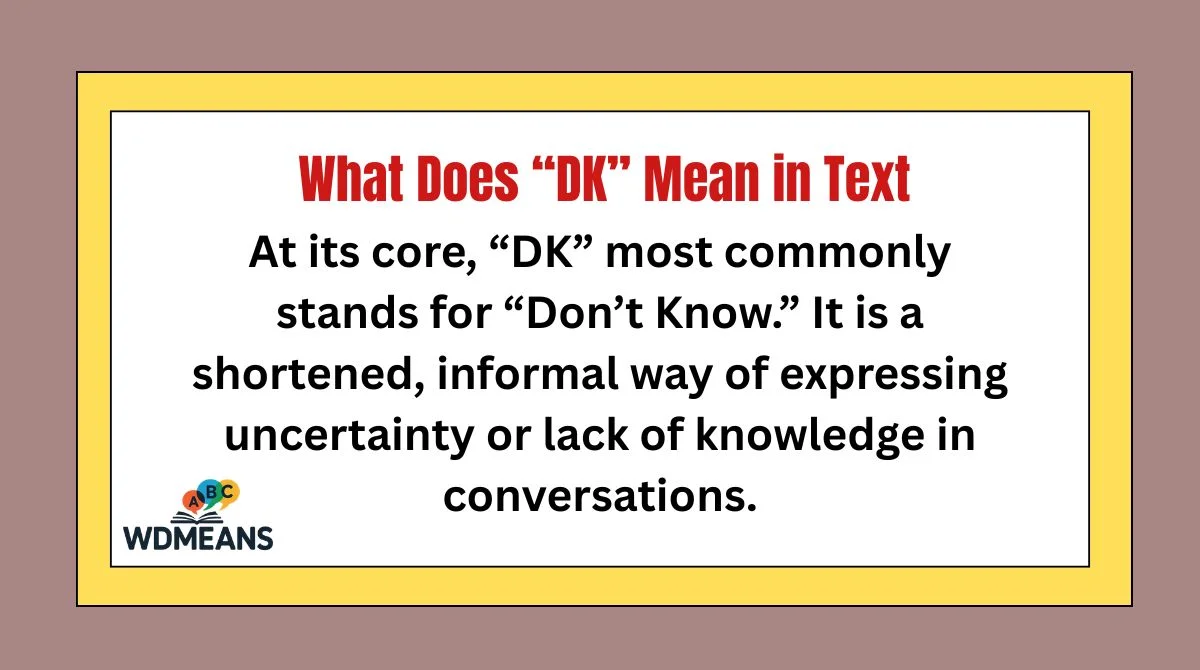
At its core, “DK” most commonly stands for “Don’t Know.” It is a shortened, informal way of expressing uncertainty or lack of knowledge in conversations. Instead of typing a full sentence like “I don’t know,” users prefer “DK” for speed and convenience.
However, “DK” is not limited to a single definition. Depending on context, it may also mean:
- “Donkey Kong” (in gaming discussions)
- “Dark Knight” (in entertainment or fandom conversations)
- Initials or shorthand for names or places
The meaning is usually determined by the surrounding conversation. For example:
- “What time is the meeting?” → “DK” clearly means “Don’t Know”
- “I love DK in that game!” → likely refers to a character
Because of its brevity, “DK” relies heavily on context clues. Without them, it can sometimes lead to confusion.
Background
The use of abbreviations like “DK” emerged alongside the rise of SMS texting and early internet chatrooms. Limited character counts and slow typing speeds encouraged users to shorten common phrases.
Over time, shorthand expressions became a standard part of digital communication. As messaging platforms evolved—such as WhatsApp, Instagram, and TikTok—these abbreviations carried over and became even more widespread.
“DK” gained popularity because it represents a universal human response: uncertainty. It’s simple, quick, and easily understood among frequent texters. Today, it is part of a broader language of internet slang that includes terms like “IDK” (I don’t know) and “BRB” (be right back).
Usage in Different Contexts
General Chat & Social Media
In everyday texting and casual conversations, “DK” is used to express uncertainty:
- “Are you coming tonight?” → “DK yet”
It is informal and typically used among friends or peers.
Professional Fields
In professional settings, “DK” is rarely used in formal communication. However, in quick internal chats or notes, it may appear as shorthand. Still, professionals often prefer clearer phrases like “uncertain” or “not confirmed.”
Meaning in Chat, WhatsApp, Instagram, TikTok
Across platforms, “DK” mostly retains its meaning as “Don’t Know,” but usage style varies:
- WhatsApp: Used in personal chats, often casually
- Instagram: Seen in comments or replies, sometimes paired with emojis
- TikTok: May appear in captions or comments, often in a humorous or sarcastic tone
Examples:
- “Why did that happen?” → “DK 😂”
- “DK what’s going on here”
Tone plays a big role—sometimes it’s serious, other times playful or dismissive.
Meaning in Physics, Medical, and Aircraft Terminology
Outside casual texting, “DK” can take on technical meanings:
- Physics: Sometimes used as shorthand for specific variables or constants (though not universally standard)
- Medical Field: May appear as initials for terms, patient notes, or abbreviations (context-dependent)
- Aircraft/Aviation: Could represent airport codes, model abbreviations, or internal shorthand
In these fields, “DK” is not slang but a domain-specific abbreviation. Interpretation requires subject knowledge.
Common Misconceptions
One major misconception is assuming “DK” always means “Don’t Know.” While that’s the most common usage, it’s not universal.
Other misunderstandings include:
- Thinking it’s a typo of “IDK”
- Misinterpreting it as a name or brand
- Confusing it with unrelated abbreviations
Context is key—without it, the meaning can easily be misread.
Similar Terms & Alternatives
Several similar abbreviations are often used interchangeably:
- IDK: I don’t know (more explicit version)
- IDC: I don’t care
- IK: I know
- IDTS: I don’t think so
Among these, “IDK” is the closest and more commonly used alternative.
How to Respond to It
When someone replies with “DK,” your response depends on the situation:
- Ask for clarification: “Let me know when you find out.”
- Provide information: “It’s at 7 PM, just confirmed.”
- Acknowledge uncertainty: “No worries, we’ll figure it out.”
Avoid overanalyzing—it usually just means the person doesn’t have an answer yet.
Differences from Similar Words
“DK” vs “IDK”:
- “DK” is shorter and less formal
- “IDK” is clearer and more widely understood
“DK” vs “IDC”:
- “DK” = lack of knowledge
- “IDC” = lack of interest
These small differences can significantly change the tone of a conversation.
Relevance in Online Conversations & Dating Apps
In online conversations and dating apps, “DK” can signal uncertainty, hesitation, or casual engagement. For example:
- “What are you looking for?” → “DK yet”
This may indicate someone is unsure, exploring options, or not ready to commit to a clear answer.
It can also reflect a relaxed communication style, especially in early-stage conversations where people prefer low-pressure responses.
Conclusion
“DK” is a simple yet versatile abbreviation that plays a significant role in modern digital communication. While it most commonly means “Don’t Know,” its meaning can shift depending on context, platform, and field of use.
Understanding how to interpret and respond to it helps avoid confusion and improves communication clarity.
As online language continues to evolve, abbreviations like “DK” remain essential tools for quick and efficient interaction.
Whether you’re chatting casually or navigating social media, recognizing its meaning ensures smoother, more effective conversations.

I am Alexander Hayes, creator of WDMEANS, dedicated to simplifying English learning through clear word meanings. I help learners improve vocabulary with easy, accurate, and practical explanations for everyday use online.