In today’s fast-paced digital world, abbreviations and slang dominate online communication. One such term that frequently appears in texts, chats, and social media is “IDGAF.”
Many people search for its meaning because they encounter it in casual conversations and want to understand its tone and intent.
Whether you’re scrolling through Instagram, chatting on WhatsApp, or reading comments on TikTok, this acronym can seem confusing or even offensive at first glance.
Understanding what it means—and when it’s appropriate to use—is important for navigating modern communication effectively.
This article breaks down the meaning, origin, usage, and nuances of IDGAF in a clear and structured way, helping you grasp not only its definition but also how it fits into different contexts, including professional and technical misunderstandings.
Meaning & Definition
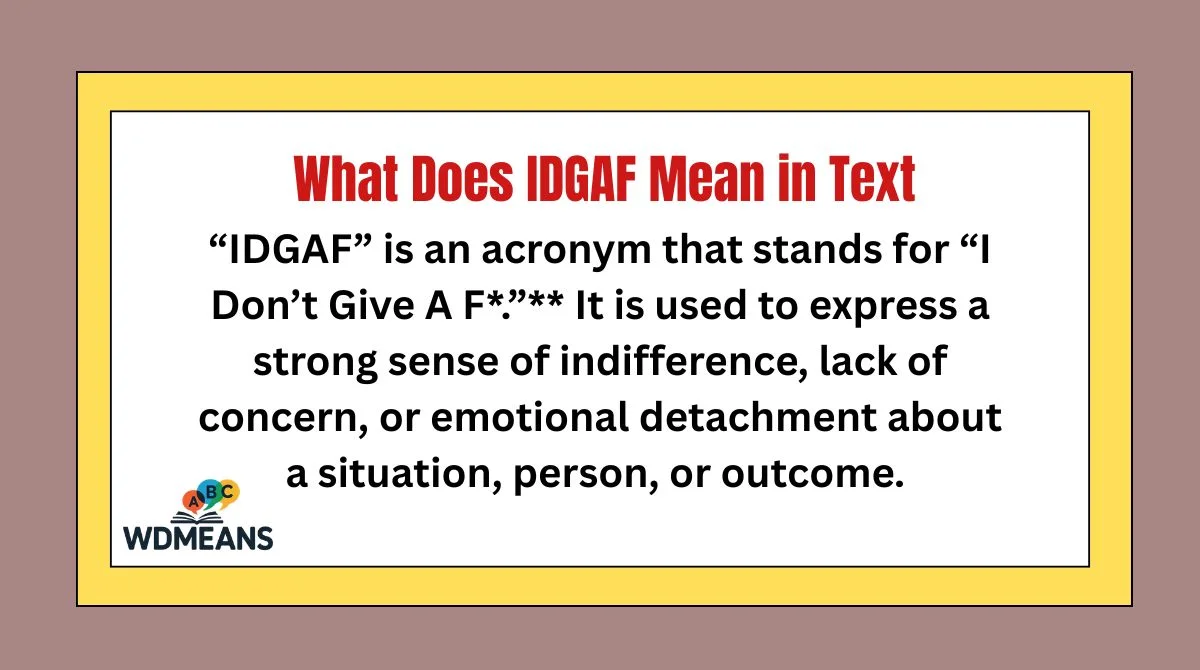
“IDGAF” is an acronym that stands for “I Don’t Give A F*.”** It is used to express a strong sense of indifference, lack of concern, or emotional detachment about a situation, person, or outcome. The phrase is intentionally blunt and often carries a bold or rebellious tone.
People typically use IDGAF when they want to show that something does not matter to them at all. It can reflect confidence, frustration, or even defiance depending on how it is used. For example, someone might use it to signal that they are unaffected by criticism or uninterested in others’ opinions.
Despite its popularity, the phrase includes profanity, which makes it informal and sometimes inappropriate in certain settings. Its tone can vary from humorous to aggressive, so understanding context is essential.
Background
The rise of IDGAF is closely linked to the growth of internet culture and texting habits. As communication shifted toward shorter, faster formats, acronyms became a convenient way to express complex emotions quickly.
The phrase itself has roots in casual spoken English long before it became an acronym. However, it gained popularity with the expansion of SMS messaging, online forums, and later social media platforms. Over time, it became a widely recognized expression among younger generations, especially in digital environments.
Music, pop culture, and influencers have also played a role in popularizing the term. Its edgy tone makes it appealing for expressing independence or boldness, which resonates strongly in modern online culture.
Usage in Different Contexts
IDGAF is used across various communication platforms, but its appropriateness depends heavily on the setting.
In casual chats with friends, it is often used humorously or to emphasize a carefree attitude. On social media, it may appear in captions, comments, or memes to convey confidence or disregard for negativity.
However, in professional fields, the use of IDGAF is generally discouraged. Its explicit language can be seen as disrespectful or unprofessional. In workplace communication, more neutral expressions are preferred to maintain professionalism.
In online communities, the tone can shift depending on the audience. Among peers, it may feel relatable, while in formal or mixed groups, it might come across as rude or insensitive.
Meaning in Chat, WhatsApp, Instagram, TikTok
On messaging apps like WhatsApp or in direct chats, IDGAF is usually used casually among friends. It often appears in responses like “IDGAF about what they said,” indicating indifference.
On Instagram, it is commonly used in captions to project confidence or a carefree lifestyle. For example, someone might use it to show they are unaffected by criticism or judgment.
TikTok users often incorporate the term in videos or comments to emphasize bold attitudes or humorous indifference. The tone here is often exaggerated for entertainment.
Overall, in these platforms, IDGAF is less about literal meaning and more about expressing attitude—confidence, rebellion, or emotional detachment.
Meaning in Physics, Medical, and Aircraft Terminology
Interestingly, IDGAF does not have any recognized meaning in formal fields like physics, medicine, or aviation. It is purely an informal internet slang term.
In technical disciplines, acronyms are usually standardized and carefully defined. IDGAF does not appear in scientific literature, medical terminology, or aircraft communication systems.
If encountered in such contexts, it is almost certainly being used informally or humorously rather than as a technical term. Misinterpreting it as a professional acronym can lead to confusion.
Common Misconceptions
One common misconception is that IDGAF always implies rudeness. While it can sound harsh, it is sometimes used playfully among friends.
Another misunderstanding is assuming it can be used in any setting. In reality, its explicit nature makes it unsuitable for formal communication.
Some people also believe it has multiple technical meanings, but as mentioned earlier, it is strictly slang and not used in professional jargon.
Similar Terms & Alternatives
There are several alternatives to IDGAF that convey similar meanings with varying levels of intensity:
- “I don’t care” – neutral and widely acceptable
- “Whatever” – casual and slightly dismissive
- “No big deal” – softer and more polite
- “It doesn’t matter to me” – formal and respectful
These alternatives are often better choices in situations where professionalism or politeness is important.
How to Respond to It
Responding to IDGAF depends on the context and tone. If it is used jokingly, a lighthearted reply works well. For example, you might respond with humor or continue the conversation casually.
If it feels dismissive or negative, it is best to stay calm and not escalate the situation. You can acknowledge the statement or redirect the conversation.
In professional settings, it is advisable to avoid engaging with such language and instead maintain a respectful tone.
Differences from Similar Words
While IDGAF and phrases like “I don’t care” may seem similar, the difference lies in tone and intensity. IDGAF is much stronger and more emotionally charged due to its explicit wording.
“I don’t care” can be neutral or polite depending on delivery, whereas IDGAF often conveys boldness, frustration, or defiance.
Understanding these differences helps in choosing the right expression for the right situation.
Relevance in Online Conversations & Dating Apps
In online conversations, IDGAF is often used to project confidence or independence. It can signal that someone is not easily प्रभावित by opinions or criticism.
On dating apps, however, its use can be tricky. While some may find it आकर्षक as a sign of confidence, others may interpret it as rude or uninterested. Tone and context play a significant role in how it is perceived.
Using such language sparingly and thoughtfully is key to making a positive impression.
Conclusion
IDGAF is a popular internet acronym that expresses strong indifference or lack of concern. While it is widely used in casual conversations and social media, its explicit nature makes it unsuitable for professional settings.
Understanding its meaning, tone, and context helps avoid misunderstandings and ensures effective communication.
Whether you choose to use it or not, being aware of its implications allows you to navigate modern digital language with confidence and clarity.

I am Alexander Hayes, creator of WDMEANS, dedicated to simplifying English learning through clear word meanings. I help learners improve vocabulary with easy, accurate, and practical explanations for everyday use online.