In today’s fast-paced digital world, abbreviations and slang dominate everyday communication. One such commonly used term is “IDC.”
If you’ve come across it in a text message, social media comment, or online chat, you might have wondered what it actually means and why people use it so often.
Understanding modern abbreviations like this is important because they shape how people express emotions, opinions, and attitudes in a quick and efficient way.
People search for the meaning of “IDC” mainly because it can appear blunt, confusing, or even rude depending on the context.
Without tone or facial expressions, short forms like this can easily be misunderstood. This article breaks down the meaning of “IDC,” explores its origins, explains how it’s used in different contexts, and helps you respond appropriately.
By the end, you’ll not only understand what it means but also when and how to use it effectively.
Meaning & Definition
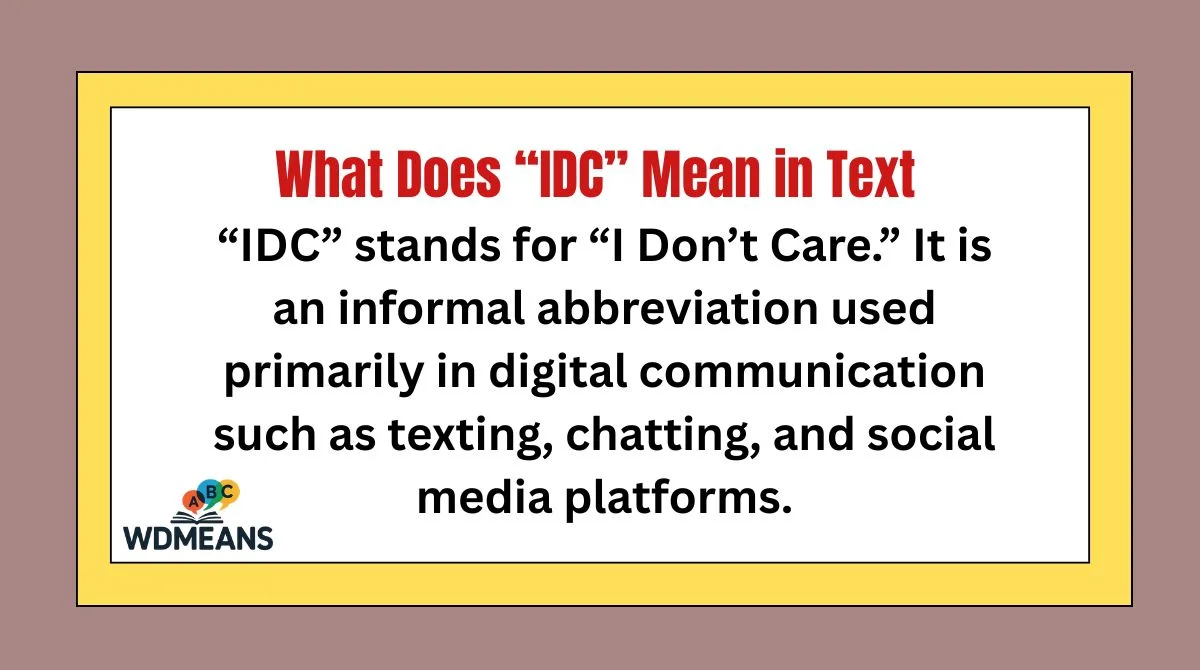
“IDC” stands for “I Don’t Care.” It is an informal abbreviation used primarily in digital communication such as texting, chatting, and social media platforms. The phrase expresses indifference, lack of interest, or neutrality toward a topic, decision, or situation.
At its core, “IDC” conveys that the speaker has no strong opinion or emotional investment. For example, if someone asks, “Where should we eat?” and the reply is “IDC,” it simply means the person has no preference.
However, tone plays a crucial role. While it can sound neutral in some cases, it may also come across as dismissive or rude if used without context or politeness. For instance, replying “IDC” to a serious concern might signal disinterest or emotional distance.
The simplicity of the abbreviation is what makes it popular. It reduces a three-word phrase into just three letters, saving time and effort—especially in fast-paced conversations. Despite its brevity, the emotional interpretation can vary widely depending on how and where it’s used.
In short, “IDC” is a powerful but blunt expression of indifference that should be used carefully to avoid misunderstandings.
Background
The use of abbreviations like “IDC” dates back to the early days of internet communication, particularly during the rise of SMS texting and online chat rooms in the late 1990s and early 2000s. At that time, character limits and slow typing speeds encouraged users to shorten phrases wherever possible.
As texting culture evolved, abbreviations became a standard part of digital language. Terms like “LOL,” “BRB,” and “IDK” gained popularity alongside “IDC.” Over time, these shortcuts moved beyond necessity and became part of everyday casual communication, especially among younger users.
The growth of social media platforms further accelerated the spread of such abbreviations. Quick replies, comment sections, and messaging apps all favored shorter expressions that conveyed meaning instantly. “IDC” fit perfectly into this trend because it was simple, direct, and easy to understand.
Interestingly, while the abbreviation originated from practicality, it has developed social and emotional layers over time. Today, it’s not just about saving time—it’s also about expressing attitude. Depending on how it’s used, “IDC” can signal confidence, indifference, sarcasm, or even frustration.
Thus, what started as a typing shortcut has evolved into a nuanced expression shaped by digital culture and human interaction.
Usage in Different Contexts (Chat, Social Media, Professional Fields)
“IDC” is used differently depending on the environment and audience.
In casual chats, it often reflects neutrality. For example, among friends, saying “IDC” about a movie choice usually means flexibility. It’s a convenient way to show you’re open to suggestions without overthinking.
On social media, the tone can shift. People might use “IDC” to express bold opinions or disregard for criticism. For example, someone posting a controversial opinion might add “IDC what anyone thinks,” signaling confidence or defiance.
In professional settings, however, “IDC” is rarely appropriate. It can appear unprofessional or dismissive. Instead of using abbreviations, people are expected to communicate more thoughtfully, such as saying, “I don’t have a preference” or “I’m okay with either option.”
In online forums or gaming communities, “IDC” can be used casually but may sometimes come off as blunt or uncooperative, depending on the tone of the conversation.
Overall, while “IDC” is widely accepted in informal communication, its use should be avoided or carefully considered in formal or professional contexts.
Meaning in Chat, WhatsApp, Instagram, TikTok
Across popular platforms, “IDC” maintains the same core meaning but carries different tones.
- Chat & WhatsApp: Usually neutral or casual. It often means “I’m fine with anything” or “It doesn’t matter to me.”
- Instagram: Can be expressive or attitude-driven. People use it in captions or comments to show confidence or indifference toward opinions.
- TikTok: Often used humorously or dramatically, sometimes exaggerating indifference for entertainment.
Because these platforms rely heavily on tone, emojis, and context, “IDC” can feel playful in one situation and harsh in another. Adding emojis or extra words can soften its impact.
Meaning in Physics, Medical, and Aircraft Terminology
Interestingly, “IDC” also has meanings outside casual texting:
- Physics: It can stand for “Insulation Displacement Connector,” used in electrical systems.
- Medical: Sometimes refers to “Infectious Disease Control” or related terms depending on context.
- Aircraft/Aviation: It may refer to technical components or systems, though usage varies by field.
These meanings are entirely unrelated to the texting abbreviation, so context is essential to avoid confusion.
Common Misconceptions
A common misunderstanding is that “IDC” always sounds rude. While it can be blunt, it’s not inherently negative. In friendly conversations, it often simply shows flexibility.
Another misconception is that it means someone is completely uninterested in everything. In reality, it usually applies to a specific situation or choice.
People also sometimes confuse it with similar abbreviations like “IDK” (I don’t know), which has a different meaning entirely.
Similar Terms & Alternatives
There are several alternatives to “IDC,” depending on tone and context:
- “Whatever works”
- “I’m okay with anything”
- “No preference”
- “Doesn’t matter to me”
- “Up to you”
These alternatives can sound more polite and are often better suited for formal or sensitive situations.
How to Respond to It
Responding to “IDC” depends on the context:
- If it’s casual, simply proceed with your choice.
- If it feels dismissive, you might ask for clarification.
- If it seems rude, respond calmly and steer the conversation positively.
For example, replying with “Alright, I’ll decide then” keeps things smooth and avoids conflict.
Differences from Similar Words
“IDC” differs from similar abbreviations:
- IDK (I Don’t Know): Expresses uncertainty, not indifference.
- IMO (In My Opinion): Shares a viewpoint rather than dismissing one.
- NVM (Never Mind): Indicates withdrawal from a topic.
Understanding these differences helps avoid confusion in conversations.
Relevance in Online Conversations & Dating Apps
In online conversations and dating apps, “IDC” can significantly affect tone. While it may signal easygoing behavior, it can also come across as uninterested or emotionally distant.
For example, replying “IDC” to a question on a dating app might make the other person feel undervalued. In such settings, it’s better to show engagement by giving thoughtful responses.
Used carefully, it can suggest flexibility—but overuse may reduce perceived interest.
Conclusion
“IDC” is a simple yet powerful abbreviation that means “I don’t care.” While it originated as a practical shortcut in early digital communication, it has evolved into an expression of attitude, emotion, and personality.
Its meaning can range from neutral indifference to blunt dismissal, depending on context and tone.
Understanding when and how to use “IDC” is essential for effective communication, especially in today’s digital world where messages lack vocal cues.
While it works well in casual settings, it should be used cautiously in professional or sensitive conversations. By choosing the right context and tone, you can avoid misunderstandings and communicate more clearly.

I am Alexander Hayes, creator of WDMEANS, dedicated to simplifying English learning through clear word meanings. I help learners improve vocabulary with easy, accurate, and practical explanations for everyday use online.