In today’s fast-paced digital world, abbreviations and slang dominate how people communicate online. One such term that frequently appears across messages, forums, and social media platforms is “OP.”
If you’ve ever come across this abbreviation and felt unsure about its meaning, you’re not alone. Many people search for its definition because it can carry different meanings depending on the context in which it’s used.
Understanding what “OP” means in text is important for effective communication, especially when interacting on platforms like messaging apps, discussion boards, or even professional spaces.
Misinterpreting it can lead to confusion or awkward responses. This article provides a clear and structured explanation of the term, covering its origins, multiple meanings, and how to use or respond to it correctly in various situations.
Meaning & Definition
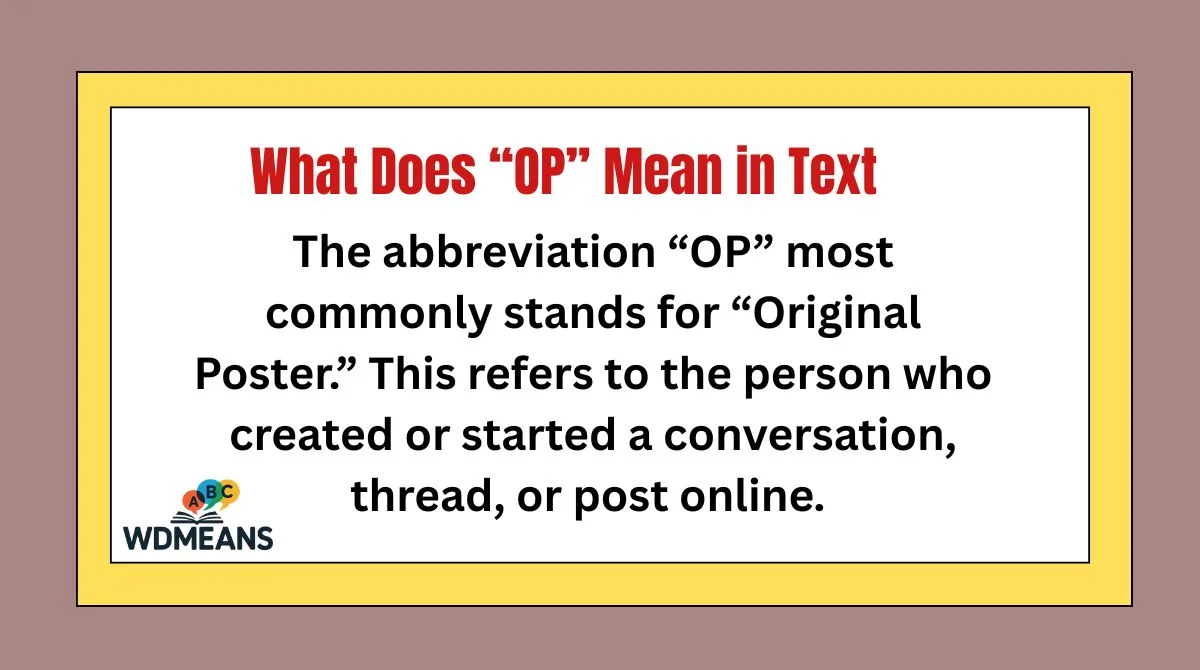
The abbreviation “OP” most commonly stands for “Original Poster.” This refers to the person who created or started a conversation, thread, or post online. For example, in forums or comment sections, users may say, “I agree with OP,” meaning they agree with the person who initiated the discussion.
However, “OP” is not limited to just one meaning. In different contexts, it can also mean:
- Overpowered (commonly used in gaming)
- Opening (in entertainment, such as TV shows or anime)
- Operation (in medical or technical fields)
Because of this variety, the correct interpretation depends entirely on where and how the term is used.
In simple terms, “OP” is a flexible abbreviation that acts as shorthand to save time and effort while communicating. Its meaning becomes clear when you consider the surrounding conversation.
Background
The use of “OP” originated primarily in online forums and early internet communities. Platforms like discussion boards and message boards required users to refer to the person who started a thread without repeating usernames. Over time, “Original Poster” became a convenient shorthand.
As internet culture expanded, especially with the rise of social media and gaming communities, the abbreviation spread widely. Gamers adopted “OP” to describe characters or weapons that were too strong, calling them “overpowered.” Meanwhile, other industries and communities began using the same abbreviation for their own purposes.
The evolution of “OP” highlights how language adapts in digital environments. What began as a simple reference term has grown into a multi-meaning abbreviation used globally across different fields and platforms.
Usage in Different Contexts (Chat, Social Media, Professional Fields)
In everyday communication, “OP” is used differently depending on the platform:
- Online forums and Reddit-style discussions: It almost always means “Original Poster.”
- Gaming communities: It refers to something being “overpowered.”
- Professional settings: It may stand for “operation” or be part of technical terminology.
In casual chat, people rely on context rather than formal definitions. For example, in a work email, “OP” might refer to an operation or project, while in a gaming chat, it clearly means something is too strong.
Understanding the context is key. Without it, the same two letters can lead to completely different interpretations.
Meaning in Chat, WhatsApp, Instagram, TikTok
On messaging apps and social media platforms, “OP” is commonly used in casual ways:
- WhatsApp & texting: Often means “Original Poster” when discussing shared posts or forwarded content.
- Instagram comments: Used to refer to the person who posted the content.
- TikTok: Can refer to the creator of a video or sometimes describe something impressive (“That move was OP!”).
In these environments, the tone is informal, and the meaning is usually easy to guess from the conversation. Younger users, in particular, use “OP” creatively, sometimes blending meanings depending on the situation.
Meaning in Physics, Medical, and Aircraft Terminology
Outside casual communication, “OP” has more technical meanings:
- Physics: It can stand for “optical power,” which relates to lenses and light measurement.
- Medical field: “OP” often refers to “operation” or “operative procedure.” It may also appear in terms like “OPD” (Outpatient Department).
- Aircraft and aviation: It can mean “operational” or relate to flight procedures and systems.
In these contexts, the abbreviation is used formally, and its meaning is usually defined within professional documentation or communication.
Common Misconceptions
One common misconception is that “OP” always means “overpowered.” While this is true in gaming, it’s not the default meaning in most conversations.
Another misunderstanding is assuming it refers to a specific person or username. In reality, it simply describes the role of the person who started the discussion.
People also sometimes confuse “OP” with similar abbreviations like “OG” (original gangster) or “OTP” (one true pairing), which have entirely different meanings.
Similar Terms & Alternatives
Several terms are similar to “OP” depending on the context:
- Thread starter – used in forums instead of “Original Poster”
- Author – more formal alternative
- Creator – common on social media
- Poster – shortened version
In gaming:
- Broken – similar to “overpowered”
- Too strong – simpler phrasing
Choosing the right alternative depends on the tone and platform you’re using.
How to Respond to It
Responding to “OP” depends on how it’s being used:
- If someone refers to you as “OP,” they’re acknowledging you as the creator—no special response is required.
- If it’s used in gaming (“That character is OP”), you can agree, disagree, or discuss balance.
- In professional contexts, clarify if unsure: “Do you mean operation?”
The safest approach is to interpret the context before replying.
Differences from Similar Words
“OP” differs from similar abbreviations in both meaning and usage:
- OP vs OG: OP refers to a role or strength; OG refers to originality or seniority.
- OP vs Admin: OP is the content creator, while an admin manages the platform.
- OP vs Author: “Author” is formal; “OP” is casual and internet-specific.
Understanding these differences helps avoid confusion in conversations.
Relevance in Online Conversations & Dating Apps
In online conversations, “OP” helps streamline communication. It allows users to refer to the original speaker without repeating names, making discussions more efficient.
On dating apps, it’s less commonly used but may appear in shared content discussions or memes. In such cases, it still typically means “Original Poster.”
Its relevance continues to grow as digital communication evolves, making it a useful term to understand for anyone active online.
Conclusion
“OP” is a versatile abbreviation with multiple meanings depending on context. While it most commonly stands for “Original Poster,” it can also mean “overpowered,” “operation,” or other technical terms.
Its widespread use across social media, gaming, and professional fields makes it an essential part of modern digital language.
By understanding its different meanings and contexts, you can communicate more clearly and avoid misunderstandings.
Whether you’re chatting with friends, engaging in online discussions, or navigating professional environments, knowing how to interpret and use “OP” effectively is a valuable skill.

I am Alexander Hayes, creator of WDMEANS, dedicated to simplifying English learning through clear word meanings. I help learners improve vocabulary with easy, accurate, and practical explanations for everyday use online.