In today’s fast-paced digital world, communication has become shorter, quicker, and more expressive.
Abbreviations and acronyms dominate texting, social media, and online conversations, making it easier to convey emotions in just a few characters.
One such commonly used abbreviation is “TYSM.” Many people encounter it in chats or comments and wonder what it means and how to use it properly.
Understanding these shorthand expressions is essential, especially for staying connected in modern conversations.
Whether you’re chatting with friends, scrolling through social media, or exploring online communities, knowing the meaning of “TYSM” helps you interpret messages accurately and respond appropriately.
This article explores the full meaning, background, and usage of this popular abbreviation across different contexts, ensuring you can use it confidently and correctly in your daily communication.
Meaning & Definition
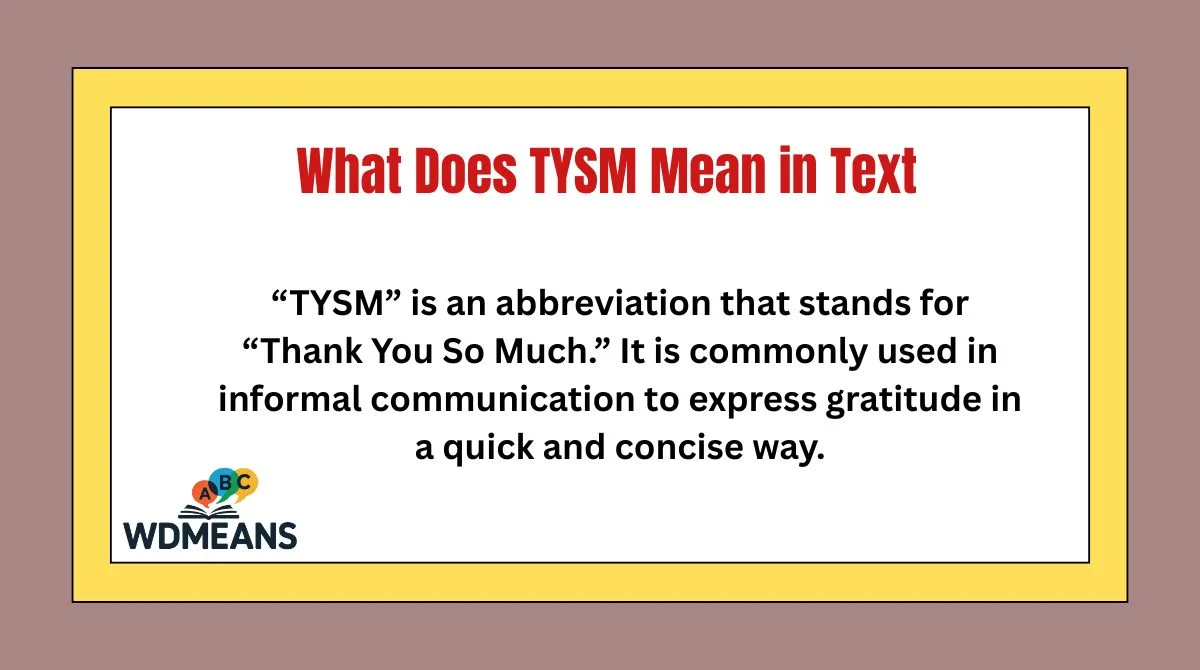
“TYSM” is an abbreviation that stands for “Thank You So Much.” It is commonly used in informal communication to express gratitude in a quick and concise way. Instead of typing out the full phrase, users shorten it to save time and effort while still conveying appreciation.
The phrase carries a warm and positive tone. While it is brief, it still communicates genuine thanks, making it widely accepted in casual conversations. People often use it when they feel appreciative but want to keep their message short, especially in fast-moving chats.
Unlike a simple “thanks,” “TYSM” emphasizes stronger gratitude. The inclusion of “so much” adds emotional depth, making it feel more heartfelt even in its abbreviated form. However, the tone can vary slightly depending on context—sometimes it may sound enthusiastic, while in other cases it might feel casual or routine.
It is important to note that “TYSM” is primarily used in informal settings. While it is widely understood, it may not always be suitable for formal or professional communication where full phrases are preferred.
Background
The rise of abbreviations like “TYSM” can be traced back to the early days of texting and internet chat rooms. When mobile phones had limited character counts and slower typing systems, users began shortening common phrases to communicate more efficiently.
Over time, this habit evolved into a digital language of its own. Acronyms such as “LOL,” “BRB,” and “OMG” became widely recognized, and “TYSM” naturally followed as a convenient way to express gratitude.
Social media platforms further accelerated its popularity. As communication shifted to apps and instant messaging, speed became even more important. Users adopted abbreviations not just for convenience but also as part of online culture and identity.
Today, “TYSM” is widely used across different age groups, though it remains most popular among younger audiences who are more accustomed to digital slang. It reflects how language evolves alongside technology, adapting to new forms of communication.
Usage in Different Contexts
“TYSM” is versatile and appears in various communication settings, though its tone remains casual. In personal chats, it is often used to thank friends or family for small favors, kind gestures, or helpful information.
On social media, it is frequently seen in comments and replies. For example, someone might use it to thank followers for support, compliments, or engagement. It helps maintain a friendly and approachable tone without requiring long responses.
In online communities, such as forums or gaming platforms, “TYSM” is used to quickly acknowledge help or advice. It keeps conversations flowing without interrupting the pace.
However, in professional environments, its use is limited. While it might occasionally appear in informal workplace chats or team messaging apps, it is generally better to use full expressions like “Thank you very much” in emails or formal communication to maintain professionalism.
Meaning in Chat, WhatsApp, Instagram, TikTok
Across popular platforms, “TYSM” carries the same core meaning but may vary slightly in tone depending on how it is used.
- Chat & WhatsApp: Here, it is used in direct, personal conversations. It often feels sincere and friendly, especially when thanking someone for help or support.
- Instagram: On this platform, “TYSM” commonly appears in comments or captions. Influencers and users use it to express appreciation for likes, comments, or compliments.
- TikTok: The abbreviation is often used in replies to fans or viewers. It conveys quick gratitude, especially when responding to large volumes of comments.
In all these platforms, “TYSM” helps maintain a conversational and engaging tone while saving time.
Meaning in Physics, Medical, and Aircraft Terminology
Interestingly, “TYSM” is not a recognized standard abbreviation in technical fields like physics, medicine, or aviation. However, in rare cases, abbreviations can overlap or be interpreted differently depending on context.
- Physics: There is no established meaning for “TYSM” in scientific terminology.
- Medical Field: It is not commonly used in clinical or medical documentation.
- Aircraft/Aviation: Similarly, it does not serve as a standard aviation abbreviation.
If “TYSM” appears in these contexts, it is most likely being used informally to mean “Thank You So Much,” rather than as a technical term. This highlights the importance of context when interpreting abbreviations.
Common Misconceptions
One common misconception is that “TYSM” is always highly emotional or deeply sincere. While it can express strong gratitude, it is often used casually and may not always carry significant emotional weight.
Another misunderstanding is assuming it is appropriate in all settings. In reality, using “TYSM” in formal communication can appear unprofessional or overly casual.
Some people also confuse it with other abbreviations or misinterpret it entirely, especially if they are unfamiliar with texting slang. This can lead to confusion in conversations.
Similar Terms & Alternatives
There are many alternatives to “TYSM,” depending on the level of formality and tone you want to convey:
- “Thanks”
- “Thank you”
- “Thanks a lot”
- “Much appreciated”
- “Thx” (more casual)
- “Tysm!!” (more enthusiastic)
Each variation offers a slightly different tone, allowing users to adjust their message based on context.
How to Respond to It
Responding to “TYSM” is simple and depends on the situation. Common replies include:
- “You’re welcome!”
- “No problem!”
- “Anytime!”
- “Glad I could help!”
In casual conversations, responses are usually short and friendly. In slightly more formal contexts, you might choose a more polite reply like “You’re very welcome.”
Differences from Similar Words
“TYSM” differs from similar expressions mainly in tone and formality. For example:
- “Thanks” is shorter and more neutral.
- “Thank you” is more formal and widely accepted in professional settings.
- “Thx” is even more casual than “TYSM” and may feel less expressive.
“TYSM” strikes a balance between warmth and brevity, making it ideal for informal communication.
Relevance in Online Conversations & Dating Apps
In online conversations, especially on dating apps, tone plays a crucial role. “TYSM” can help create a friendly and approachable impression. It shows appreciation without being overly formal, which is important in casual interactions.
On dating platforms, it can be used to thank someone for a compliment, a thoughtful message, or a kind gesture. However, overusing abbreviations may sometimes come across as lazy or less genuine, so balance is key.
Overall, “TYSM” contributes to smooth, positive communication in digital spaces where quick responses and friendly tones are valued.
Conclusion
“TYSM” is a simple yet powerful abbreviation that reflects the evolution of modern communication.
Standing for “Thank You So Much,” it allows users to express gratitude quickly and effectively in informal settings.
From personal chats to social media platforms, it has become a widely recognized part of digital language.
While it is convenient and friendly, understanding when and where to use it is essential to avoid miscommunication or appearing unprofessional.
By knowing its meaning, context, and alternatives, you can confidently use “TYSM” in your daily interactions and respond appropriately when others use it.

I am Alexander Hayes, creator of WDMEANS, dedicated to simplifying English learning through clear word meanings. I help learners improve vocabulary with easy, accurate, and practical explanations for everyday use online.