If you’ve ever received the message “GTFO” in a text, online game, or social media comment, you may have wondered whether it was meant as a joke, an insult, or something in between.
Internet slang evolves quickly, and abbreviations like GTFO can carry different meanings depending on the situation, the people involved, and even the tone of the conversation.
People search for GTFO meaning in text because they encounter it on platforms like WhatsApp, Instagram, TikTok, Snapchat, Discord, Reddit, X (formerly Twitter), and in online gaming chats.
While the phrase has existed for years, it continues to appear in memes, reaction videos, and casual conversations, making it important to understand both its literal meaning and its intended tone.
Like many internet abbreviations, GTFO isn’t always offensive. Friends may use it playfully after hearing surprising news, while strangers might use it aggressively during an argument. Knowing the context helps you decide whether to laugh, ignore it, or respond carefully.
This guide explains the meaning of GTFO, where it came from, how people use it today, and how to understand it across different online platforms and situations.
Meaning & Definition
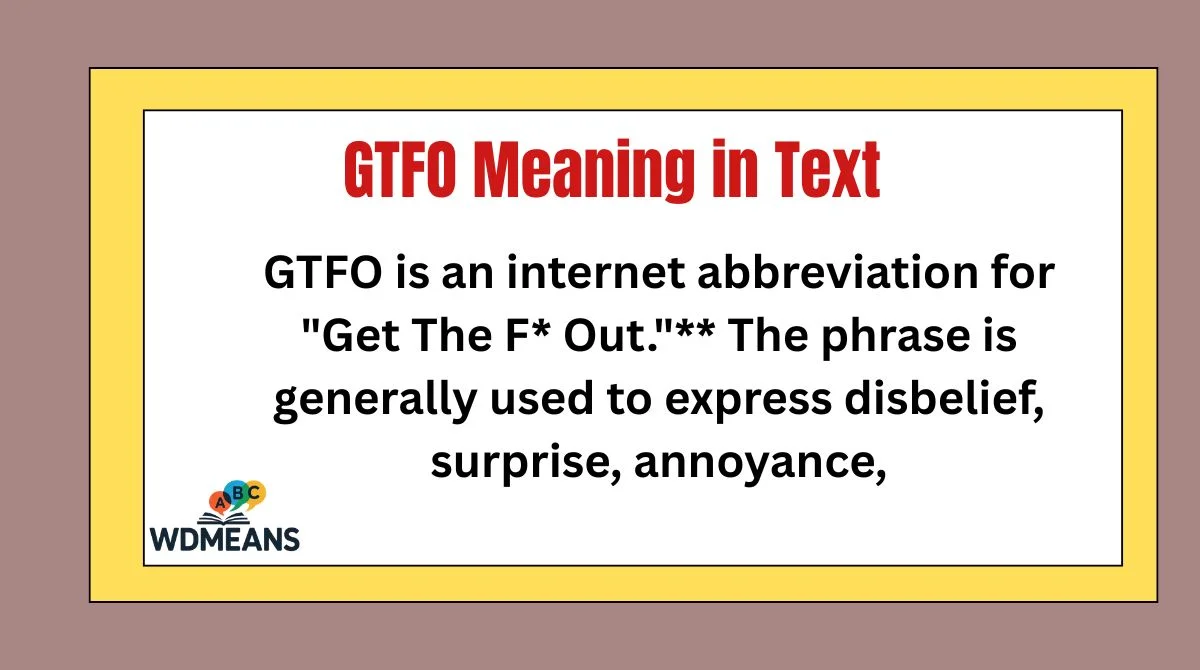
GTFO is an internet abbreviation for “Get The F* Out.”** The phrase is generally used to express disbelief, surprise, annoyance, excitement, or anger. Because it contains profanity, its tone can range from humorous to highly offensive.
At its core, GTFO tells someone to leave or stop talking, but in modern online communication, the literal meaning isn’t always intended.
Simple definition
GTFO means:
- Get out.
- No way!
- You’re kidding!
- Leave me alone.
- Stop saying that.
- I can’t believe it.
The exact interpretation depends entirely on the conversation.
Friendly example
Friend: I won free concert tickets.
You: GTFO 😂 That’s amazing!
Here, GTFO means:
“No way! I can’t believe it!”
It isn’t rude.
Angry example
Person A: Keep bothering me.
Person B: GTFO.
In this situation, the speaker genuinely wants the other person to leave.
Shocked example
Friend: I met my favorite celebrity today.
You: GTFO! Seriously?
Again, the phrase expresses amazement rather than hostility.
Why context matters
GTFO is one of those abbreviations whose meaning changes based on:
- Relationship between people
- Conversation topic
- Emojis
- Capitalization
- Overall tone
For example:
- GTFO 😂 = playful
- GTFO 😭 = dramatic disbelief
- GTFO! = could sound aggressive
- gtfo lol = casual joking
Because tone is difficult to read in text messages, people often add emojis or extra words to make their intention clearer.
Background
GTFO became popular during the early days of internet forums, multiplayer gaming, and online chat rooms. Long before messaging apps became mainstream, internet users preferred abbreviations because they were faster to type.
As texting culture expanded, short expressions like:
- LOL
- BRB
- OMG
- WTF
- GTFO
became common vocabulary online.
Originally, GTFO almost always meant telling someone to leave. Over time, internet culture softened its usage.
Today, many people use it simply to react to unbelievable stories.
For example:
“I just found $500.”
“GTFO 😂”
Nobody expects the other person to actually leave.
Gaming communities also helped spread the abbreviation. Competitive players often used GTFO during intense matches to tell teammates or opponents to move away from danger quickly.
Memes, reaction GIFs, and viral videos later made GTFO even more recognizable. It eventually crossed into mainstream social media where younger audiences began using it sarcastically and humorously.
Today, the phrase appears in:
- Group chats
- Meme pages
- Gaming communities
- TikTok comments
- Instagram replies
- Reddit discussions
- Discord servers
Although widely recognized, GTFO remains a slang expression that may not be appropriate in professional or formal communication because of the implied profanity.
Usage in Different Contexts (Chat, Social Media, Professional Fields)
The meaning of GTFO changes depending on where it’s used.
Casual texting
Friends often use GTFO to react dramatically.
Example:
“I passed my driving test.”
“GTFO! Congratulations!”
It shows surprise rather than anger.
Social media
People frequently comment GTFO beneath unbelievable posts.
Examples:
- GTFO 😂
- GTFO this is hilarious.
- GTFO I needed this today.
Here, it usually means:
- No way.
- That’s unbelievable.
- That’s funny.
Online gaming
Gamers may use GTFO literally.
Examples:
- GTFO the zone!
- GTFO before the boss attacks!
The phrase acts as a quick warning.
Forums and communities
Users sometimes use GTFO sarcastically.
Example:
“You’re still using that old phone?”
“GTFO 😂”
The tone depends on whether participants are joking.
Workplace or professional communication
GTFO is generally considered inappropriate.
Even if coworkers are friendly, using profanity-based abbreviations in emails, meetings, or official chats may appear disrespectful.
Instead, professionals might say:
- Please leave.
- That’s unbelievable.
- Seriously?
- No way.
Professional environments usually avoid slang containing offensive language.
Meaning in Chat, WhatsApp, Instagram, TikTok
Different platforms give GTFO slightly different personalities.
Chat
Private conversations often use GTFO between close friends.
Example:
“I just got engaged.”
“GTFO!! I’m so happy for you!”
Meaning:
“I can’t believe it.”
Family groups usually avoid GTFO because older members may interpret it literally.
Among friends, it often appears jokingly.
Example:
“You ate the whole pizza?”
“GTFO 😂”
GTFO commonly appears in comments under:
- Funny videos
- Amazing photos
- Celebrity news
- Memes
It expresses surprise or amusement.
Example:
“GTFO that’s adorable.”
TikTok
TikTok users often type GTFO after watching unbelievable clips.
Examples:
- GTFO 😭
- GTFO this can’t be real.
- GTFO I’m crying.
The abbreviation becomes a reaction rather than an insult.
Overall, younger audiences frequently interpret GTFO as dramatic internet slang rather than a serious command.
Meaning in Physics, Medical, and Aircraft Terminology
Unlike many abbreviations, GTFO has no widely recognized official meaning in physics, medicine, or aviation.
However, abbreviations can occasionally have specialized meanings inside individual companies, laboratories, military organizations, or technical documents. These uses are usually internal and are not standardized.
Physics
There is no established scientific abbreviation known as GTFO in mainstream physics literature.
Medical
Medical professionals do not commonly use GTFO as an official medical acronym. Healthcare communication relies on standardized abbreviations to avoid confusion, and GTFO is not among them.
Aircraft and aviation
In aviation, GTFO is not an internationally recognized abbreviation used in flight operations, navigation, maintenance, or air traffic control.
If you encounter GTFO in a technical document, check the document’s glossary because it may represent an organization-specific abbreviation rather than the internet slang.
For most people, especially in text messages and online conversations, GTFO almost always refers to “Get The F* Out.”**
Common Misconceptions
Many people misunderstand GTFO because it can express different emotions.
Misconception 1: It is always rude.
Not true.
Friends often use it playfully.
Misconception 2: It literally means “leave.”
Sometimes it does.
Other times it simply means:
- No way!
- Seriously?
- You’re joking!
Misconception 3: Everyone finds it funny.
Since GTFO includes profanity, some people may consider it offensive regardless of the context.
Misconception 4: It is appropriate everywhere.
It’s best avoided in formal communication, workplaces, customer service, schools, and professional emails.
Similar Terms & Alternatives
Many abbreviations express emotions similar to GTFO.
| Abbreviation | Meaning | Typical Use |
|---|---|---|
| WTF | Expresses confusion or shock | Informal conversations |
| OMG | Oh My God | Surprise or excitement |
| No way | Disbelief | Friendly chats |
| Seriously? | Questioning something surprising | Casual conversations |
| You’re kidding | Disbelief | Everyday speech |
| Get out! | Friendly surprise | Informal conversations |
| LOL | Laughing | Humor |
| BRUH | Reaction to something ridiculous | Internet slang |
If you’re unsure whether GTFO might offend someone, choosing a milder alternative is often the safer option.
How to Respond to It
Your response should match the sender’s tone.
If they are joking
You can reply with:
- 😂 I know, right?
- I couldn’t believe it either!
- It’s true!
- I’m serious!
If they’re surprised
Reply with evidence or details.
Example:
“I’ve got pictures if you don’t believe me.”
If they’re angry
Avoid escalating the argument.
You could respond with:
- Let’s calm down.
- I didn’t mean to upset you.
- I’ll leave the conversation.
If you don’t understand
Simply ask:
“What do you mean by GTFO?”
Clarifying is always better than making assumptions.
Differences from Similar Words
Although GTFO resembles several internet abbreviations, each has a different purpose.
| Term | Main Meaning | Tone |
|---|---|---|
| GTFO | Leave / No way | Can be humorous or offensive |
| WTF | Confusion or shock | Strong reaction |
| OMG | Surprise | Usually positive or neutral |
| STFU | Be quiet | More aggressive |
| IDC | I don’t care | Indifference |
| SMH | Disappointment | Mild frustration |
The biggest difference is that GTFO may either express disbelief or tell someone to leave, while most similar abbreviations have only one primary meaning.
Understanding the surrounding conversation helps you interpret it correctly.
Relevance in Online Conversations & Dating Apps
GTFO remains popular because online conversations often rely on quick emotional reactions.
In dating apps, the abbreviation appears in playful conversations between people who already share a comfortable rapport.
Example:
“I’ve never had pizza before.”
“GTFO 😂”
Here, the message expresses disbelief rather than rejection.
However, early conversations with someone new require more caution.
Since text lacks facial expressions and voice tone, GTFO can easily be misunderstood.
Many people prefer softer alternatives like:
- No way!
- Seriously?
- You’re kidding!
- I can’t believe it!
On gaming platforms, meme communities, and among close friends, GTFO often creates humor and exaggeration.
In professional networking or conversations with people you don’t know well, avoiding profanity-based slang usually leads to clearer and more respectful communication.
The best rule is simple: consider your audience before using GTFO. Close friends may laugh, while strangers or coworkers may interpret it as disrespectful.
Conclusion
GTFO is one of the internet’s most recognizable slang abbreviations, standing for “Get The F* Out.”** Although it originally served as a forceful command telling someone to leave, its meaning has expanded over time.
Today, it frequently expresses surprise, disbelief, excitement, or playful exaggeration, especially among friends on social media, messaging apps, and gaming platforms.
The key to understanding GTFO is context. The same four letters can signal humor in one conversation and genuine frustration in another.
Paying attention to the relationship between the people involved, the surrounding messages, and any accompanying emojis can help you interpret the intended meaning accurately.
While GTFO is common in casual online communication, it is generally unsuitable for professional or formal settings because it contains implied profanity.
When in doubt, choose a more neutral expression or ask for clarification. Understanding modern internet slang like GTFO helps you communicate more confidently and avoid unnecessary misunderstandings in today’s fast-moving digital conversations.

I am Alexander Hayes, creator of WDMEANS, dedicated to simplifying English learning through clear word meanings. I help learners improve vocabulary with easy, accurate, and practical explanations for everyday use online.