In today’s fast-paced digital world, abbreviations dominate how people communicate online.
One such commonly used abbreviation is “DC.” If you’ve come across it in a message, social media post, or even a professional setting, you might have paused and wondered what it means.
The truth is, “DC” can have multiple meanings depending on the context in which it’s used.
People search for this term because it appears frequently in texting, online chats, and even technical discussions, yet its meaning isn’t always obvious.
Understanding “DC” helps avoid confusion and ensures smoother communication, whether you’re chatting with friends, browsing social media, or engaging in a professional conversation.
This article breaks down the meaning of “DC,” explores its origins, and explains how it’s used in different contexts—from casual texting to scientific terminology—so you can confidently interpret and use it.
Meaning & Definition
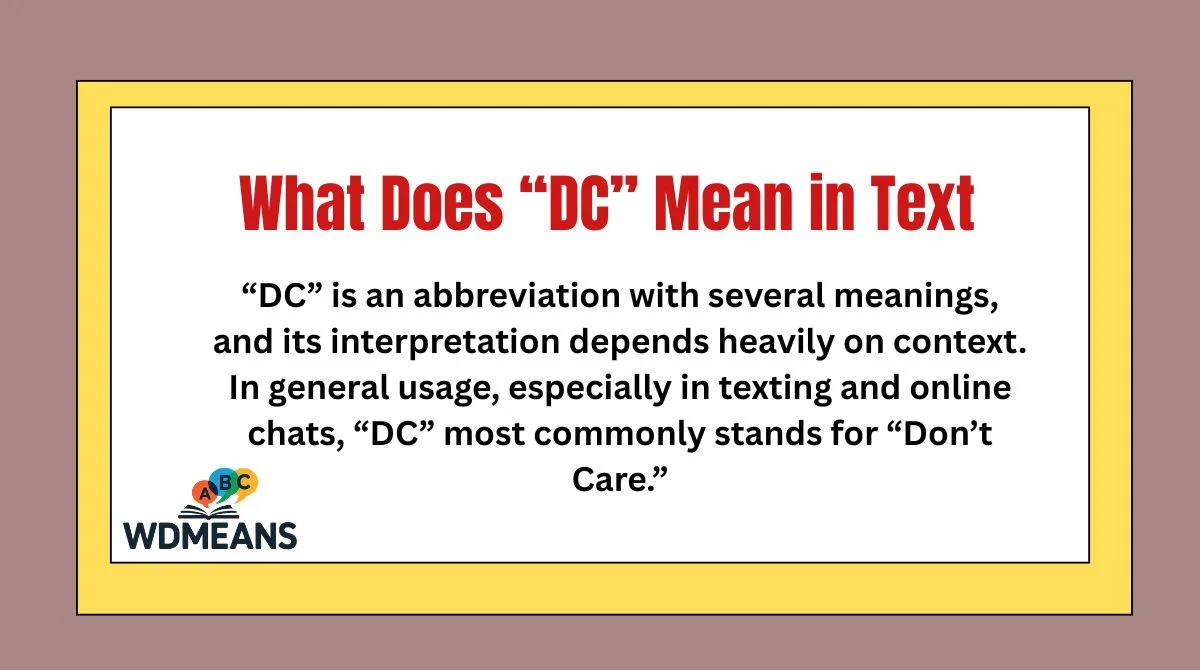
“DC” is an abbreviation with several meanings, and its interpretation depends heavily on context. In general usage, especially in texting and online chats, “DC” most commonly stands for “Don’t Care.” It is used to express indifference or a lack of preference about something. For example, if someone asks where you want to eat and you reply “DC,” you’re essentially saying it doesn’t matter to you.
Another popular meaning of “DC” in online environments is “Disconnect” or “Disconnected.” This is often used in gaming or technical conversations when someone loses connection to the internet or a server. For instance, “I got DC’d” means the person was disconnected unexpectedly.
In some cases, “DC” can also stand for “Direct Current,” especially in scientific or engineering contexts. This meaning is unrelated to texting but widely recognized in technical fields.
Because “DC” has multiple interpretations, understanding the tone, platform, and conversation is key to identifying the correct meaning. Its flexibility is what makes it both useful and occasionally confusing in communication.
Background
The abbreviation “DC” has evolved alongside digital communication. Like many short forms, it emerged from the need to type faster and communicate more efficiently, especially during the early days of texting when character limits were strict.
In casual conversations, abbreviations such as “LOL,” “BRB,” and “DC” became part of everyday language. Over time, their meanings expanded beyond simple shortcuts and began to reflect emotions, reactions, and behaviors. “DC” as “Don’t Care” became particularly popular among younger users who wanted a quick way to express neutrality or indifference.
Meanwhile, in technical fields, “DC” has a much older origin. It has long been used in science and engineering to refer to “Direct Current,” a type of electrical flow. This usage dates back to early developments in electricity and remains standard terminology today.
The dual nature of “DC”—both casual and technical—demonstrates how language adapts across different environments. Its widespread usage today reflects the blending of informal communication with specialized knowledge in a digitally connected world.
Usage in Different Contexts (Chat, Social Media, Professional Fields)
“DC” is versatile and appears in multiple environments, each with its own meaning.
In casual chat, it typically expresses indifference. For example, “DC what we watch tonight” signals that the speaker has no strong preference. This usage is informal and commonly seen among friends or peers.
On social media platforms, “DC” can mean different things depending on the context. It might refer to a “Dance Credit” on platforms like TikTok, where users credit the original creator of a dance. Alternatively, it could still mean “Don’t Care” in comments or captions.
In gaming communities, “DC” almost always means “Disconnect.” Players use it to describe sudden connection losses, such as “He DC’d in the middle of the match.”
In professional settings, the meaning shifts entirely. “DC” might stand for “Domain Controller” in IT, “Direct Current” in engineering, or even “District of Columbia” in geographical references.
Because the abbreviation spans so many fields, recognizing the context is essential. Misinterpreting “DC” can lead to confusion, especially when switching between casual and professional conversations.
Meaning in Chat, WhatsApp, Instagram, TikTok
On messaging platforms like WhatsApp and social apps like Instagram and TikTok, “DC” is used in several distinct ways.
In chat and WhatsApp, “DC” usually means “Don’t Care.” It’s a quick, informal response often used in relaxed conversations.
On Instagram, “DC” might appear in captions or comments, either as “Don’t Care” or as shorthand for something specific within a community.
On TikTok, however, “DC” often stands for “Dance Credit.” Creators use it to acknowledge the original choreographer of a dance trend. For example, a caption might read “DC: @username,” giving proper credit.
Understanding platform-specific meanings is important because the same abbreviation can carry completely different interpretations depending on where it’s used.
Meaning in Physics, Medical, and Aircraft Terminology
Outside casual communication, “DC” has well-established meanings in professional and technical fields.
In physics and engineering, “DC” stands for Direct Current, a type of electrical current that flows in one direction. It is commonly used in batteries and electronic devices.
In medical terminology, “DC” can mean “Discontinue,” referring to stopping a medication or treatment. For example, a doctor might write “DC medication” in patient notes.
In aviation, “DC” might appear in aircraft names or technical discussions, though it is less commonly used as a standalone abbreviation in modern contexts.
These meanings highlight how “DC” is not just an internet slang term but also a critical abbreviation in specialized industries.
Common Misconceptions
One common misconception is that “DC” always means “Don’t Care.” While this is true in many casual conversations, it is far from universal.
Another misunderstanding is assuming that “DC” has a negative tone. While it can sometimes sound dismissive, it often simply indicates neutrality rather than rudeness.
People also confuse “DC” with similar abbreviations like “IDK” (I Don’t Know), even though they express different ideas—uncertainty versus indifference.
Recognizing these nuances helps avoid miscommunication and ensures more accurate interpretation.
Similar Terms & Alternatives
Several abbreviations convey meanings similar to “DC,” depending on the context.
- IDK – I don’t know
- IDC – I don’t care (more explicit than DC)
- NVM – Never mind
- BRB – Be right back
- AFK – Away from keyboard
Among these, “IDC” is the closest equivalent to “DC” when used to express indifference. However, “DC” is shorter and often used when speed is a priority.
How to Respond to It
Responding to “DC” depends on the tone and context of the conversation.
If someone uses it casually, you can proceed with a decision since they’ve indicated no preference. For example, if they say “DC where we go,” you can choose a place confidently.
If it seems dismissive, you might ask for clarification to ensure they’re genuinely okay with any option.
In professional or technical contexts, always confirm the intended meaning to avoid misunderstandings.
Differences from Similar Words
“DC” differs from similar abbreviations in subtle but important ways.
- DC vs IDC: “IDC” is clearer and more direct, while “DC” is shorter and sometimes ambiguous.
- DC vs IDK: “DC” expresses indifference; “IDK” expresses lack of knowledge.
- DC vs AFK: “AFK” indicates absence, while “DC” may refer to disconnection or indifference.
Understanding these differences ensures more precise communication.
Relevance in Online Conversations & Dating Apps
In online conversations and dating apps, “DC” plays a role in expressing personality and communication style.
When someone uses “DC,” it can signal flexibility or a laid-back attitude. However, overuse may come across as disinterest or lack of engagement.
In dating contexts, clarity is important. If you want to show interest, it’s often better to provide specific responses rather than relying on neutral abbreviations like “DC.”
Used appropriately, “DC” can keep conversations efficient, but balance is key to maintaining meaningful interactions.
Conclusion
“DC” is a simple yet versatile abbreviation with meanings that vary widely depending on context.
From expressing indifference in casual chats to representing technical concepts like direct current, it demonstrates how language evolves across digital and professional spaces.
Understanding its different interpretations allows you to communicate more effectively and avoid confusion.
Whether you’re texting friends, scrolling through social media, or engaging in technical discussions, recognizing the intended meaning of “DC” ensures smoother and more accurate communication.
As online language continues to evolve, staying aware of such abbreviations helps you stay connected and relevant in modern conversations.

I am Alexander Hayes, creator of WDMEANS, dedicated to simplifying English learning through clear word meanings. I help learners improve vocabulary with easy, accurate, and practical explanations for everyday use online.