In today’s fast-paced digital communication, short expressions and abbreviations have become a natural part of how people interact—especially in texting and social media.
One such commonly used expression is “mhm.” While it may seem simple at first glance, its meaning can vary significantly depending on tone, context, and the relationship between the people involved.
This is why many people search to understand what “mhm” means, particularly when it comes from a girl in a conversation.
Unlike straightforward words like “yes” or “no,” “mhm” carries subtle emotional cues. It can signal agreement, indifference, acknowledgment, or even hidden feelings.
Misinterpreting it can easily lead to confusion in conversations, especially in dating or casual chats. Understanding how this expression works can help you respond more appropriately and improve communication overall.
Meaning & Definition
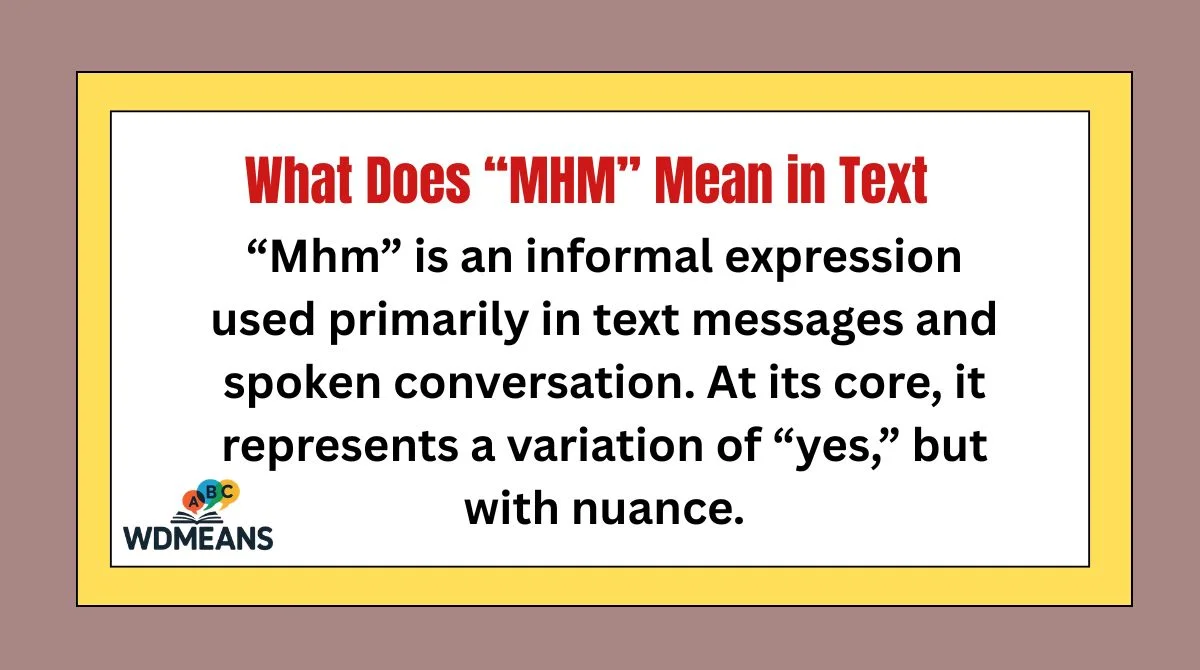
“Mhm” is an informal expression used primarily in text messages and spoken conversation. At its core, it represents a variation of “yes,” but with nuance. It is often used to acknowledge something rather than strongly confirm it.
The tone behind “mhm” is what gives it meaning. For example:
- A warm “mhm” can indicate agreement or interest.
- A short, dry “mhm” may signal boredom or disinterest.
- A delayed “mhm” might suggest hesitation or distraction.
When a girl uses “mhm” in a text, it often reflects her emotional engagement level rather than just a simple answer. It may mean:
- “Yes, I agree”
- “I hear you”
- “Okay, if you say so”
- “I’m not fully interested but I’m responding”
Because text lacks vocal tone, the interpretation relies heavily on context, timing, and conversation flow. Emojis, punctuation, or message length can also influence its meaning.
Background
The expression “mhm” originates from spoken language, where it mimics a humming sound used to show acknowledgment. It has long been part of everyday verbal communication, especially in English-speaking cultures.
As texting became popular, people naturally adapted spoken cues into written form. “Mhm” became a way to replicate that subtle vocal acknowledgment in digital conversations. Unlike formal responses such as “yes” or “certainly,” it retained its casual and emotional flexibility.
Over time, its use expanded across messaging platforms and social media. Younger generations, in particular, adopted it as a quick and effortless way to respond without typing full sentences. Its popularity also grew because it allows ambiguity—something often useful in casual or uncertain conversations.
Usage in Different Contexts (Chat, Social Media, Professional Fields)
“Mhm” is versatile and appears in various communication settings, though its meaning shifts depending on the environment.
In casual chat:
It is most commonly used to show acknowledgment or mild agreement. It keeps conversations flowing without requiring much effort.
On social media:
People use “mhm” in comments, replies, or direct messages. It may indicate agreement with a post or a passive reaction to content.
In professional settings:
“Mhm” is generally avoided in formal communication such as emails or business messages. It can come across as too informal or even dismissive. Instead, people use clearer responses like “Yes,” “Understood,” or “Agreed.”
Understanding where it is appropriate is important, as using it in the wrong setting can create misunderstandings or appear unprofessional.
Meaning in Chat, WhatsApp, Instagram, TikTok
Across platforms like WhatsApp, Instagram, and TikTok, “mhm” is widely used but interpreted slightly differently depending on context.
In WhatsApp chats:
It often acts as a quick acknowledgment. If a girl replies with “mhm,” she might simply be listening rather than engaging deeply.
On Instagram:
In direct messages, “mhm” can signal mild interest or polite continuation of a conversation. It may also indicate she doesn’t have much to add.
On TikTok:
It may appear in comments or replies as a reaction, often agreeing subtly or expressing a vibe rather than a strong opinion.
In all these platforms, the key factor is engagement level. A lively conversation usually includes longer responses, while repeated “mhm” replies might suggest fading interest.
Meaning in Physics, Medical, and Aircraft Terminology
Outside of casual conversation, “MHM” can have completely different meanings depending on the field.
In physics:
“MHM” is not a standard abbreviation but could occasionally appear as shorthand in notes or informal references, though it is rare.
In medical terminology:
It may stand for specific internal abbreviations in certain institutions, but it is not universally recognized. Medical professionals typically use standardized acronyms instead.
In aviation (aircraft):
“MHM” could refer to internal codes, maintenance shorthand, or location identifiers depending on the system being used. However, it is not a widely recognized global aviation abbreviation.
In general, outside texting, “MHM” is highly context-specific and not commonly used in formal technical language.
Common Misconceptions
Many people assume “mhm” always means a clear “yes,” but that is not accurate. One of the biggest misconceptions is treating it as a strong agreement.
Other misunderstandings include:
- Thinking it shows enthusiasm (it often doesn’t)
- Assuming it signals interest in romantic contexts
- Believing it always means the conversation is going well
In reality, “mhm” can sometimes indicate the opposite—lack of interest or minimal engagement. Misreading it can lead to awkward or one-sided conversations.
Similar Terms & Alternatives
Several expressions are similar to “mhm,” each with slightly different tones:
- “Hmm” – Indicates thinking or uncertainty
- “Yeah” – Casual agreement, more engaged than “mhm”
- “Okay” – Neutral acknowledgment
- “Uh-huh” – Verbal equivalent, often more positive
- “Sure” – Agreement with mild commitment
These alternatives often provide clearer emotional signals compared to “mhm,” which is more ambiguous.
How to Respond to It
Responding to “mhm” depends on the situation and your goal in the conversation.
- If you want to keep the conversation going:
Ask an open-ended question to encourage more engagement. - If it feels like disinterest:
Change the topic or introduce something more engaging. - If it seems positive:
Continue naturally and build on the conversation. - If you’re unsure:
Clarify gently by asking for their opinion.
Avoid overanalyzing a single “mhm,” but pay attention to patterns. Repeated short responses usually signal reduced interest.
Differences from Similar Words
“Mhm” differs from other responses mainly in tone and clarity.
- Compared to “yes,” it is less direct
- Compared to “yeah,” it is less enthusiastic
- Compared to “okay,” it is more passive
- Compared to “hmm,” it shows acknowledgment rather than thinking
These subtle differences make “mhm” unique but also easy to misinterpret.
Relevance in Online Conversations & Dating Apps
In online conversations, especially on dating apps, “mhm” can carry significant meaning. It often reflects how invested someone is in the interaction.
If a girl frequently uses “mhm” in a dating chat:
- It may indicate she is not খুব engaged
- She could be multitasking or distracted
- She might be unsure about continuing the conversation
However, context matters. If mixed with longer replies, it may simply be part of her texting style.
In dating scenarios, engagement level is key. Balanced conversations with thoughtful replies are generally a better sign than repeated short acknowledgments.
Conclusion
“Mhm” may look like a simple expression, but it carries a wide range of meanings depending on context, tone, and intent. When used by a girl in text, it can signal agreement, acknowledgment, hesitation, or even disinterest.
Understanding these nuances is essential for effective communication, especially in casual chats and online dating environments.
Rather than focusing on the word alone, it’s important to consider the overall conversation, response patterns, and emotional cues. By doing so, you can interpret “mhm” more accurately and respond in a way that keeps communication clear and engaging.

I am Alexander Hayes, creator of WDMEANS, dedicated to simplifying English learning through clear word meanings. I help learners improve vocabulary with easy, accurate, and practical explanations for everyday use online.