In today’s fast-paced digital world, abbreviations and slang dominate online conversations. One such acronym that often leaves people puzzled is “JFC.”
If you’ve seen it in texts, social media posts, or chats and wondered what it means, you’re not alone. Many users search for this term to understand its meaning, tone, and appropriate usage.
“JFC” is commonly used in informal communication, especially in moments of strong emotion like frustration, disbelief, or shock.
However, its meaning can vary depending on the context, making it important to interpret it correctly. While it may appear harmless at first glance, it can carry a strong tone that may not always be suitable in every situation.
This article explores the meaning, origins, different uses, and nuances of “JFC,” helping you understand when and how to use—or respond to—it appropriately.
Meaning & Definition
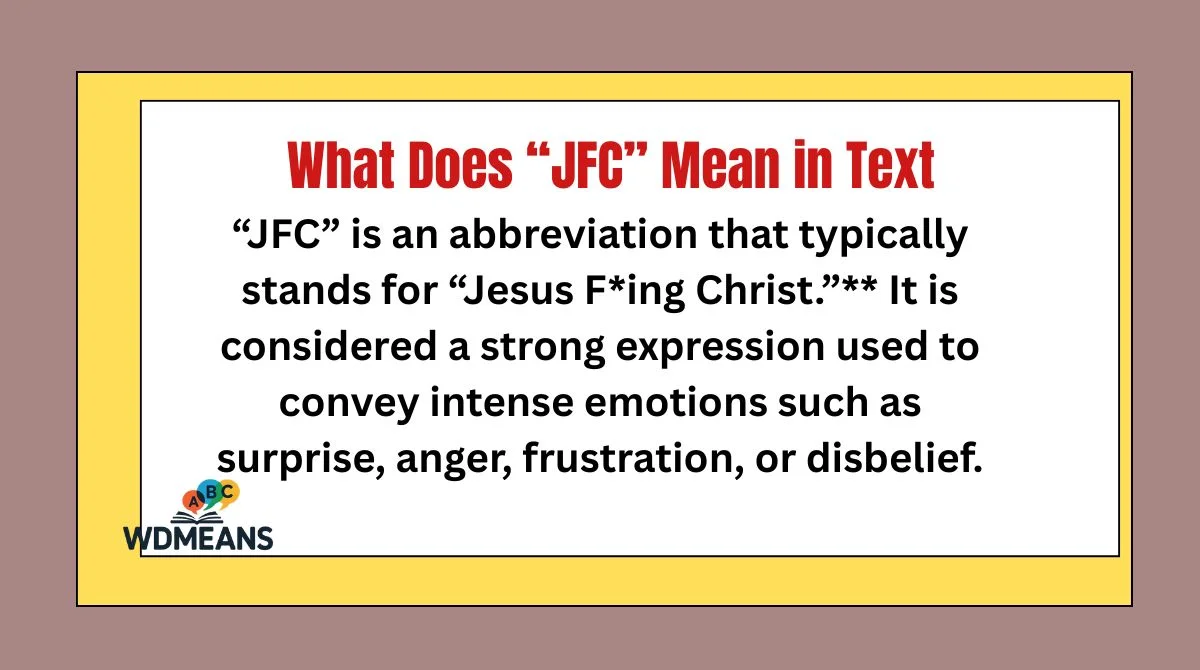
“JFC” is an abbreviation that typically stands for “Jesus F*ing Christ.”** It is considered a strong expression used to convey intense emotions such as surprise, anger, frustration, or disbelief.
People use it similarly to other exclamations like “Oh my God” or “What the heck,” but with a much stronger and more explicit tone. Because of this, it is generally seen as informal and sometimes offensive, depending on the audience.
At its core, “JFC” functions as an emotional amplifier. Instead of calmly reacting to something unexpected, the user emphasizes their reaction with heightened intensity. For example:
- “JFC, I can’t believe that just happened!”
- “JFC, this traffic is impulsive.”
Despite its blunt nature, many people use it casually among friends or in relaxed online environments. However, it is rarely appropriate in formal or professional communication.
Background
The phrase behind “JFC” has roots in English-speaking cultures where religious references are often used in expressions of emotion. Over time, as internet culture evolved, longer phrases were shortened into acronyms for quicker typing and subtlety.
With the rise of texting, forums, and platforms like instant messaging apps, abbreviations like “JFC” became popular. It allowed users to express strong feelings without typing out the full phrase. This also helped avoid censorship filters on some platforms.
The acronym gained traction particularly in online communities where informal language is common. Its usage spread rapidly through memes, comment sections, and social media posts, eventually becoming part of everyday digital slang.
Usage in Different Contexts (Chat, Social Media, Professional Fields)
In casual chat and social media, “JFC” is widely used to express immediate emotional reactions. It fits naturally into conversations where people are venting, joking, or reacting to surprising news.
For example:
- Chat: “JFC, you scared me!”
- Social media: “JFC, that plot twist was impulsive!”
However, in professional fields, the use of “JFC” is strongly discouraged. Its explicit nature can come across as unprofessional, disrespectful, or inappropriate. In workplaces, emails, or formal discussions, it is best to avoid such language entirely.
Interestingly, in some niche professional or technical contexts, “JFC” may appear as an acronym for something entirely different (which we’ll explore later). But in most everyday communication, its slang meaning dominates.
Meaning in Chat, WhatsApp, Instagram, TikTok
On platforms like WhatsApp, Instagram, and TikTok, “JFC” is used as a quick reaction to content or messages. The tone can range from humorous to frustrated, depending on context.
- WhatsApp: Often used in private conversations among friends.
Example: “JFC, why didn’t you tell me earlier?” - Instagram: Seen in comments reacting to photos, reels, or stories.
Example: “JFC, this is hilarious!” - TikTok: Common in comment sections reacting to viral or shocking videos.
Example: “JFC, that ending caught me off guard!”
In these environments, the acronym is generally understood and accepted, especially among younger audiences. However, tone matters—what feels funny to one person might seem rude to another.
Meaning in Physics, Medical, and Aircraft Terminology
While “JFC” is mostly known as slang, it can have entirely different meanings in technical fields:
- Physics: It may refer to specific constants, frameworks, or abbreviations used within niche research contexts (though this is rare and not widely standardized).
- Medical Field: Occasionally used as shorthand in internal documentation, though not commonly recognized as a standard abbreviation.
- Aircraft/Aviation: It might appear as a code or internal abbreviation in specific organizations, but it is not a widely known aviation term.
In these fields, the meaning of “JFC” depends entirely on the context. Unlike its slang usage, these interpretations are usually formal and unrelated to emotional expression.
Common Misconceptions
One common misconception is that “JFC” is always offensive. While it can be strong language, its impact depends heavily on context and audience. Among close friends, it may be seen as harmless or even humorous.
Another misunderstanding is that it has a single universal meaning across all fields. As discussed, its interpretation can change completely in technical or professional environments.
Some people also assume it’s safe to use everywhere because it’s abbreviated. However, even in shortened form, it can still be considered inappropriate in formal settings.
Similar Terms & Alternatives
There are several alternatives to “JFC” that convey similar emotions but with varying intensity:
- “OMG” (Oh My God)
- “WTF” (What The F***)
- “Jeez”
- “Good grief”
- “Seriously?!”
These alternatives may be more suitable depending on the tone you want to convey and the audience you’re addressing.
How to Respond to It
When someone uses “JFC,” your response should depend on the context and tone:
- If it’s humorous: Respond casually or play along.
- If it expresses frustration: Acknowledge their feelings or offer support.
- If it feels offensive: You can gently steer the conversation or set boundaries.
Example responses:
- “I know, right? That was wild!”
- “Yeah, that sounds really frustrating.”
- “Let’s keep it chill 😅”
Differences from Similar Words
“JFC” differs from terms like “OMG” or “WTF” mainly in intensity. It is generally stronger and more explicit than “OMG,” but similar in tone to “WTF.”
However, “JFC” often carries a sharper emotional edge, making it more impactful but also more risky to use in sensitive situations.
Relevance in Online Conversations & Dating Apps
In online conversations and dating apps, “JFC” can be a double-edged sword. On one hand, it can make messages feel expressive and authentic. On the other, it may come across as overly aggressive or inappropriate if used too early in a conversation.
In dating contexts, first impressions matter. Using milder language is usually safer until you understand the other person’s communication style. Once familiarity is established, casual slang like “JFC” may feel more natural.
Conclusion
“JFC” is a powerful internet slang acronym that expresses strong emotions like shock, frustration, or disbelief. While it is widely used in casual conversations and social media, its explicit nature makes it unsuitable for formal or professional settings.
Understanding its meaning, tone, and context is essential to using it effectively and avoiding misunderstandings.
As with any slang, the key is awareness—knowing your audience and choosing your words accordingly. Whether you decide to use it or not, recognizing its implications will help you navigate modern digital communication more confidently.

I am Alexander Hayes, creator of WDMEANS, dedicated to simplifying English learning through clear word meanings. I help learners improve vocabulary with easy, accurate, and practical explanations for everyday use online.