In today’s fast-paced digital world, abbreviations and slang dominate online communication.
One term that often confuses people is “POS.” You might have seen it in a text message, on social media, or even in a professional setting and wondered what it actually means.
The reason so many people search for this phrase is simple: “POS” has multiple meanings depending on the context in which it is used.
From casual chats to technical fields like medicine and aviation, the interpretation of this short abbreviation can vary widely.
Misunderstanding it can lead to confusion—or even awkward situations—especially in conversations or online interactions.
This article breaks down everything you need to know about “POS,” including its definitions, origins, uses across different platforms, and how to respond appropriately.
By the end, you’ll have a clear and confident understanding of how this small acronym carries such diverse meanings.
Meaning & Definition
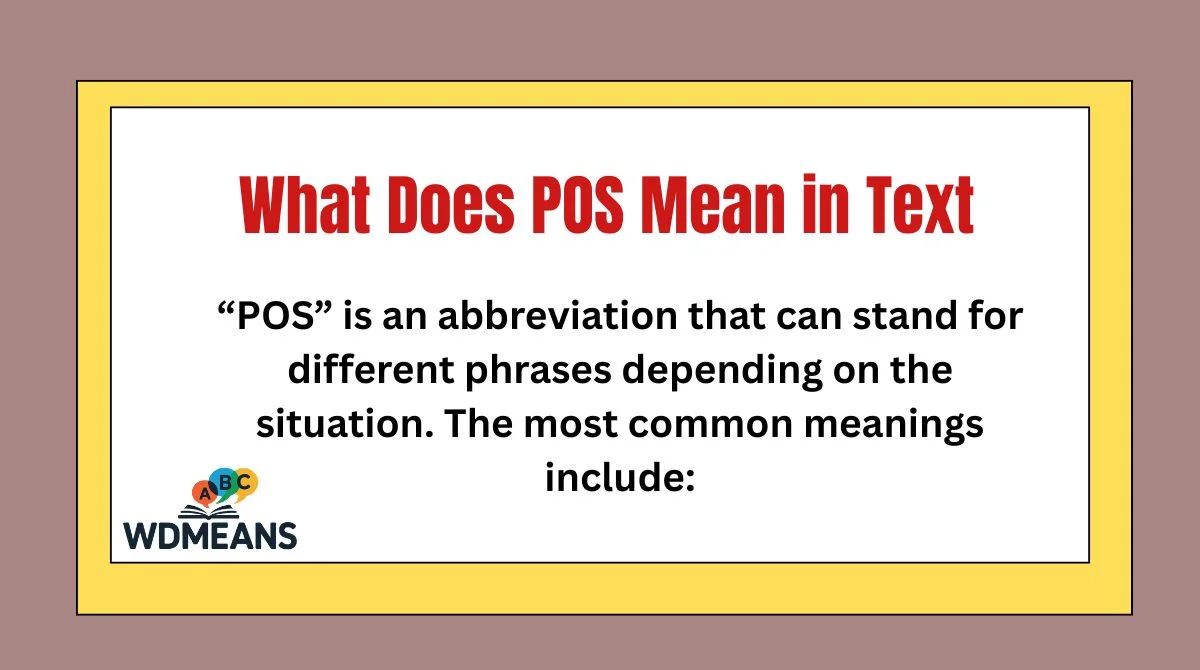
“POS” is an abbreviation that can stand for different phrases depending on the situation. The most common meanings include:
- Point of Sale – Often used in business and retail environments to refer to the place or system where transactions occur.
- Piece of Sh*t – A slang expression used to insult someone or something, often in a negative or emotional context.
- Parent Over Shoulder – Used in texting to indicate that someone’s parent is nearby, so communication should be cautious.
- Positive – In medical or scientific contexts, it can refer to a positive test result.
Because of these varied meanings, context is everything. A message saying “This system has a new POS installed” likely refers to a retail system, while “He’s such a POS” is clearly an insult.
Understanding the tone and setting of the conversation is essential for interpreting the correct meaning.
Background
The abbreviation “POS” didn’t originate from a single source. Instead, it evolved across different industries and social environments. In retail and business, “Point of Sale” has been used for decades, especially with the rise of computerized billing systems.
Meanwhile, internet culture and texting introduced more informal meanings. As messaging became faster and more abbreviated, users began shortening longer phrases into acronyms like “POS” for convenience. Over time, slang interpretations—especially negative ones—became widespread in online conversations.
In professional fields, the abbreviation maintained a more formal tone. For instance, in healthcare, “POS” is commonly used in documentation and reports. Similarly, aviation and engineering adopted their own technical meanings.
This dual nature—formal and informal—makes “POS” unique but also potentially confusing. Its evolution reflects how language adapts across industries and digital communication.
Usage in Different Contexts (Chat, Social Media, Professional Fields)
The meaning of “POS” shifts significantly depending on where it is used:
- Casual Chat & Messaging: Often used as slang, either humorously or offensively.
- Social Media: Can appear in memes, captions, or comments, usually with informal meanings.
- Business & Retail: Refers to systems used for processing payments and managing sales.
- Healthcare & Science: Indicates a positive result or classification.
- Technology: May refer to software systems or operational points.
In casual environments, tone plays a major role. Among friends, it might be used jokingly. In professional communication, however, it is strictly formal and technical.
Recognizing the environment helps you interpret the meaning correctly and avoid misunderstandings.
Meaning in Chat, WhatsApp, Instagram, TikTok
On messaging apps and social platforms, “POS” is mostly used in informal ways:
- Insult or joke: “That movie was POS”
- Warning message: “Can’t talk, POS” (Parent Over Shoulder)
- Humor or sarcasm: Often used in memes or playful teasing
On platforms like WhatsApp or Instagram, it often depends on your relationship with the sender. Friends might use it casually, while strangers might use it more harshly.
On TikTok, it may appear in captions or comments, usually with a humorous or exaggerated tone.
Because tone is harder to detect in text, it’s important to consider the context and the sender before reacting.
Meaning in Physics, Medical, and Aircraft Terminology
In technical fields, “POS” carries very different meanings:
- Medical: “POS” means positive, such as a test result indicating the presence of a condition.
- Physics/Science: It may stand for “Position,” referring to a location or coordinate.
- Aviation: Could refer to “Position” in navigation systems or flight tracking.
Unlike casual usage, these meanings are precise and standardized. There is little room for interpretation, as professionals rely on clarity and consistency.
Common Misconceptions
One of the biggest misconceptions is assuming “POS” always has a negative meaning. While it can be an insult, it is not inherently offensive in all contexts.
Another misunderstanding is thinking it has only one definition. In reality, it is a multi-purpose abbreviation used across different domains.
People also sometimes misinterpret it in professional settings, leading to confusion or embarrassment.
Similar Terms & Alternatives
Several other abbreviations and slang terms overlap with “POS”:
- LOL – Laughing out loud
- BRB – Be right back
- IMO – In my opinion
- NSFW – Not safe for work
In professional contexts, alternatives might include full phrases like “Point of Sale system” instead of “POS” for clarity.
How to Respond to It
Your response should depend on the context:
- If it’s slang/insult: Stay calm and decide whether to engage or ignore.
- If it’s a warning (Parent Over Shoulder): Keep your reply neutral and appropriate.
- If it’s professional: Respond formally and stay on topic.
When unsure, it’s always okay to ask for clarification.
Differences from Similar Words
Unlike many abbreviations that have a single meaning, “POS” is highly context-dependent. This makes it different from terms like “FYI” or “ASAP,” which are more consistent.
Its dual nature—formal and informal—sets it apart and requires more careful interpretation.
Relevance in Online Conversations & Dating Apps
In online conversations and dating apps, tone and clarity are crucial. Using “POS” can be risky because it may be misunderstood.
- In dating apps, it could come across as rude if interpreted negatively.
- In friendly chats, it may be acceptable depending on humor and familiarity.
Understanding how your audience might interpret it is key to effective communication.
Conclusion
“POS” is a small abbreviation with a wide range of meanings, from professional terms like “Point of Sale” to informal slang used in everyday conversations.
Its versatility makes it useful but also potentially confusing. By paying attention to context, tone, and the platform being used, you can easily determine its intended meaning and respond appropriately.
As digital communication continues to evolve, understanding abbreviations like “POS” helps you stay informed and avoid misunderstandings.
Whether you encounter it in a text message, workplace, or social media post, you now have the knowledge to interpret it correctly.

I am Alexander Hayes, creator of WDMEANS, dedicated to simplifying English learning through clear word meanings. I help learners improve vocabulary with easy, accurate, and practical explanations for everyday use online.