In today’s fast-paced digital world, abbreviations and acronyms dominate communication.
One of the most commonly used yet sometimes confusing abbreviations is “PM.” Many people search for its meaning because it can represent different things depending on the context—ranging from casual texting to professional environments.
Whether you’ve seen it in a chat message, social media comment, or workplace email, understanding what “PM” means is essential for clear communication.
The ambiguity of “PM” makes it interesting: it can refer to time, private messaging, professional roles, or even scientific terms.
This versatility is why users often feel uncertain about how to interpret it correctly. In this article, we’ll break down its meanings, explore where it comes from, and explain how it’s used in different situations.
By the end, you’ll confidently understand and use “PM” in any context.
Meaning & Definition
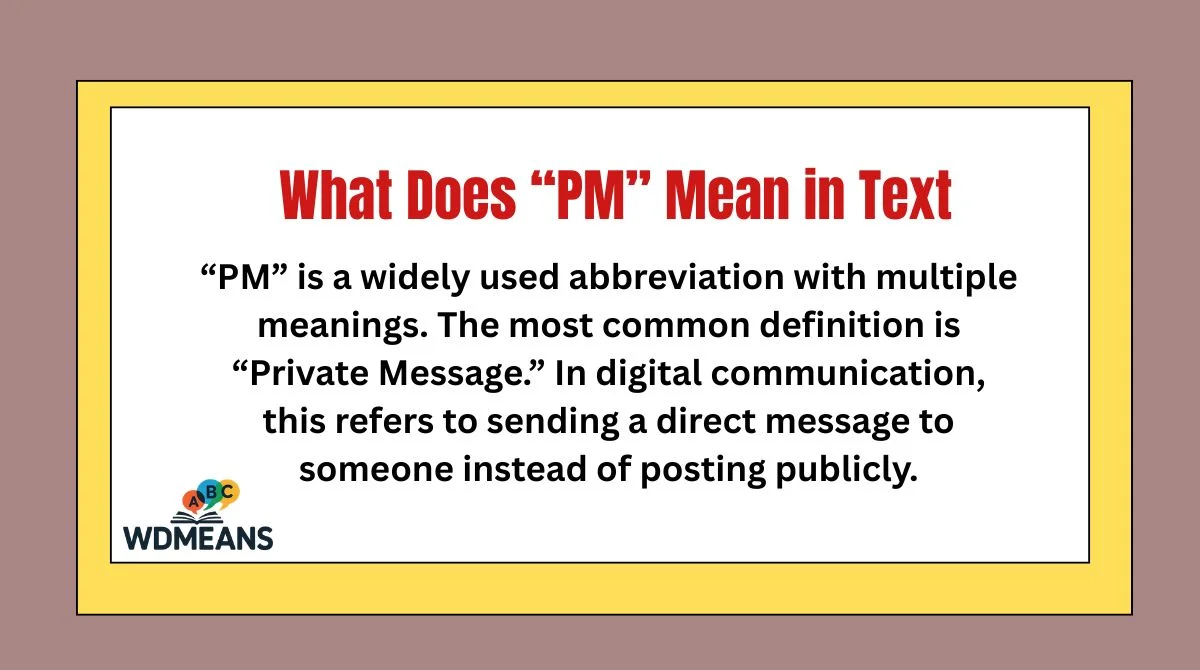
“PM” is a widely used abbreviation with multiple meanings. The most common definition is “Private Message.” In digital communication, this refers to sending a direct message to someone instead of posting publicly. For example, when someone says “PM me,” they are asking you to message them privately.
Another popular meaning is related to time: “Post Meridiem.” This Latin term translates to “after midday” and is used to indicate time from 12:00 noon to 11:59 at night. For instance, 7:00 PM refers to evening time.
In professional settings, “PM” can also stand for “Project Manager,” a person responsible for planning and executing projects. Additionally, in some contexts, it may mean “Prime Minister,” referring to the head of government in certain countries.
Because “PM” has multiple interpretations, understanding its meaning depends entirely on the situation in which it appears. Context clues—such as the platform, topic, or tone—usually help determine the correct definition.
Background
The abbreviation “PM” has roots in both ancient language and modern technology. Its time-related meaning, “Post Meridiem,” originates from Latin, which has influenced many aspects of modern language, especially in science and timekeeping. This system was developed to divide the 24-hour day into two 12-hour segments: AM (before midday) and PM (after midday).
As communication evolved, especially with the rise of the internet, “PM” gained new meanings. Online forums and early messaging platforms introduced the term “Private Message” to distinguish direct communication from public posts. Over time, this usage spread to social media platforms, messaging apps, and even gaming communities.
In professional environments, abbreviations like “PM” became standard shorthand for roles such as Project Manager. This reflects a broader trend of simplifying communication in fast-paced workplaces.
Today, “PM” is a perfect example of how language adapts to technological and cultural changes. Its multiple meanings show how a simple abbreviation can evolve and remain relevant across different fields and generations.
Usage in Different Contexts
The meaning of “PM” changes depending on where and how it is used. In casual conversations, especially online, it often refers to private messaging. For example, someone selling an item online might say, “PM me for details,” indicating that further discussion should happen privately.
In time-related contexts, “PM” is used globally in schedules, invitations, and daily planning. For instance, “The meeting starts at 3 PM” clearly refers to the afternoon.
In professional environments, “PM” can denote a role, such as a Project Manager. In emails or meetings, you might hear phrases like “The PM will handle this task,” referring to a person responsible for managing a project.
Additionally, in political discussions, “PM” may refer to a Prime Minister. The meaning becomes clear based on the topic being discussed.
Understanding the context is crucial because the same abbreviation can shift meaning completely. Recognizing the environment—whether casual, professional, or technical—helps avoid confusion.
Meaning in Chat, WhatsApp, Instagram, TikTok
On messaging apps and social media platforms, “PM” almost always means “Private Message.” It’s commonly used to move conversations from public spaces to private chats. For example:
- “PM me your number.”
- “I’ll send you the details, PM me.”
On platforms like WhatsApp, the term is less common because all communication is already private, but people still use it informally. On Instagram and TikTok, “PM” is often used in comments or captions to invite direct interaction.
In these environments, “PM” is part of a broader culture of quick, efficient communication. It helps users maintain privacy and have more personal conversations without sharing details publicly.
Because of its simplicity, “PM” has become a standard phrase across nearly all social platforms.
Meaning in Physics, Medical, and Aircraft Terminology
Beyond everyday communication, “PM” also appears in technical fields with entirely different meanings.
In physics, “PM” can stand for “Picometer,” a unit of length equal to one trillionth of a meter. It is used to measure atomic and subatomic distances.
In medical terminology, “PM” often means “Post Meridiem” for time notation or may refer to specific medical abbreviations depending on context. Healthcare professionals rely heavily on abbreviations, so clarity is essential.
In aviation, “PM” can mean “Pilot Monitoring.” This refers to the pilot responsible for monitoring instruments and assisting the pilot flying the aircraft.
These specialized meanings highlight the importance of context. In technical fields, “PM” is rarely about messaging or time alone—it often has precise, domain-specific definitions.
Common Misconceptions
One common misconception is assuming “PM” always means “Private Message.” While this is true in many online contexts, it’s not universal. Misinterpreting it can lead to confusion, especially in professional or technical discussions.
Another misunderstanding is confusing “PM” with “AM” when referring to time. This can result in scheduling errors, particularly in international communication.
Some people also mistakenly believe “PM” has a single fixed meaning. In reality, it is a flexible abbreviation with multiple interpretations.
Recognizing these misconceptions helps improve communication and ensures messages are understood correctly.
Similar Terms & Alternatives
There are several alternatives to “PM,” depending on the context. For private messaging, people often use terms like “DM” (Direct Message), “inbox me,” or simply “message me.”
For time, “PM” is paired with “AM,” which indicates morning hours. Some regions prefer the 24-hour format instead of using AM/PM.
In professional settings, instead of “PM,” people may use full titles like “Project Manager” for clarity.
These alternatives provide more specific or regionally preferred ways to communicate the same idea.
How to Respond to It
Responding to “PM” depends on how it is used. If someone says “PM me,” you should send them a private message through the platform you’re using.
If “PM” refers to time, simply acknowledge or confirm the schedule. For example, “See you at 5 PM” can be answered with “Got it!”
In professional contexts, if someone mentions “PM,” ensure you understand whether they are referring to a person or a time before responding.
Clear and appropriate responses help maintain effective communication.
Differences from Similar Words
“PM” is often confused with “DM,” but they are slightly different. “DM” specifically refers to direct messaging on social media platforms, while “PM” is a broader term used across various platforms.
In time notation, “PM” differs from “AM,” which represents morning hours. Mixing these up can lead to misunderstandings.
In professional roles, “PM” (Project Manager) is distinct from other roles like team leads or coordinators, each having specific responsibilities.
Understanding these differences ensures accurate communication.
Relevance in Online Conversations & Dating Apps
In online conversations and dating apps, “PM” plays an important role in transitioning from public interaction to private communication. When someone says “PM me,” it often signals interest in a more personal or detailed conversation.
On dating platforms, it can indicate a willingness to connect beyond initial interactions. However, users should always prioritize safety and privacy when moving conversations to private messages.
The use of “PM” reflects modern communication habits, where people value quick, direct, and private interactions. Its relevance continues to grow as digital communication evolves.
Conclusion
“PM” is a simple yet versatile abbreviation with meanings that vary across contexts.
From “Private Message” in social media to “Post Meridiem” in timekeeping and specialized uses in professional and technical fields, its interpretation depends entirely on where and how it is used.
qUnderstanding these meanings helps avoid confusion and improves communication in both casual and formal settings.
As digital communication continues to evolve, abbreviations like “PM” will remain essential for quick and efficient interaction.
By recognizing its different uses and responding appropriately, you can confidently navigate conversations across platforms and contexts.

I am Alexander Hayes, creator of WDMEANS, dedicated to simplifying English learning through clear word meanings. I help learners improve vocabulary with easy, accurate, and practical explanations for everyday use online.