If you’ve ever received a one-letter reply saying “K”, you’ve probably wondered what it actually means. Is the person simply acknowledging your message, or are they upset?
The truth is that K meaning in text depends heavily on context, tone, and the relationship between the people chatting.
People search for this abbreviation because it appears everywhere—text messages, WhatsApp chats, Instagram DMs, Snapchat, TikTok comments, Discord servers, gaming communities, and even workplace conversations.
While it looks like a simple shortcut for “okay,” it can sometimes carry hidden emotions ranging from friendliness to frustration.
Understanding digital communication has become more important than ever because short replies often leave room for interpretation. A single letter can sound polite, casual, cold, sarcastic, or even passive-aggressive depending on how it’s used.
This guide explains everything you need to know about K meaning in text, including its origin, different meanings across platforms, professional usage, common misunderstandings, and how to respond confidently in any situation.
Meaning & Definition
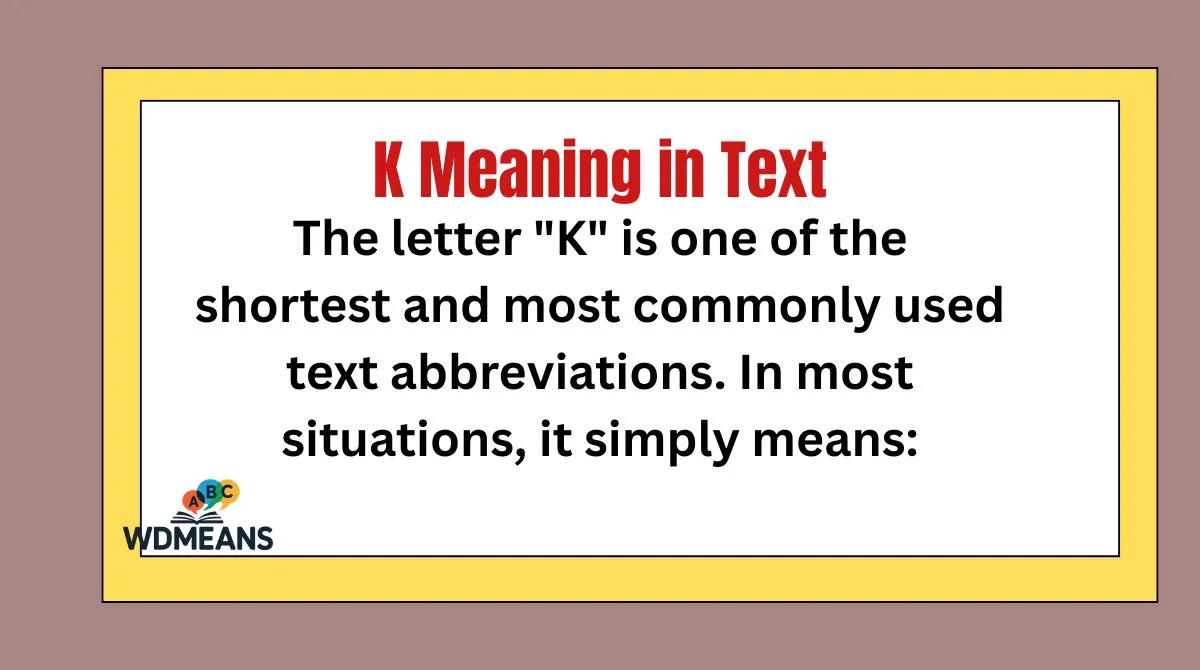
The letter “K” is one of the shortest and most commonly used text abbreviations. In most situations, it simply means:
- Okay
- I understand
- I agree
- Message received
- That’s fine
Instead of typing the full word “okay,” many people save time by replying with just the letter K.
Simple Examples
Friend: I’ll be there at 7.
You: K
Mom: Don’t forget to buy milk.
You: K
Coworker: The meeting starts in ten minutes.
You: K
Although its literal meaning is “okay,” the emotional meaning changes depending on context.
For example:
Neutral
K, thanks.
This simply acknowledges the message.
Friendly
K 😊
The emoji makes the response feel warmer.
Cold
K.
Adding a period can sometimes make it appear more serious.
Annoyed
After an argument:
Person A:
Can we talk?
Person B:
K
The short response may suggest irritation rather than agreement.
Why Is It So Popular?
People like using “K” because it is:
- Fast
- Easy to type
- Universally understood
- Convenient during busy conversations
- Common on mobile devices
However, because it’s so brief, readers often interpret emotion based on the surrounding conversation instead of the word itself.
Background
The abbreviation K has existed for decades, long before smartphones became common.
Early Internet Culture
During the early days of internet chat rooms and instant messaging, people wanted to type as quickly as possible.
Instead of writing:
Okay
they shortened it to:
OK
Eventually that became:
K
As texting became more common in the late 1990s and early 2000s, one-letter replies spread quickly because early mobile phones required multiple key presses for each character.
Influence of SMS
Old text messages had character limits.
Users naturally shortened words like:
- You → U
- Before → B4
- Great → Gr8
- Okay → K
Even though modern smartphones no longer have these limitations, the habit remained.
Social Media Evolution
Platforms like:
- Snapchat
- TikTok
- Discord
- Messenger
made short, rapid conversations the norm.
Today, “K” has become part of internet culture.
Cultural Differences
Some countries view “K” as perfectly normal.
Others interpret it as rude or dismissive.
Generational differences also matter.
Older users often see it as a harmless shortcut.
Many younger users associate it with:
- boredom
- annoyance
- lack of enthusiasm
- emotional distance
Because of this, context matters much more than the letter itself.
Usage in Different Contexts (Chat, Social Media, Professional Fields)
The meaning of K changes depending on where it’s used.
Casual Texting
Among friends:
Friend:
Movie tonight?
You:
K
Simple agreement.
Family Conversations
Dad:
Dinner is ready.
You:
K
Acknowledgment.
Gaming
Teammate:
Defend the left side.
You:
K
Quick confirmation.
Online Communities
Forums and Discord servers often use “K” because fast replies keep conversations moving.
Workplace
Professional settings require a little more care.
Instead of:
K
Many people prefer:
- Okay
- Sounds good
- Understood
- Will do
- Thanks
A single-letter response can seem too informal in business communication.
Customer Service
Companies usually avoid replying with just “K.”
Instead they write:
- Certainly.
- Understood.
- We’ll take care of it.
Professional communication values clarity and politeness.
Education
Students often text classmates:
“Homework due tomorrow.”
“K”
Teachers, however, generally expect more complete responses.
Meaning in Chat, WhatsApp, Instagram, TikTok
Although the definition stays similar, the tone changes across platforms.
Chat Messages
“K” usually means:
- Got it
- Okay
- Understood
Friends often use it casually.
Examples:
See you later.
K
or
Send me the photo.
K 👍
The emoji makes the reply friendlier.
In DMs, “K” can be interpreted differently.
If someone suddenly starts replying with one-word answers after previously writing long messages, they may seem less interested.
Context is everything.
TikTok
People often comment:
“K”
as a joke, meme, or sarcastic response.
Sometimes it simply means:
“I’ve seen this.”
Other times it’s intentionally dramatic.
Snapchat
Snapchat conversations move quickly.
“K” usually means:
- Message received
- Continue talking
- Okay
Because snaps disappear, people often type the shortest responses possible.
Meaning in Physics, Medical, and Aircraft Terminology
Outside texting, the letter K has many specialized meanings.
Physics
In physics, K commonly represents:
- Kelvin (unit of temperature)
- Boltzmann constant (in some formulas)
- Kinetic energy (depending on notation)
Example:
300 K means 300 Kelvin.
Medical
Medical professionals may use K to represent:
- Potassium (from the Latin word Kalium)
- Blood potassium levels
- Potassium supplements
Example:
Low K level means low potassium.
Aircraft & Aviation
The letter K appears in aviation in several ways.
Examples include:
- Airport identifiers
- Navigation references
- Aircraft documentation
- Radio communication abbreviations
Its meaning depends entirely on the aviation system being used.
Science
Scientists also use K for:
- Mathematical constants
- Chemical equations
- Engineering symbols
Therefore, outside texting, K rarely means “okay.”
Common Misconceptions
Many people misunderstand the meaning of K.
Misconception 1
“K always means someone is angry.”
Not true.
Many people simply type quickly.
Misconception 2
“K is rude.”
Not always.
Tone depends on context.
Misconception 3
“K means goodbye.”
Usually it doesn’t.
It simply acknowledges a message.
Misconception 4
“K and OK are emotionally identical.”
Actually, many readers perceive:
OK
as friendlier than:
K
even though they technically mean the same thing.
Misconception 5
Everyone interprets K the same way.
Age, culture, personality, and relationship all influence interpretation.
Similar Terms & Alternatives
Instead of using K, people often reply with similar expressions.
| Abbreviation | Meaning | Tone |
|---|---|---|
| OK | Okay | Neutral |
| Okay | Full agreement | Friendly |
| KK | Okay, sounds good | Casual |
| Oki | Cute version of okay | Playful |
| Sure | Agreement | Positive |
| Yep | Yes | Friendly |
| Yup | Yes | Casual |
| Alright | Agreement | Relaxed |
| Got it | Understood | Professional |
| Sounds good | Agreement | Warm |
| Roger | Understood | Informal/military-inspired |
| Copy | Message received | Technical |
Choosing a slightly longer reply often sounds more engaging than a single-letter response.
How to Respond to It
If someone texts you K, don’t panic.
First, consider the conversation.
If They’re Busy
Simply continue chatting.
Example:
You:
See you tomorrow.
Them:
K
No further interpretation is necessary.
If They Seem Upset
You could ask:
Everything okay?
or
Did I say something wrong?
This avoids making assumptions.
If It’s Work-Related
Continue professionally.
Example:
Employee:
Report submitted.
Manager:
K
You can simply reply:
Thank you.
If It’s a Friend
Continue naturally.
Example:
K
Great! See you later.
Avoid Overthinking
Many misunderstandings happen because people read too much emotion into very short messages.
Always consider:
- previous conversation
- emojis
- punctuation
- writing style
- relationship
Differences from Similar Words
Although these words appear similar, they create different impressions.
| Reply | Typical Impression |
|---|---|
| K | Very brief |
| OK | Neutral |
| Okay | Friendly |
| Okay! | Enthusiastic |
| KK | Casual and cheerful |
| Sounds good | Positive |
| Got it | Professional |
| Sure | Cooperative |
| Alright | Relaxed |
Notice how adding just one extra word can completely change the tone.
For example:
“K.”
may sound colder than
“Okay 😊”
even though both communicate agreement.
Relevance in Online Conversations & Dating Apps
Dating apps rely heavily on conversation flow, making short replies especially noticeable.
If someone consistently replies with:
- K
- Yep
- Sure
while giving little else, they may:
- be busy
- lose interest
- dislike texting
- expect you to continue the conversation
One isolated “K” isn’t necessarily a bad sign.
Look for patterns instead of judging a single message.
Better Dating Replies
Instead of:
K
Try:
- Sounds good!
- Can’t wait 😊
- Sure! What time?
- Awesome, see you then!
These replies keep the conversation alive.
Online Friendships
Short replies work well when:
- confirming plans
- acknowledging information
- ending conversations
- responding quickly
Longer replies work better when building relationships because they encourage more interaction and show genuine interest.
Conclusion
The K meaning in text is usually simple: it stands for “okay” or acknowledges that a message has been received. However, its emotional tone isn’t fixed.
Depending on context, punctuation, platform, and the relationship between the people involved, it can feel friendly, neutral, rushed, or occasionally dismissive. That’s why it’s important not to judge a conversation based on a single letter alone.
Beyond texting, K also has important meanings in fields like physics, medicine, aviation, and science, proving that its interpretation depends entirely on where it’s used.
Whether you’re chatting with friends, messaging coworkers, or talking on a dating app, understanding the context will help you interpret “K” more accurately and avoid unnecessary misunderstandings.
When in doubt, focus on the overall conversation rather than one brief reply, and remember that clear communication always beats assumptions.

I am Alexander Hayes, creator of WDMEANS, dedicated to simplifying English learning through clear word meanings. I help learners improve vocabulary with easy, accurate, and practical explanations for everyday use online.